Japanese rock garden ideas blend ancient design wisdom with modern low-maintenance landscaping. These serene landscapes offer more than aesthetic appeal; they provide structured beauty that requires minimal water, withstands various climate conditions, and demands far less upkeep than traditional lawns.
This guide adapts traditional karesansui (dry landscape garden) principles to modern home landscapes. You’ll discover how to select appropriate materials and create authentic Japanese garden design that thrives in your specific conditions.
Whether you’re transforming a compact courtyard or reimagining your entire backyard, these 11 Japanese rock garden ideas deliver both tranquility and practicality.
What is a Japanese rock garden?
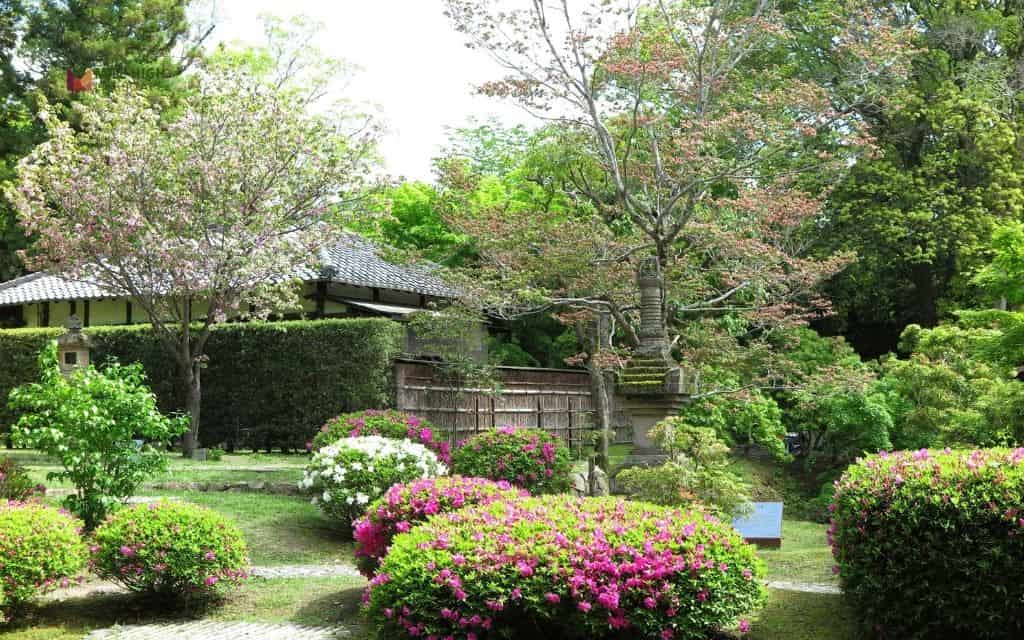
A Japanese rock garden, known as karesansui (literally “dry mountain water”), is a minimalist landscape composition that uses non-living elements to represent natural scenery. Instead of relying on flowing water or lush plantings, these gardens create their impact through:
Core components:
- Rocks and stones: Carefully selected and positioned to symbolize mountains, islands, or animals
- Gravel or sand: Raked into patterns representing water, waves, or ripples
- Minimal plants: Used sparingly as accents rather than focal points
- Negative space: Empty areas that create balance and breathing room
Design focus:
- Stillness and contemplation: Designed for meditation and quiet reflection
- Symbolic representation: Elements suggest natural landscapes rather than replicate them literally
- Structure over spontaneity: Intentional placement creates visual harmony
- Timelessness: Looks essentially the same through all four seasons
Types of Japanese gardens
Understanding different japanese gardens design styles helps you match your vision to your specific site conditions, maintenance capacity, and aesthetic preferences. Each type offers distinct advantages for various climates and spaces.
Karesansui (Dry rock garden)
The most water-efficient option and ideal for areas with water conservation needs. These gardens use only gravel and stones, with occasional accent plants.
Key advantages:
- Minimal to zero irrigation requirements after establishment
- No plant die-back to manage during dormant seasons
- Ideal for sunny exposures
- Extremely low maintenance
Tsukiyama (Hill & pond garden)
Traditional versions feature miniature landscapes with elevation changes and water features. Modern adaptations can replace ponds with “dry streams” using river rock and decorative gravel.
Modern adaptation:
- Use gravel channels instead of actual water
- Create visual water flow without plumbing
- Excellent for managing runoff from downspouts
- Hillside properties benefit from natural elevation
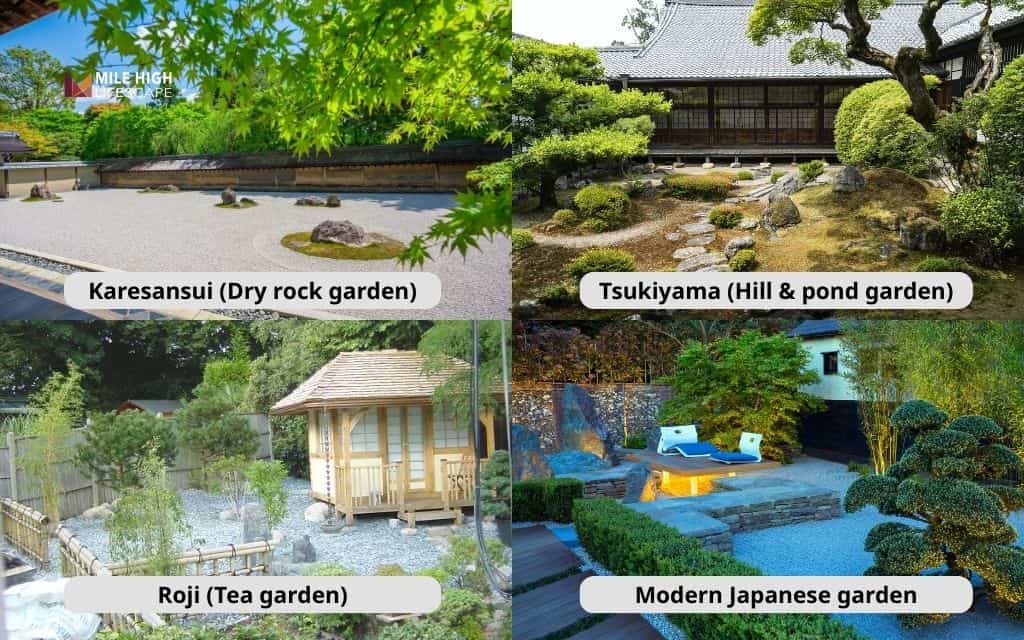
Roji (Tea garden)
Characterized by natural, quiet pathways leading to a destination (traditionally a tea house). These gardens embrace shade and create journey-focused experiences.
Practical application:
- Perfect for narrow side yards between structures
- Works well in shaded areas
- Uses stepping stones and understated plantings
- Provides transition between different yard areas
Modern Japanese garden
Contemporary interpretations emphasizing clean lines, minimal materials, and geometric simplicity. This Japanese garden modern approach appeals to homeowners with mid-century or contemporary architecture.
Current trend advantages:
- Fewer traditional ornaments (lanterns, basins)
- Larger gravel areas with bold stone placement
- Integration with modern hardscaping materials
- Works with metal edging and concrete
Essential elements of a Japanese garden
Successful Japanese rock garden ideas rely on thoughtful selection and placement of specific components. Here’s what you actually need:
Rocks & stones
Stones form the permanent skeleton of your garden. In Japanese design, they’re selected for shape, texture, and implied age.
Selection guidelines:
- Weathered stones: Natural appearance with character
- Local materials: Reduces cost and looks appropriate to region
- Granite, sandstone, or limestone: Durable, weather-resistant options
- Avoid: Overly smooth or perfectly geometric stones (lack authenticity)
Size guidelines:
- Feature stones: 100–500+ lbs for stability against wind
- Accent stones: 25–75 lbs
- Arrangement: Odd-numbered groupings (3, 5, 7)
Gravel or sand
Gravel serves as both ground cover and symbolic element representing water flow.
Material recommendations:
- ⅜” to ¾” angular gravel: Stays in place better than smooth pea gravel
- Crushed granite or decomposed granite: Compacts well, natural appearance
- Consider local wind conditions when selecting gravel size
- Color: Natural grays, tans, or subtle earth tones
Practical tip: Areas with strong winds require heavier, angular gravel rather than fine sand or smooth pebbles.
Plants
Japanese gardens favor structural plants with year-round form rather than seasonal color explosions.
Evergreen structure:
- Pine varieties (appropriate for your climate zone)
- Spruce or juniper
- Compact evergreen shrubs
Deciduous accents:
- Japanese maple (where climate allows)
- Flowering ornamental trees
- Shrubs with interesting bark or fall color
Groundcovers:
- Moss (in humid climates with shade)
- Low-growing thyme or sedums (dry climates)
- Ornamental grasses
Paths & stepping stones
Paths control visitor flow and create intentional viewing perspectives.
Material choices:
- Flagstone: Natural, irregular shapes
- Cut granite pavers: Modern aesthetic
- Natural stepping stones: 15–24″ spacing for comfortable stride
Focal accents
These elements add authenticity but aren’t required for a successful design.
Stone lanterns (tōrō):
- Use sparingly (one per garden maximum)
- Position near paths or viewing areas
- Available from specialty landscaping suppliers
Tsukubai (water basin):
- Traditional designs require plumbing
- Dry versions work as sculptural elements
- Can collect rainwater for birds
Bamboo elements:
- Deer fencing (shishi-odoshi) – decorative only in Denver
- Split bamboo edging
- Source from online specialty retailers
Design principles of Japanese gardens
Understanding core design philosophy helps you make better decisions during planning and installation. These principles guide placement, proportion, and overall composition.
Asymmetry (Fukinsei)
Japanese garden design photos reveal carefully planned irregularity rather than mirror-image symmetry. This creates natural, unstudied beauty.
Practical application:
- Place three stones in triangular arrangement, not straight line
- Vary gravel raking patterns, don’t make them identical
- Position plants off-center from major sight lines
- Use odd numbers: 3 stones, 5 plantings, 7 stepping stones
Simplicity (Kanso)
Every element should serve a purpose. Restraint creates clarity and calm.
How to practice:
- Start with 3 – 5 major stones rather than scattering dozens
- Use one gravel type throughout (not multiple colors)
- Limit plant species to 2–3 varieties
- Remove more than you add during design process
Beginner mistake: Overcrowding a small Japanese rock garden with too many features. Negative space (empty gravel areas) is as important as filled areas.
Naturalism (Shizen)
Elements should appear as if formed by natural processes—erosion, growth, weathering—rather than human intervention.
Design approach:
- Bury 30 – 40% of each stone (they should look rooted, not placed)
- Follow natural grain and directional lines in rock formations
- Allow slight irregularity in gravel edges
- Position plants as if self-seeded rather than evenly spaced
Choose weathered, textured stones over perfectly smooth or geometric blocks. Colorado moss rock exemplifies this principle beautifully.
Enclosure (Kankyō)
Japanese gardens create contained worlds separate from surrounding chaos. Even without walls, you can establish psychological boundaries.
Practical methods:
- Use taller stones along perimeter as “borrowed” walls
- Plant evergreen screens for privacy
- Install simple fencing (horizontal slat, bamboo style)
- Create subtle grade changes to separate garden from lawn
Borrowed Scenery (Shakkei)
Traditional Japanese gardens incorporate distant mountains or landmarks into compositions.
Applications:
- Frame views of natural features (mountains, hills, water)
- Use stones to direct sight lines toward scenic elements
- Keep sight corridors clear of tall plants
- Position seating to capture attractive views
11 Japanese rock garden ideas for your home
These Japanese rock garden ideas progress from minimal dry landscapes to more complex mixed designs. Choose based on your maintenance capacity, site conditions, and aesthetic preferences.
Classic zen rock garden (dry landscape)
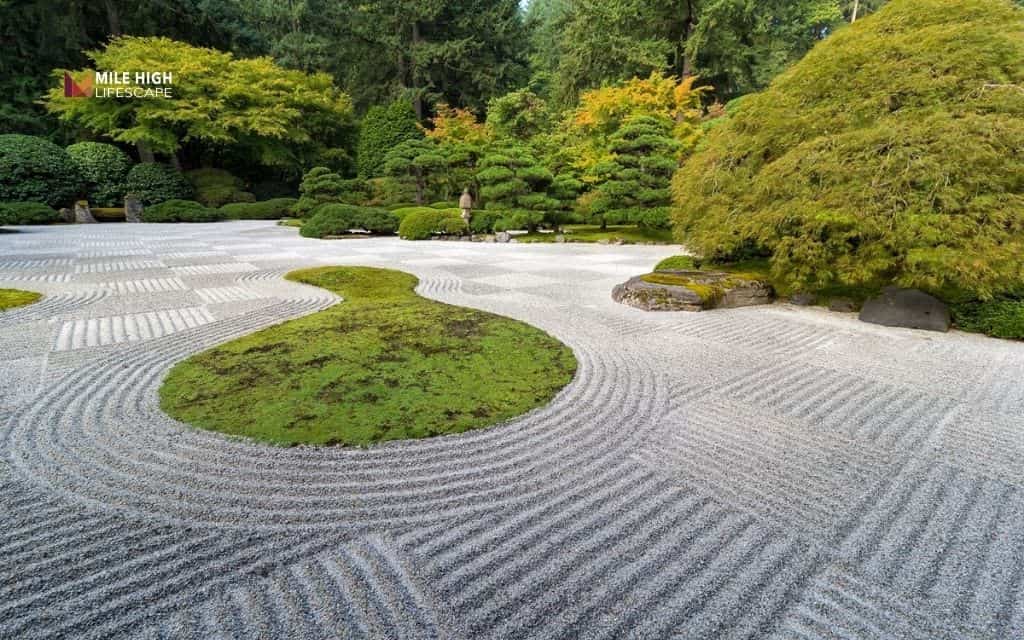
The purest expression of karesansui: minimal gravel fields with carefully positioned stone groupings designed for meditation and contemplation. Open expanses of raked gravel punctuated by 3 – 5 strategically placed stone arrangements, with little to no plant material. The raked patterns in the gravel symbolize water ripples or waves flowing around island-like rocks.
Advantages:
- Requires zero irrigation after establishment
- Wind-resistant and maintains visual consistency year-round
- Looks identical in winter and summer
- Ultimate low-maintenance option for busy homeowners
- Perfect for meditation spaces and front yards
Small Japanese rock garden for urban yards
Scaled-down designs proving that authentic Japanese gardens design works in compact spaces – patios, townhome courtyards, balconies, and rental properties.
Condensed versions of traditional rock gardens adapted to spaces as small as 6′ × 8′, using fewer but well-chosen elements to create maximum impact within limited square footage.
Advantages:
- Transforms underutilized urban spaces into peaceful retreats
- Works in apartments, condos, and rental properties
- Easier to maintain than larger installations
- Concentrates design impact better than sprawling layouts
- Budget-friendly due to smaller material quantities
Modern Japanese rock garden
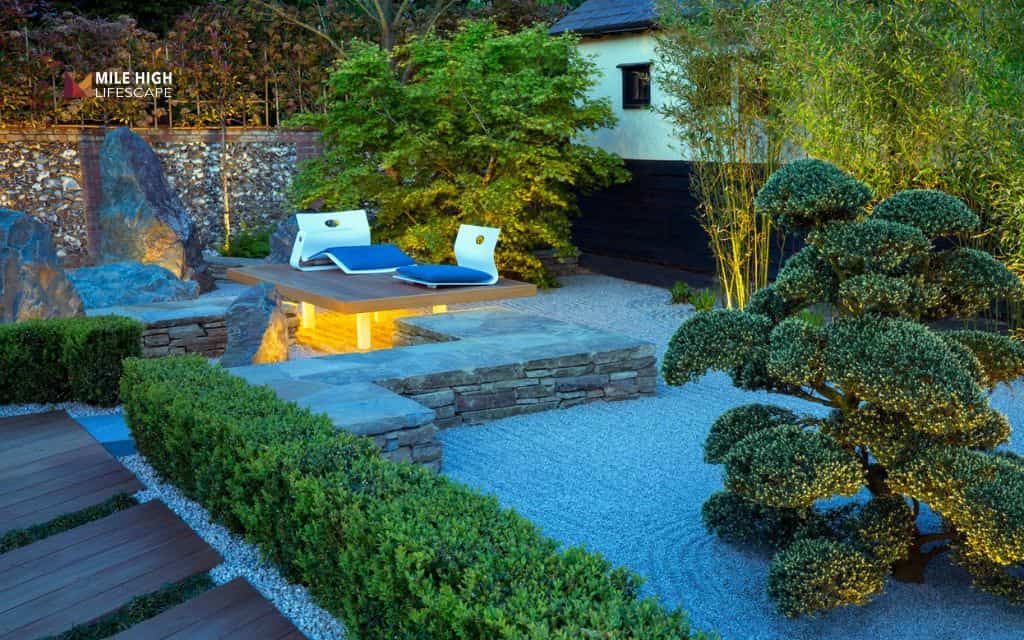
Contemporary interpretation emphasizing geometric precision, monochromatic palettes, and bold minimalism. This Japanese garden modern approach suits mid-century and contemporary architecture.
Advantages:
- Complements modern architectural styles perfectly
- Requires minimal traditional ornaments (lanterns, basins)
- Creates bold visual statements with fewer elements
- Appeals to homeowners wanting low maintenance without traditional aesthetics
- Easier to integrate with existing contemporary landscaping
- Timeless design that won’t look dated
Japanese backyard retreat
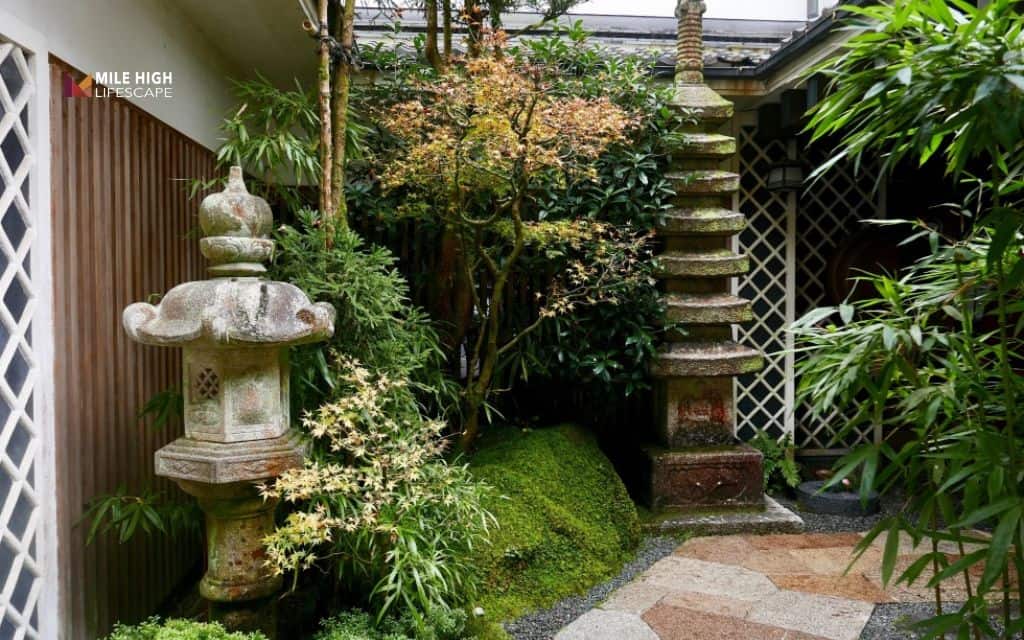
Full-yard transformation creating private sanctuary spaces with layered zones for relaxation, meditation, and entertaining – complete outdoor living environments.
Comprehensive landscape design incorporating meditation areas, stepping stone paths, evergreen privacy screening, seating zones with mountain views, and optional dry streams or gravel “ponds.”
Advantages:
- Provides year-round visual interest through evergreen structure
- Creates true outdoor living space for entertaining
- Offers privacy and separation from surrounding properties
- Allows microclimate creation for tender plants
- Large enough for multiple viewing perspectives and experiences
- Significantly increases property value and curb appeal
Japanese-inspired garden with climate-adapted plants
Hybrid approach using Japanese design principles with locally adapted plant selections – honoring aesthetic traditions while ensuring plant survival in your specific climate.
Gardens that maintain Japanese form, structure, and pruning styles while substituting climate-appropriate, water-wise plants that thrive in your region instead of traditional Asian species that may struggle.
Advantages:
- Reduces irrigation requirements significantly
- Eliminates plant loss from climate stress
- Uses locally available, affordable plant materials
- Maintains authentic visual character without botanical restrictions
- More environmentally sustainable for your region
- Allows seasonal interest while preserving Japanese aesthetic
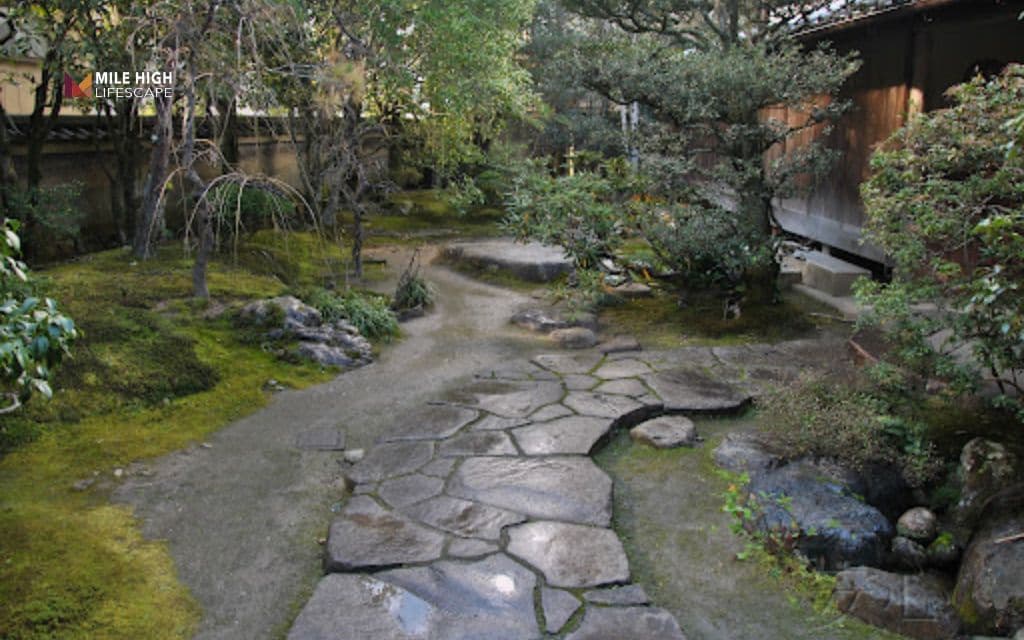
Stepping stone path in a Japanese garden
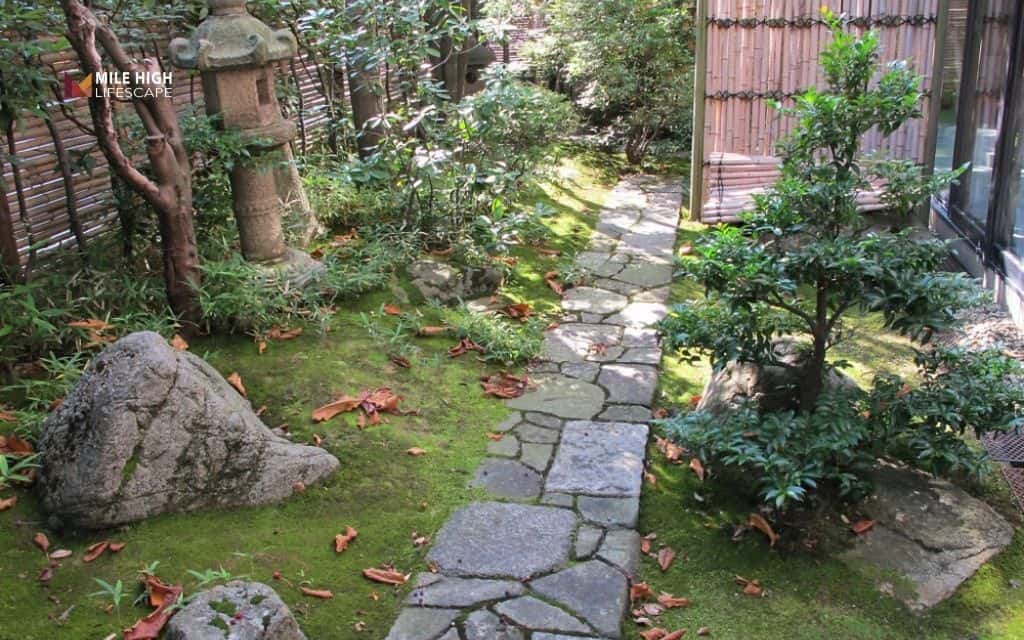
Focused design element featuring carefully spaced stones that control movement, create contemplative pacing, and serve as both functional walkways and artistic composition.
Irregular stone pathways with intentional spacing (15 – 18″ apart) that force deliberate, mindful steps while connecting different garden zones or creating journey experiences through gravel fields.
Advantages:
- Creates sense of intentional movement and meditation
- Provides access for maintenance without compacting gravel
- Works as standalone feature or integrated component
- Suits narrow side yards and transition spaces
- Adds vertical interest and texture contrast
- Prevents soil compaction in high-traffic areas
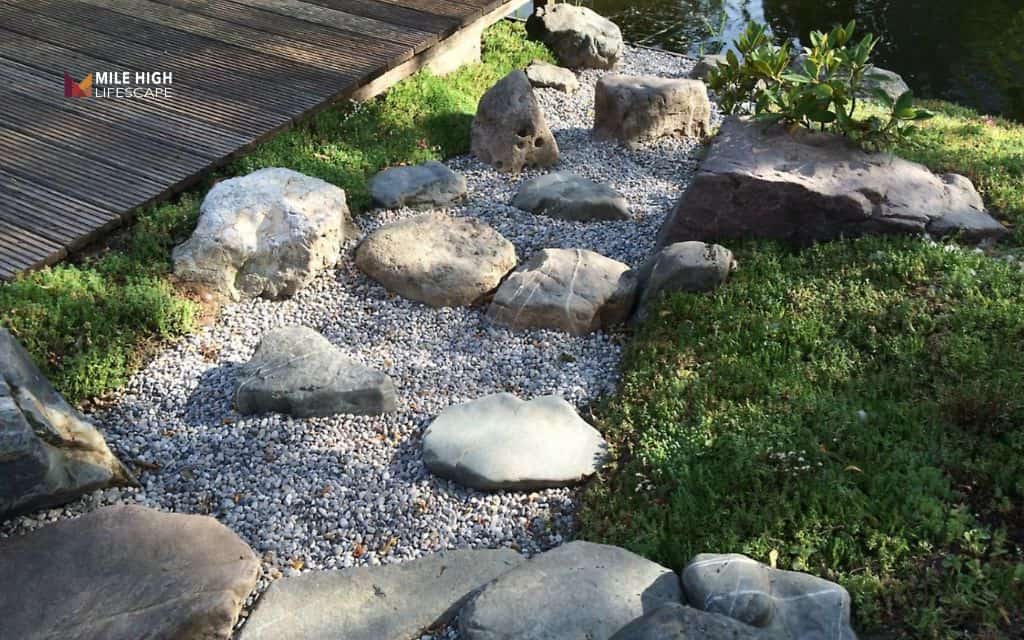
Dry stream japanese rock garden
Gravel channels suggest flowing water while providing practical drainage function – decorative features that solve real landscape problems. River rock “streams” raked and arranged to mimic water flow, often routing actual runoff from downspouts through designed channels that appear as dry creek beds.
Advantages:
- Solves drainage problems beautifully
- Creates movement and visual interest
- Serves dual decorative and functional purposes
- Eliminates need for buried drainage pipes
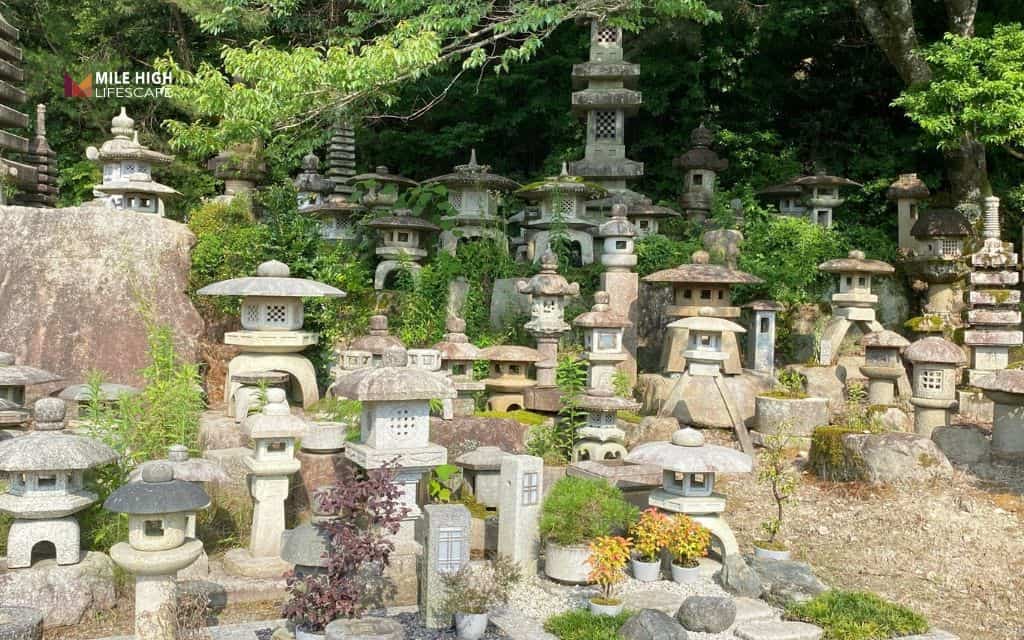
Japanese rock garden with stone lantern accent
Traditional tōrō (stone lantern) used sparingly as a carefully positioned focal point, one quality accent piece rather than decorative clutter.
The garden is centered around a single stone lantern positioned near pathways or primary viewing areas, surrounded by open gravel space that emphasizes its presence and symbolic meaning.
Advantages:
- Adds authentic Japanese character with minimal commitment
- Creates clear focal point for compositions
- Available in various traditional styles and sizes
- Single high-quality piece outperforms multiple cheap accents
- Provides vertical element without plant maintenance
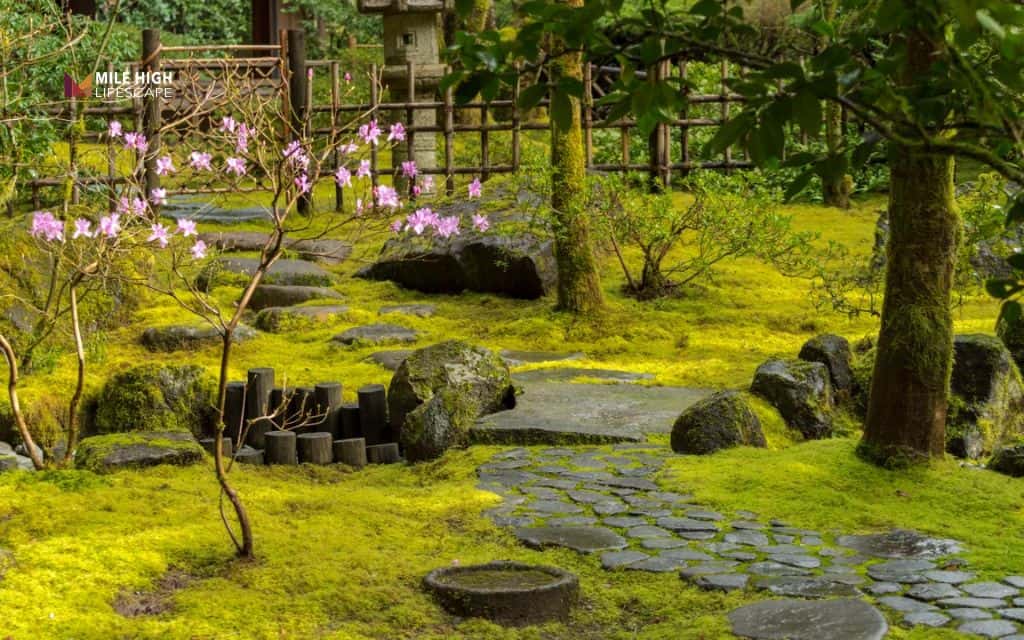
Japanese garden with moss alternatives
Denver-adapted designs using drought-tolerant groundcovers that achieve similar visual softness to traditional moss without requiring impossible humidity levels. Gardens featuring creeping thyme, woolly thyme, blue fescue, or low sedums planted between stones and in gravel gaps to provide textural contrast and organic softness.
Advantages:
- Achieves moss-like appearance in semi-arid climate
- Survives Denver’s low humidity and high sun exposure
- Provides seasonal interest (flowers, texture changes)
- Drought-tolerant once established
- Softens harsh rock-only compositions
Japanese courtyard garden
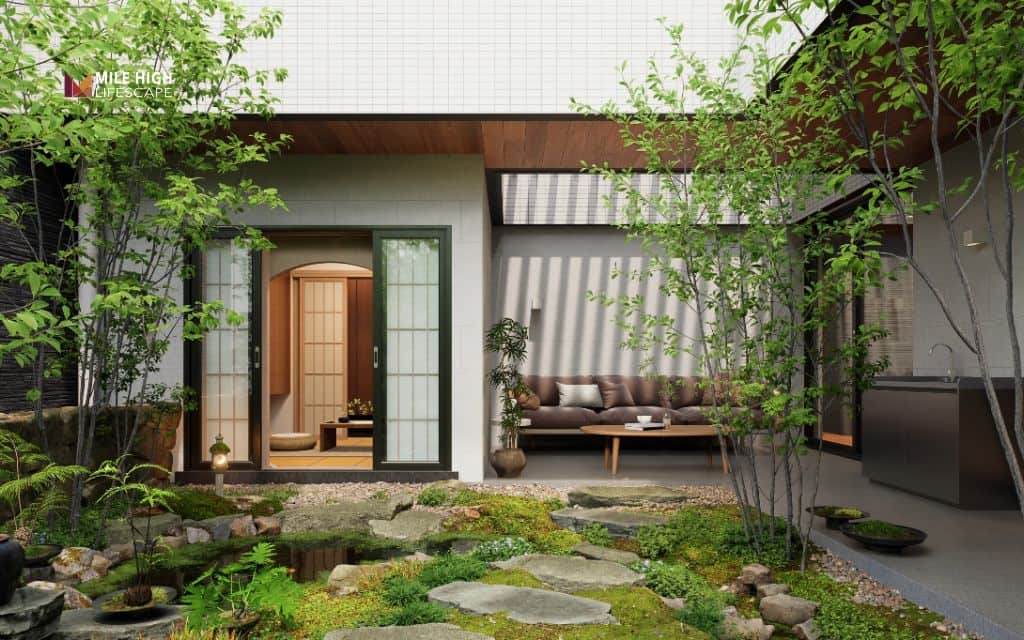
Enclosed small japanese garden design perfect for urban spaces – transforming walled courtyards, patios, and interior-facing yards into private meditation retreats.
Intimate gardens designed for enclosed spaces surrounded by walls or fencing, emphasizing vertical elements, light-colored materials, and simplified compositions suited to limited square footage.
Advantages:
- Transforms underutilized enclosed spaces
- Protected from wind (allows finer gravel and delicate plants)
- Enhanced privacy supports meditation and relaxation
- Visible from interior rooms year-round
- Walls become “borrowed” landscape features
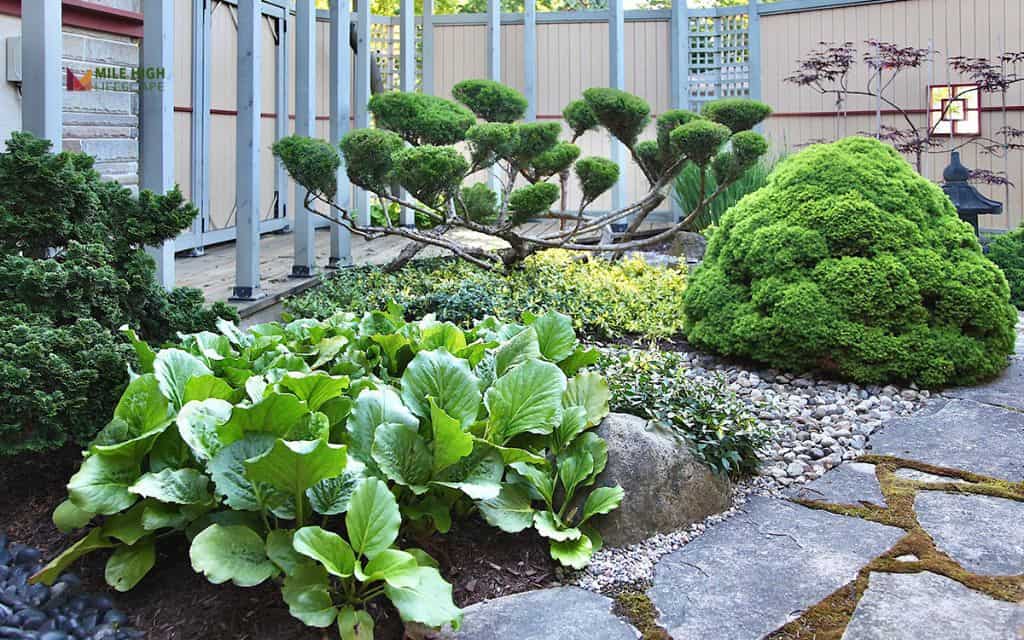
Mixed rock & plant Japanese garden
Hybrid approach balancing traditional rock elements with substantial plantings for homeowners wanting more seasonal interest, texture, and organic softness. Gardens combine 50 – 60% gravel coverage with 20 – 30% planted areas featuring evergreen backbone plants, deciduous accents, and perennial/grass layers for four-season visual variety.
Advantages:
- Provides seasonal changes and movement
- Appeals to gardeners who enjoy plant care
- Offers more color and texture than pure rock gardens
- Still lower maintenance than traditional landscapes
- Accommodates existing mature trees and shrubs naturally
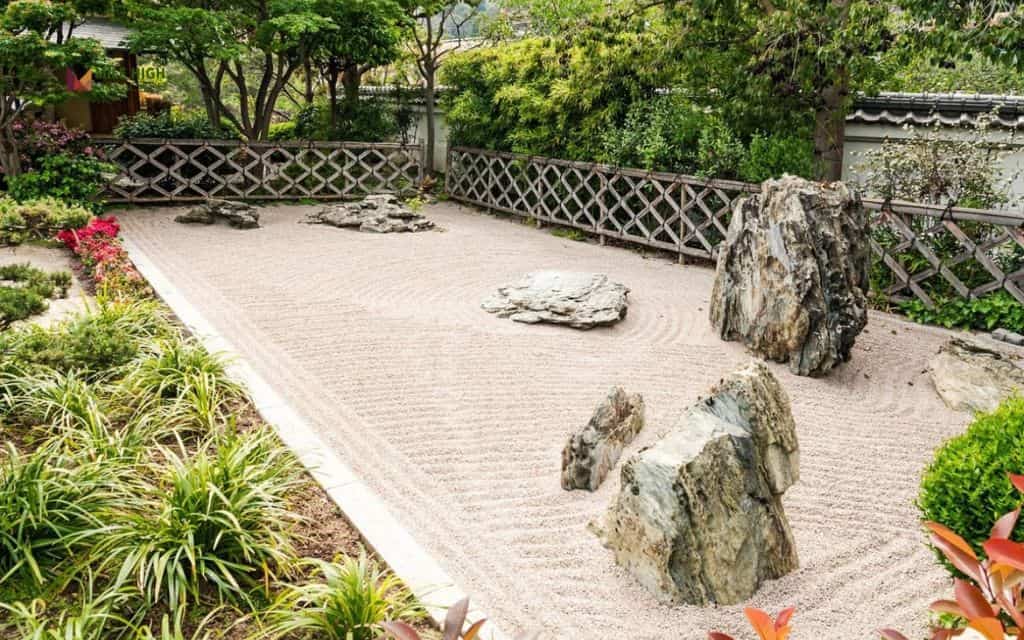
How to maintain a Japanese garden
Japanese rock gardens earn their reputation as low-maintenance landscapes, but “low” doesn’t mean “zero.” Here’s what actual upkeep looks like in Denver’s climate.
Raking
Using a bamboo or metal garden rake to create patterns in the gravel surface—straight lines, concentric circles, or waves around stones. This is primarily aesthetic maintenance that refreshes the garden’s appearance.
Rake monthly during active seasons and after storms that deposit debris. Wind and weather will disrupt patterns naturally – accept this as part of the garden’s changing character.
Weed control
Preventing weed growth through proper installation and quick intervention when weeds appear. Remove fallen leaves promptly to prevent organic buildup that supports weed seeds.
Hand-pull weeds immediately when spotted and never allow them to go to seed. Weekly weed patrols prevent hours of remedial work later. Proper gravel depth blocks 90 – 95% of weeds, but nothing eliminates them completely.
Refresh gravel in problem areas and replace landscape fabric every 8 – 10 years as it degrades.
Plants
Light annual pruning to maintain natural forms – removing dead or damaged wood, thinning interior branches for light penetration, and revealing interesting branch structure. Japanese pruning emphasizes enhancement rather than geometric shaping.
Prune evergreens in late spring after new growth hardens, deciduous shrubs in late winter while dormant, and never in fall.
Water deeply but infrequently, then monthly supplemental watering or less once mature. Advanced cloud pruning techniques are optional and require ongoing commitment.
Winter care
Minimal intervention during cold months. Allow snow accumulation (it insulates plants and protects gravel), brush heavy wet snow off evergreen branches to prevent breakage, and limit foot traffic when ground is frozen.
Don’t shovel gravel areas – it disrupts patterns and damages fabric beneath. Never use rock salt on or near the garden as it damages plants and degrades gravel appearance.
Expect minor stone shifting from freeze-thaw cycles (normal seasonal movement) and reset displaced stones in spring after thaw completes.
Watering
Pure gravel and stone areas require zero irrigation. Planted zones need weekly drip irrigation during establishment , then only supplemental watering during extended drought once mature.
Turn irrigation systems off during rainy periods and winterize completely before the first hard freeze. Native and adapted plants may need zero supplemental water after establishment.
Even water-demanding plants like Japanese maples require only monthly deep watering compared to weekly for traditional landscapes.
Conclusion
A Japanese rock garden doesn’t require perfect conditions or constant attention to create a profound impact. With thoughtful material selection and design that respects your local climate, you can create a serene, low-maintenance garden that provides lasting beauty and tranquility.
The Japanese rock garden ideas presented here demonstrate that traditional karesansui principles adapt successfully to various climates and spaces when you honor both design philosophy and practical reality. Properly selected gravel resists displacement. Quality landscape fabric prevents weed problems. Climate-appropriate plants thrive without heroic efforts. Strategic stone placement creates visual interest through all seasons.
Success comes from balancing aesthetic vision with practical execution. Begin with the foundation then add complexity only if your maintenance capacity and interest support it. Choose locally available materials, select plants suited to your climate, and design for long-term sustainability.
_______________________
Looking for reliable landscape rock service in Denver?
Mile High Lifescape creates stunning, low-maintenance rock landscapes that thrive in Colorado’s challenging climate. We handle everything: rock garden design, gravel installation, stone pathways, xeriscaping, and drainage solutions.
Our locally sourced materials withstand freeze-thaw cycles, high winds, and intense sun while reducing water use by up to 70%. Serving Denver metro and surrounding communities with expert craftsmanship and competitive rates.
Let’s build your dream landscape! Call (303) 877-9091 for your free consultation today.
Frequently asked questions (FAQs)
What is a Japanese rock garden, and how is it different from other Japanese gardens?
A Japanese rock garden (karesansui) is a dry landscape garden using rocks, gravel, and minimal plants to represent mountains and water. Unlike pond gardens (tsukiyama), it requires very little water and focuses on symbolic representation rather than literal recreation of nature.
Which type of Japanese garden is easiest to maintain?
Dry rock gardens (karesansui) and modern Japanese gardens require the least maintenance because they rely primarily on stone and gravel rather than extensive plantings. These styles need only occasional raking, minimal weeding, and virtually no irrigation once established.
What materials should I use to build a Japanese rock garden?
Use locally sourced stone for authenticity and cost-effectiveness, angular gravel (⅜”–¾”), commercial-grade landscape fabric (6oz minimum), and compacted gravel base. Choose weathered stones with natural character rather than smooth or geometric pieces. Select gravel size and weight appropriate to your local wind conditions.
Are Japanese rock gardens suitable for small yards?
Absolutely. Japanese rock garden principles work in small spaces. Gardens as compact as 6′ × 8′ can deliver authentic design impact through clean edging, thoughtful stone placement, and restrained plant selection.
How much does it cost to install a Japanese rock garden?
Costs vary widely based on size, materials, and whether you DIY or hire professionals. Small gardens (100–200 sq ft) might cost $500 – $1,500 DIY or $2,000 – $4,000 professionally installed. Larger backyard installations can range from $3,000 – $8,000 DIY to $8,000 – $20,000+ for professional design and construction.