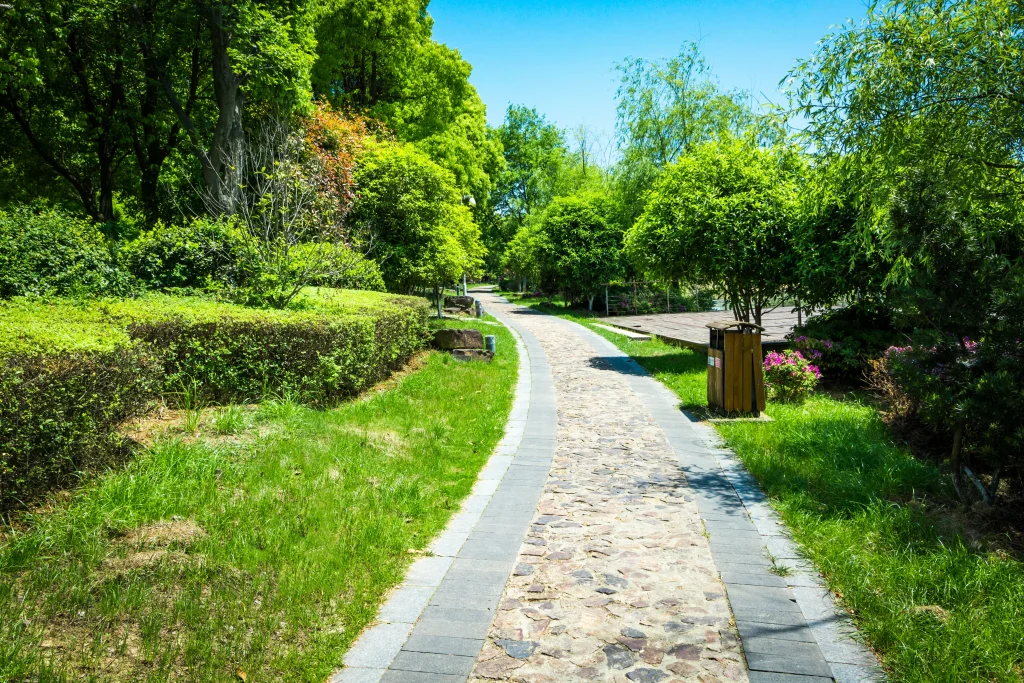
There is something undeniably magnetic about a mid century modern landscape. It does not try too hard, yet every inch of it feels purposeful.
Mid-century modern design first emerged in the 1940s through the 1960s alongside the architecture movement of the same name. Architects and landscape designers of that era shared one core belief: the outdoors should feel like a natural extension of the home, not a separate afterthought.
That philosophy still resonates strongly today, especially among homeowners who want a low-maintenance, high-style yard without the fuss of a traditional garden.
In this guide, the team at Mile High Lifescape shares 17 inspiring mid century modern landscape ideas you can actually use. Whether you are searching for low maintenance mid century landscaping solutions or a bold modern landscapes makeover, you will find something here worth building.
What is a mid-century modern landscape?
A mid century modern landscape is an outdoor design style rooted in the same principles that defined mid-century modern architecture and interior design. At its heart, it is about stripping away excess and letting structure, simplicity, and intentionality do the heavy lifting.
Unlike formal English gardens or lush cottage-style plantings, midcentury modern landscape design favors restraint. You will not find crowded flower beds or intricate topiary here. Instead, you will find bold geometric shapes, a limited plant palette repeated with purpose, and a yard that feels like a living room with the roof open to the sky.
A mid century modern landscape focuses on:
- Clean lines and geometric shapes
- Minimalism with bold focal points
- Strong indoor-outdoor connection
- Low-maintenance, climate-adapted plants
The style lends itself to ranch-style homes, split-levels, and mid-century bungalows, but it translates just as well onto contemporary new builds or any property where the owner values clean aesthetics over busy detail.
Key design principles of mid-century modern landscaping
Before jumping into specific ideas, it helps to understand the five core design principles that define the style. These principles act as a filter: every plant, pathway, and piece of furniture should pass through them before making it into your yard.
Clean lines & geometry
Mid-century modern landscapes are built on geometry. Straight paths, rectangular planting beds, square stepping stones, and grid-like patterns all contribute to that signature structured look. Curves exist in this style, but they are deliberate and smooth – think a sweeping concrete edge rather than a wiggly garden border.
Minimal plant palette
Rather than planting a wide variety of different species, mid-century modern landscape designs rely on a small selection of plants repeated throughout the space. This repetition creates cohesion and makes the yard feel designed rather than assembled by chance. A good rule of thumb: choose 3 to 5 plant types and use them in clusters or rows. The repetition itself becomes the visual pattern.
Indoor-outdoor flow
One of the defining features of mid-century modern landscape design is how seamlessly it connects the inside of the home to the outside. Large sliding glass doors, floor-to-ceiling windows, and patio doors all serve as visual bridges. The landscape design mirrors and extends the interior. If your home has warm wood tones inside, carry that into the yard with a cedar deck or wooden planter boxes. If the interior features polished concrete, extend it into the patio.
Focus on function
Every element in a mid-century modern landscape earns its place. There is no decorative clutter for the sake of it. A bench is there because people will sit on it. A raised planter defines a space and also grows herbs or specimen plants. A concrete path connects two points with zero detours. This function-first mentality is one reason the style appeals to busy homeowners – you are not maintaining something that does not serve a purpose.
Low-maintenance design
Mid-century modern landscapes were partly born out of practicality. Designers embraced drought-tolerant plants, gravel ground covers, and simple hardscape materials precisely because they hold up beautifully over time without demanding constant attention. For homeowners today, especially in arid climates like Denver and the Front Range, this principle is just as valuable.
17 mid-century modern landscape ideas
Use geometric concrete pavers
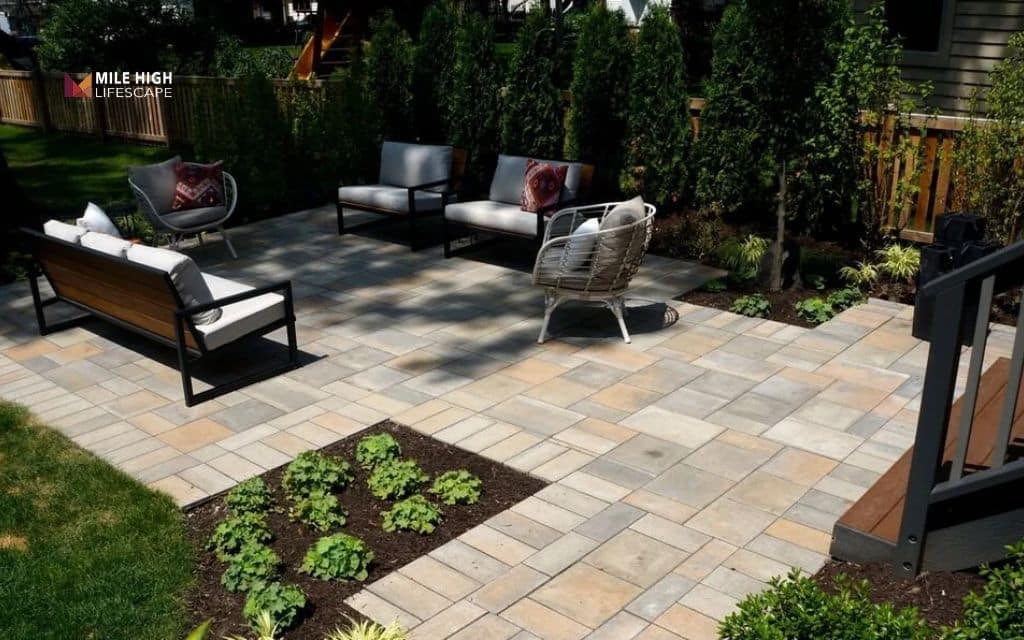
Concrete pavers are one of the most recognizable features of mid century modern landscape designs. Large-format squares or rectangles laid in a clean grid or offset pattern instantly signal the aesthetic.
For the most cohesive result, match the paver tone to your home’s exterior. Light gray concrete works with almost any facade, while charcoal or warm sand tones add contrast. Lay pavers with minimal spacing and fill the gaps with fine gravel or ground cover plants like creeping thyme for a finished look.
Combine gravel with stepping stones
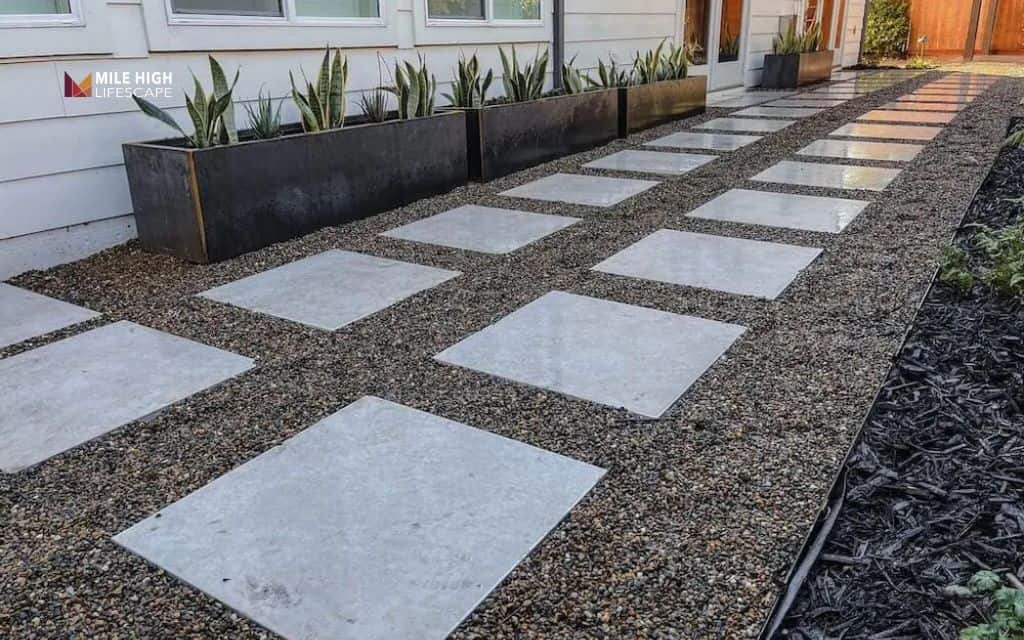
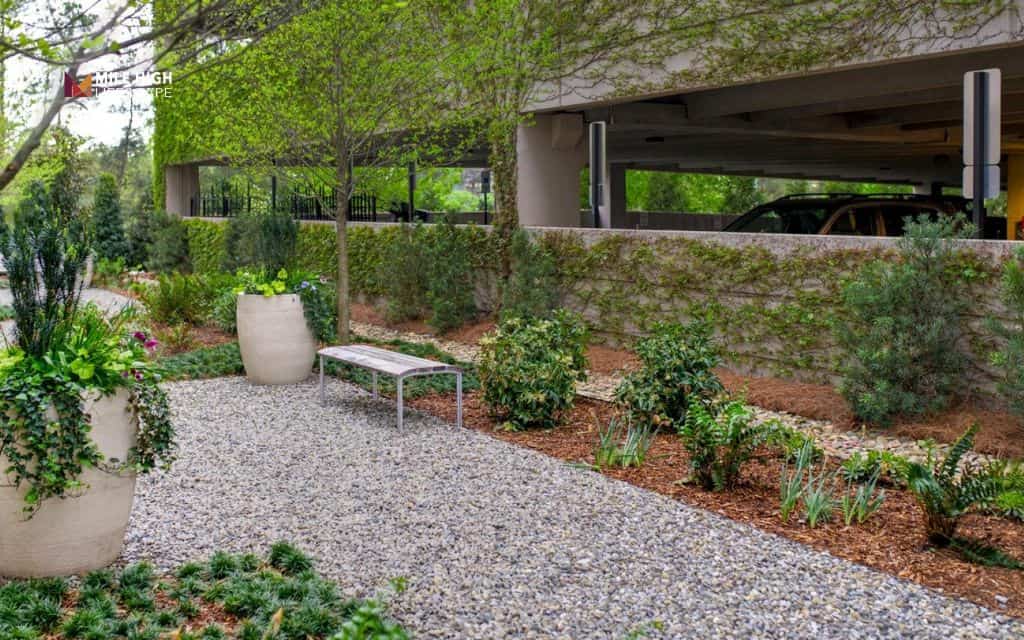
Gravel and stepping stones are a hallmark pairing in low maintenance mid century landscaping. Decomposed granite, pea gravel, or crushed basalt laid as a ground cover between large flat stepping stones creates that effortlessly modern look – textured without being busy.
This combination also solves a practical problem: it dramatically cuts down on lawn area, reduces irrigation needs, and stays looking neat through all seasons. Use stepping stones in a straight line or a subtle arc to guide visitors from the driveway to the front door, and let the gravel fill in everything around them.
Build a low-profile patio
A low-profile patio is a signature move in mid century modern landscape design. Unlike raised decks that interrupt the sightline, a flush patio keeps the visual flow continuous. The yard, the patio, and the interior of the home all read as one connected space.
Concrete, flagstone, large porcelain pavers, or a combination of concrete and wood decking all work beautifully here. Keep the patio shape simple: a clean rectangle or L-shape rather than a complicated freeform edge. Add a pergola or shade sail above to define the space without enclosing it.
Add raised planters with clean edges
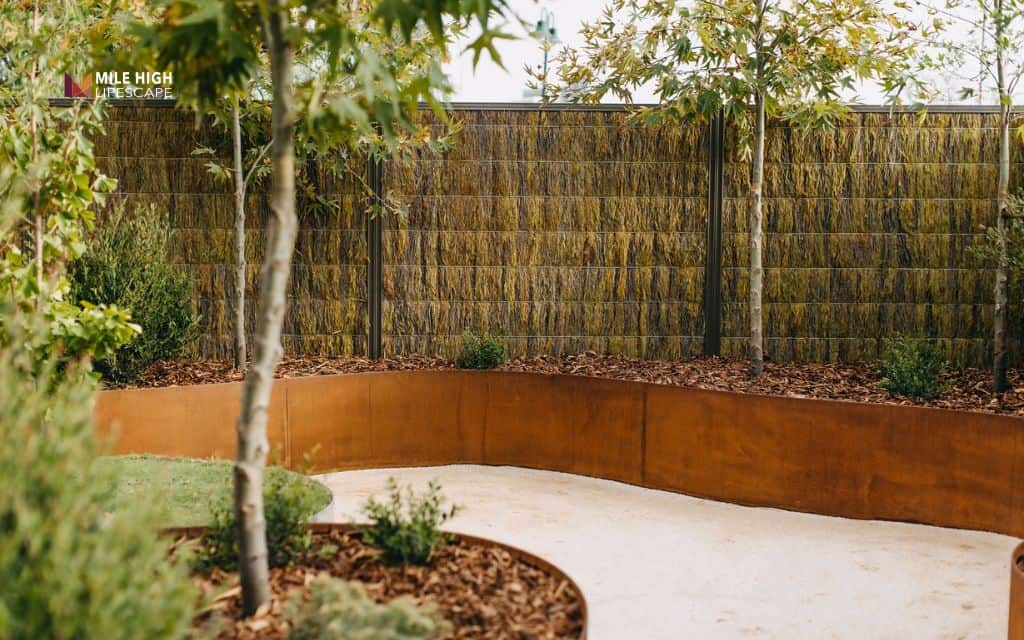
Raised planters are a practical and visually striking element in any mid-century modern landscape. When built with clean 90-degree edges in concrete, corten steel, or smooth-finished wood, they look like sculptural features rather than mere plant containers.
Line them up along a fence or the edge of a patio to frame the space. Use them to grow ornamental grasses, lavender, or a single specimen plant like an agave. The height contrast between the ground and the raised bed also adds depth to an otherwise flat yard.
Use drought-tolerant plants
One of the smartest moves in any mid century modern landscape is leaning heavily into drought-tolerant plants. These plants are not a compromise, they are a design asset. Their structural forms, interesting textures, and year-round presence are exactly what the style calls for.
In the Denver metro area and similar semi-arid climates, plants like agave, yucca, Russian sage, catmint, sedum, and blue oat grass thrive with minimal irrigation. Once established, they care for themselves, which means your landscape stays sharp-looking without weekly watering.
Repeat plant groupings
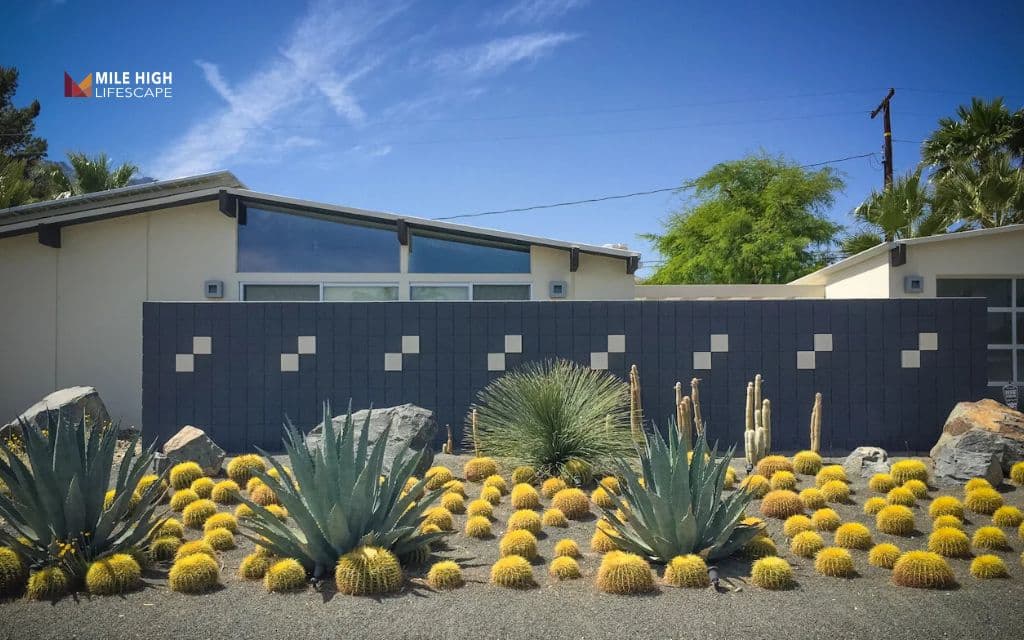
Repetition is one of the most powerful tools in mid-century modern landscape design. Instead of planting one of every species, choose a handful and repeat them in groups of 3,5, or 7 throughout the yard. This creates a sense of rhythm and intention.
A simple formula: Anchor each major area with one tall architectural plant, surround it with a mass of medium-height ground cover or ornamental grass, and edge everything with a low-spreading plant. Repeat this arrangement in multiple spots throughout the yard for instant cohesion.
Add architectural plants (agave, yucca)
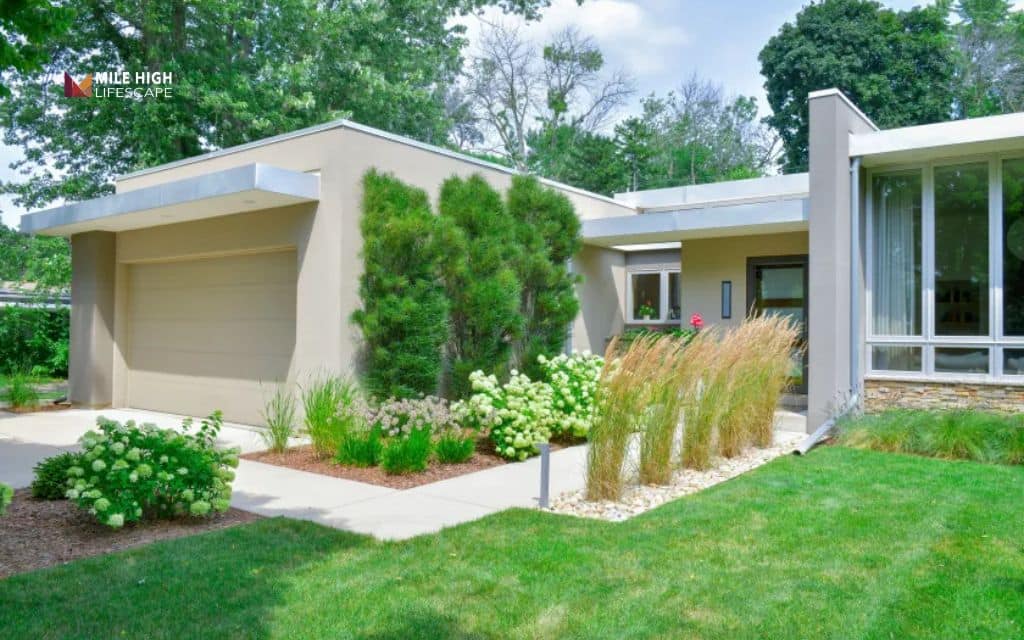
Architectural plants are the crown jewels of a mid century modern landscape. Agave, yucca, New Zealand flax (Phormium), and desert spoon (Dasylirion) all share a sculptural, almost otherworldly quality that makes them perfect focal points.
Plant a single large agave in a prominent spot (the center of a gravel bed, the corner of a patio, or flanking an entryway) and watch it command attention. These plants grow slowly, require very little water, and look just as impressive in winter as they do in summer.
In colder climates like Denver, choose cold-hardy varieties such as Agave parryi or Yucca rostrata, both of which can handle freezing temperatures.
Use ornamental grasses
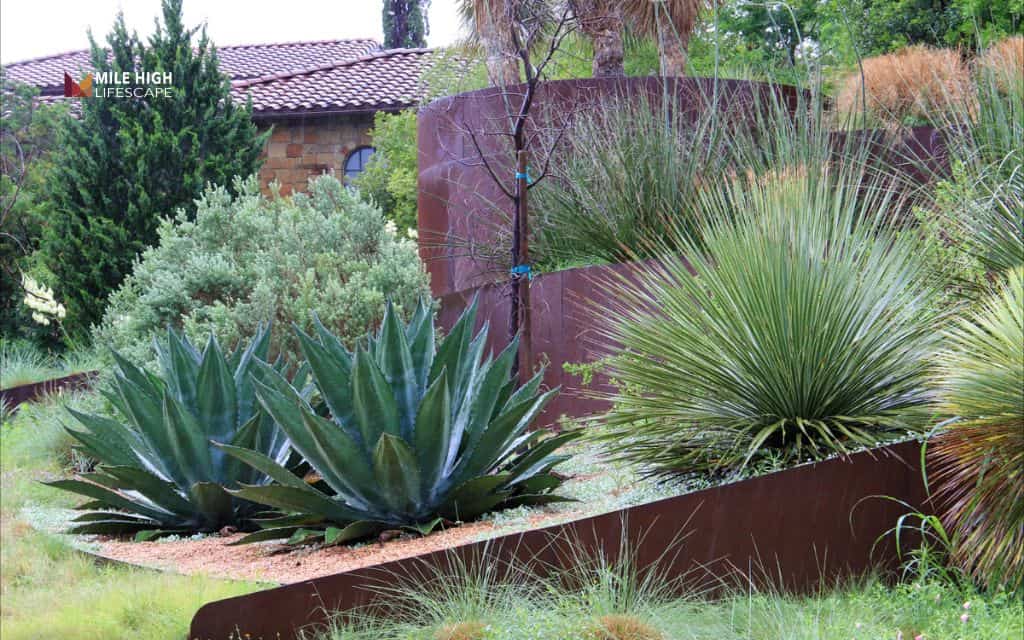
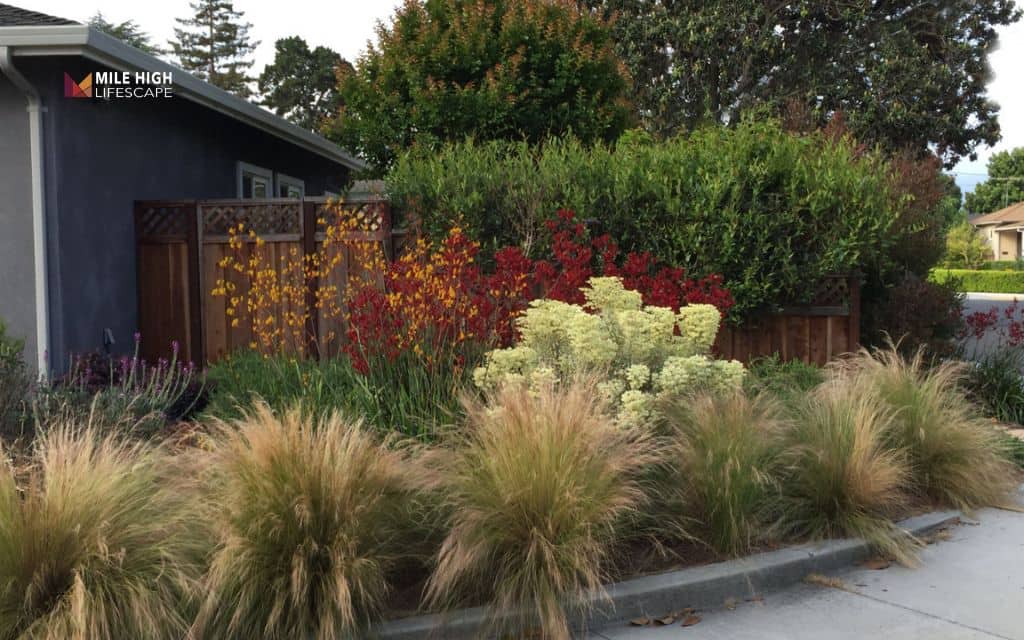
If architectural plants provide the drama, ornamental grasses provide the soul. They move in the wind, catch the light in the early morning and late afternoon, and soften the hard edges of concrete and steel without disrupting the modern aesthetic.
Karl Foerster feather reed grass is a top choice for mid-century modern landscapes, it grows in a tight upright column, stays neat, and turns golden in fall. Blue oat grass and blue fescue add a cool silver-blue tone that pairs beautifully with gravel and concrete. Mexican feather grass adds fine-textured movement for a softer vibe.
Keep lawn areas minimal
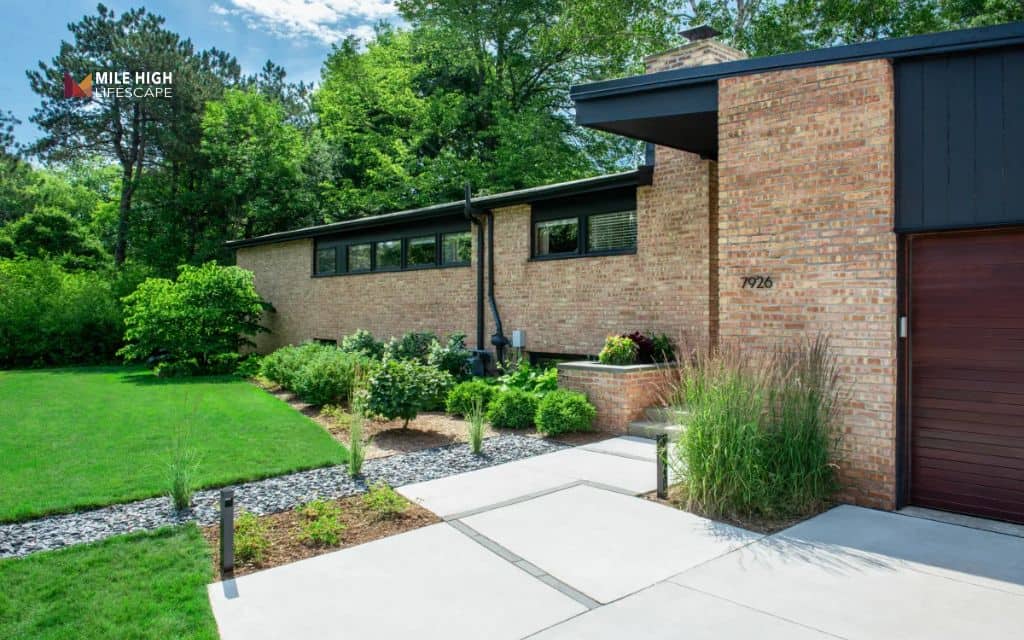
Traditional lawns are the opposite of mid-century modern landscape design. Large stretches of turf require consistent mowing, watering, fertilizing, and aerating – none of which aligns with the style’s emphasis on simplicity and low maintenance.
Instead, reduce the lawn to a minimal, intentional rectangle or strip that serves a specific purpose, like a play area or a visual green anchor. Replace the rest with gravel, ground covers, or planted beds. This shift alone can transform a yard from ordinary to distinctly modern.
Create strong focal points
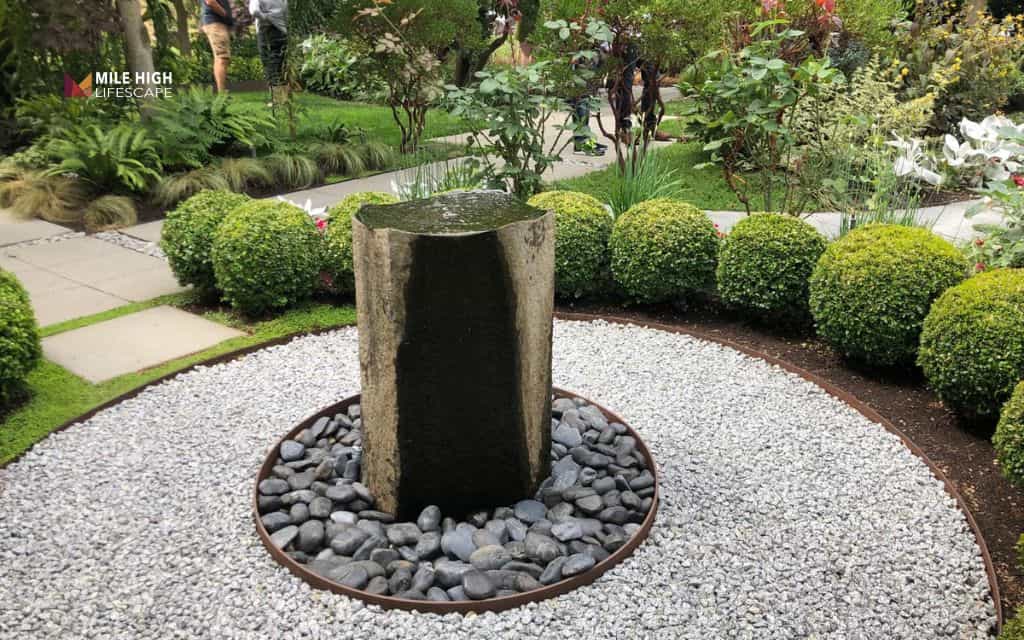
Every great mid century modern landscape has at least one feature that anchors the space visually. It might be a specimen plant, a sculpture, a fire pit, a water feature, or even a dramatically lit tree. The focal point gives the eye somewhere to land and gives the whole design a sense of purpose.
Keep it singular. The beauty of this style is that one strong focal point, surrounded by restrained planting and clean hardscape, is far more impactful than several competing features. Think of it like the statement piece in a well-curated room.
Design with symmetry or balance
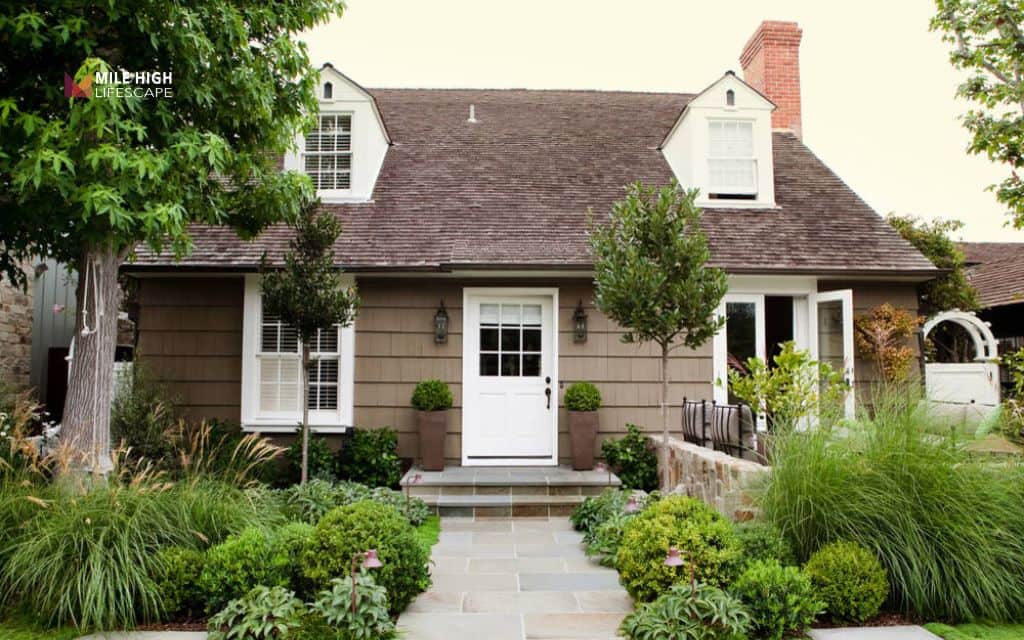
Mid-century modern landscapes often use symmetry to create that sense of order and calm. Flanking an entryway with matching planters, placing identical plant groupings on either side of a path, or mirroring the layout on both sides of a patio are all classic moves.
That said, the style also embraces asymmetrical balance, where the left and right sides differ but still carry equal visual weight. A large agave on one side balanced by a cluster of ornamental grasses on the other, for example, feels balanced even though it is not identical. Both approaches work, as long as the result feels intentional and polished.
Use open space
In mid-century modern landscape design, empty space is a design element in its own right. A sweep of smooth gravel, a bare stretch of concrete, or a simple patch of low ground cover gives the eye room to breathe and makes the planted or featured areas pop.
Resist the urge to fill every inch of the yard. The negative space between elements is what makes the focal points stand out. If your yard feels too open, add one well-chosen specimen plant rather than trying to fill the gap with a mix of different species.
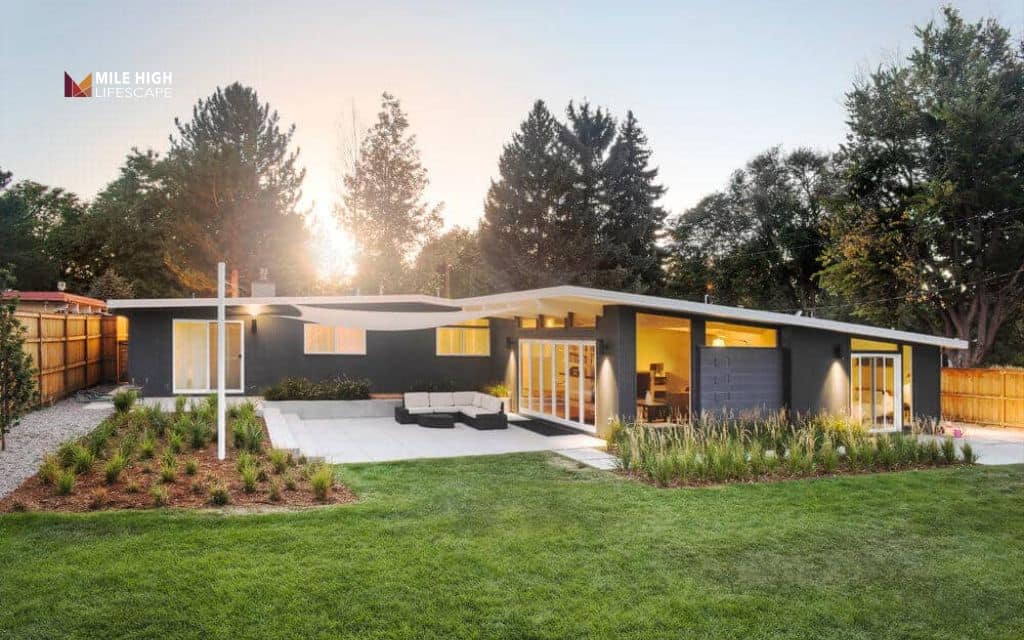
Create a seamless indoor-outdoor patio
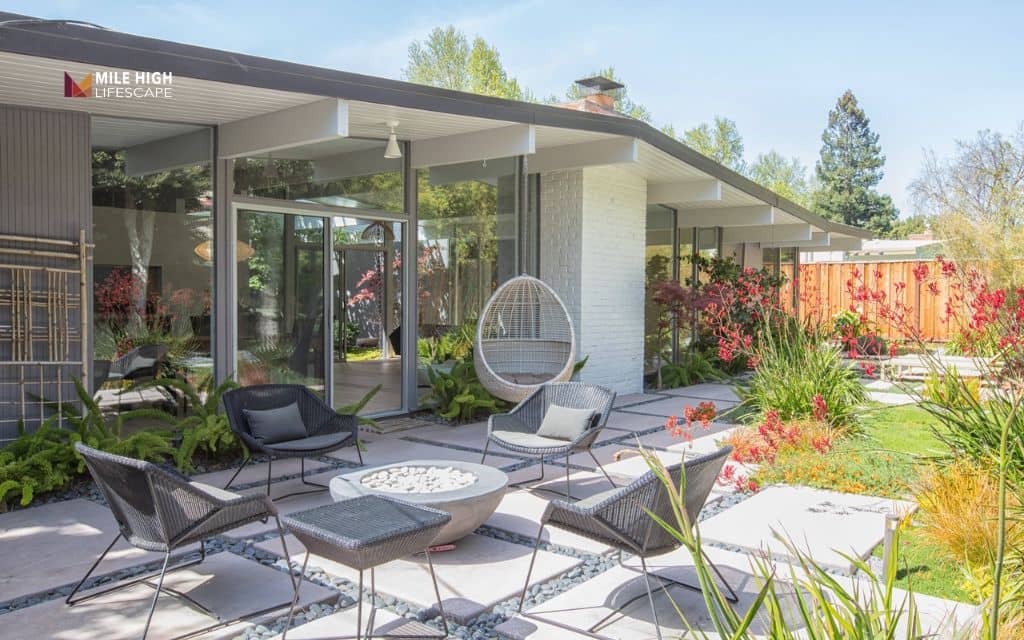
One of the most transformative upgrades in mid century modern landscape design is building a patio that truly connects to the interior of the home. Large sliding or folding glass doors, a consistent flooring material that runs from inside to outside, and matching or complementary furniture all help dissolve the boundary between indoors and out.
Use the same concrete color family inside and outside. Align the sight lines so that when you look through your glass doors, the view is framed and intentional. Add an outdoor rug that echoes the interior flooring, and choose furniture in materials (teak, powder-coated steel, or molded plastic) that feels right in the mid-century era.
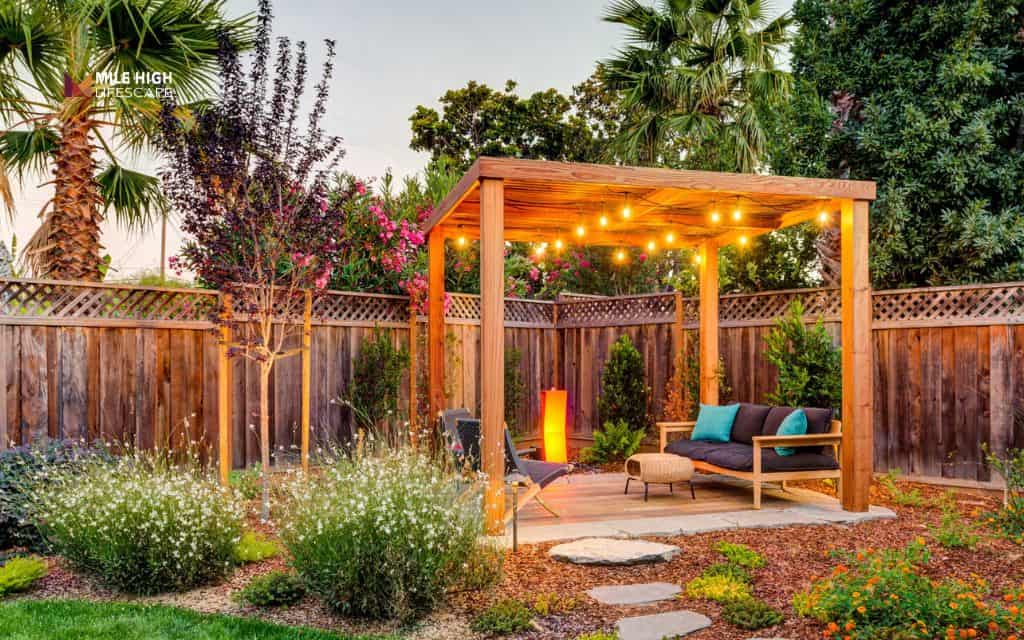
Add built-in seating
Built-in seating is both a practical and a design-forward choice in a mid-century modern landscape. A low concrete bench running along the edge of a patio, or a built-in wooden seat integrated into a raised planter wall, keeps the lines clean and eliminates the cluttered look of freestanding furniture that can drift out of place.
Pair built-in seating with seat cushions in warm neutrals or earth tones to bring in the warm, earthy color palette that mid-century interiors are known for. The combination of structural seating and soft cushions captures the style perfectly.
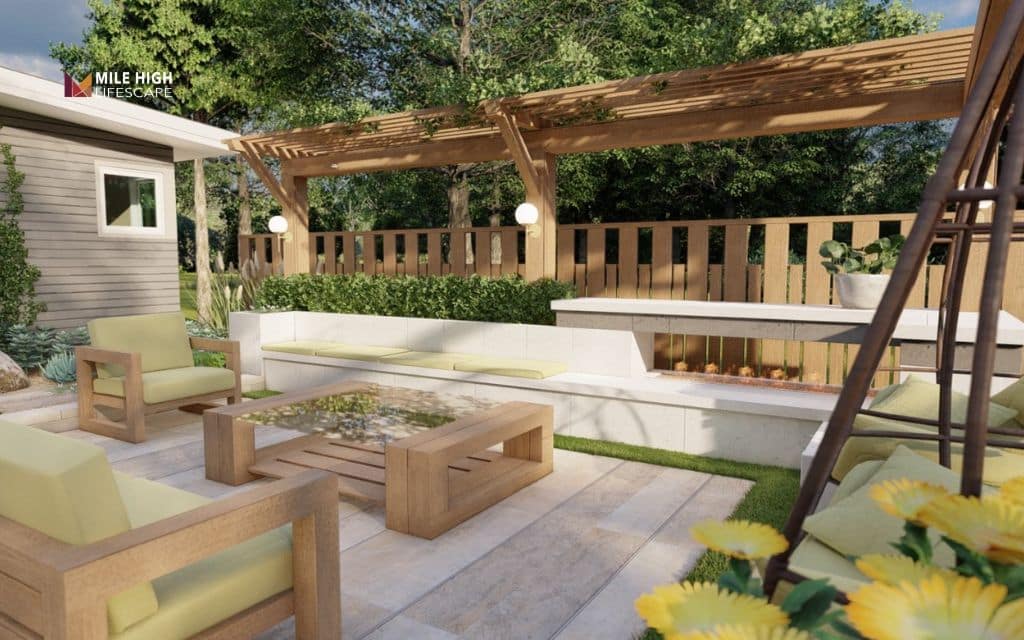
Incorporate a fire feature
A fire feature adds warmth, ambiance, and a natural gathering point to any mid century modern landscape. It extends the usability of the outdoor space well into the cooler months and creates that magnetic focal point the style depends on.
Choose a shape that echoes the geometry of the rest of your yard. A rectangular fire pit suits a yard full of straight lines and right angles. A round fire bowl softens a more rectilinear space and adds a welcome counterpoint.
In either case, keep the surrounding material simple: concrete, corten steel, or smooth stone.
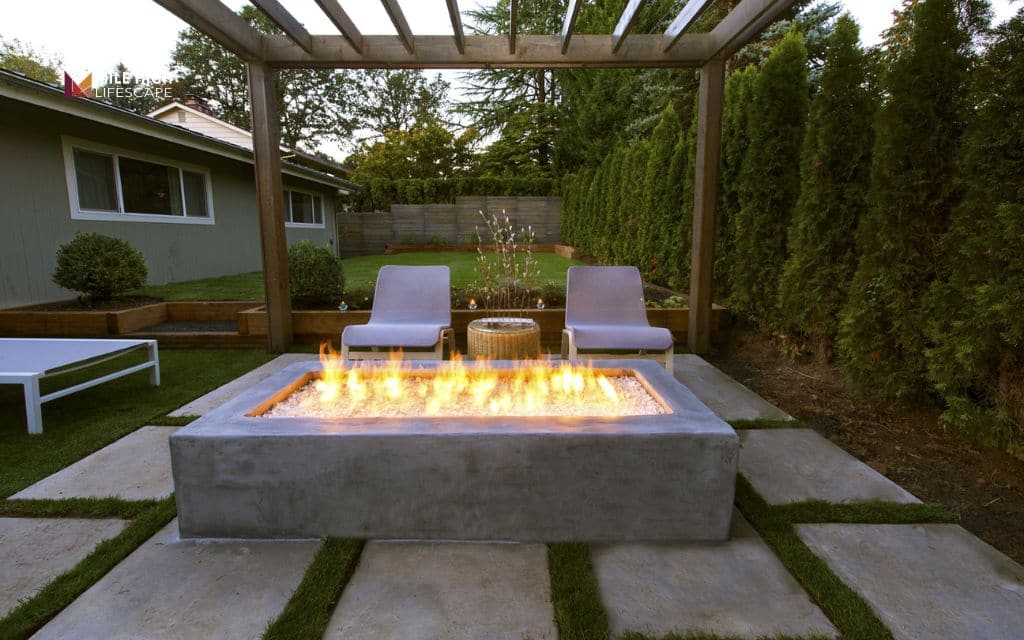
Use modern landscape lighting
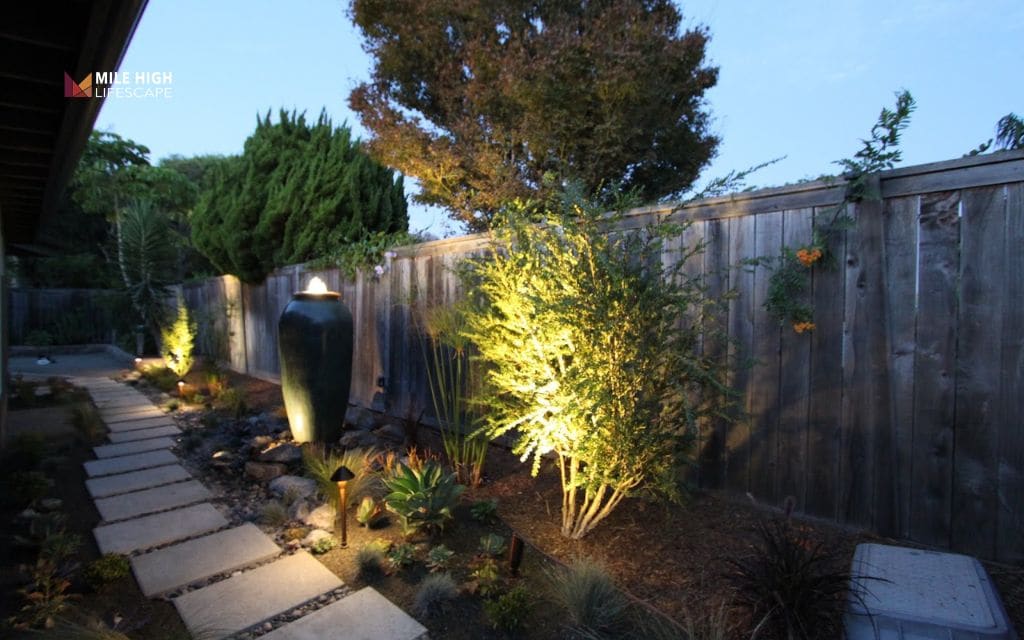
Lighting transforms a mid century modern landscape after dark. The right fixtures highlight the geometry of the pavers, cast dramatic shadows from architectural plants, and create warm pools of light that make the yard feel like an outdoor room at night.
For the most modern effect, choose low-profile in-ground uplights to illuminate specimen plants, linear path lights to define walkways, and wall-mounted sconces in a brushed steel or matte black finish.
Warm white LED bulbs (2700K to 3000K) produce the most flattering and inviting light. Avoid cool white bulbs, which can make a garden feel clinical rather than welcoming.
Stick to a simple material palette
The final and perhaps most important idea for a cohesive mid century modern landscape is to resist material overload. Choose 2 to 4 materials and use them consistently throughout the yard. Classic combinations include concrete with cedar wood, gravel with corten steel, or flagstone with painted steel edging.
When every hardscape element speaks the same material language, the yard feels designed by a professional even if you did it yourself. The simplicity is the sophistication. Every material you add beyond your core palette dilutes that impact, so be selective and intentional with every choice you make.
Best plants for mid-century modern landscapes
Plant selection can make or break a mid-century modern landscape. The best plants for this style share a few qualities: strong architectural form, a restrained color palette, and low maintenance needs.
Here is a breakdown of the top performers:
Agave
Agave is arguably the most quintessential plant for a mid century modern landscape. Its bold rosette form, sharp tips, and slow growth rate make it a low-maintenance showstopper. Cold-hardy varieties like Agave parryi and Agave havardiana survive Denver winters without protection. Plant it solo in a gravel bed or in a raised concrete planter for maximum impact.
Yucca
Yucca brings vertical drama to modern landscapes. Yucca rostrata (beaked yucca) is a standout choice. Its trunk and silver-blue leaf crown look almost alien in the best possible way. It is drought-tolerant, cold-hardy to Zone 5, and requires almost no maintenance once established.
Lavender
Lavender softens the geometry of a mid-century modern landscape without disrupting it. Plant it in long rows along a path or border, or mass it in raised planters for fragrance and silvery texture. English lavender varieties like ‘Hidcote’ and ‘Munstead’ are reliable performers in Front Range climates.
Boxwood
Boxwood is ideal for adding structure and evergreen mass to a mid-century modern landscape. Clip it into tight geometric shapes – spheres, cubes, or low hedges – to reinforce the style’s love of clean form. It is one of the few traditionally clipped plants that looks perfectly at home in this context because the shape is geometric, not ornate.
Ornamental grasses
Already discussed as an idea above, ornamental grasses deserve a place on the best-plants list in their own right. Karl Foerster feather reed grass, blue oat grass, and Mexican feather grass are all excellent choices that deliver movement, texture, and seasonal color while requiring minimal care.
Succulents
Succulents – from low rosette types like hens and chicks (Sempervivum) to taller varieties like Echeveria – bring texture and color variation to gravel beds and raised planters. In colder climates, choose hardy succulents rather than tropical varieties, and they will return year after year.
Low-maintenance mid-century landscaping tips
One of the most appealing aspects of midcentury modern landscape design is how well it aligns with a low-maintenance lifestyle. Here are 4 proven strategies to keep your yard looking sharp with minimal ongoing effort:
- Use gravel instead of large lawns. Swapping turf for decomposed granite or pea gravel eliminates mowing, watering, and fertilizing from your routine. Gravel stays neat through all seasons, improves drainage, and looks impeccably modern.
- Choose drought-tolerant plants. Native and adaptive plants that are suited to your local climate will establish quickly and need little supplemental watering after their first season. This is especially valuable in arid climates like Colorado.
- Limit plant variety. A minimal palette of 3 to 5 plant species is not just a design choice, it is a maintenance strategy. Fewer species means fewer different care requirements, pest vulnerabilities, and seasonal schedules to manage.
- Focus on structure over density. A yard with well-spaced, structurally interesting plants surrounded by gravel or low ground cover is far easier to maintain than a densely planted one. Space between plants also reduces disease pressure and allows each specimen to be appreciated on its own.
Conclusion
A mid century modern landscape is not about complexity, it is about clarity. It is about choosing fewer elements, doing them well, and letting the design breathe. It is about connecting your home to your yard in a way that feels natural and effortless. And it is about building an outdoor space that holds its good looks across every season without demanding constant attention.
With the right approach, you can create a space that is clean, stylish, functional, and easy to maintain – whether you are starting from scratch or simply refreshing what you already have.
At Mile High Lifescape, we specialize in creating modern landscapes that capture the timeless appeal of mid-century design while being perfectly adapted to Denver’s climate and lifestyle. If you are ready to transform your yard into something truly remarkable, our team is here to help.
Frequently asked questions (FAQs)
What is the best color for a mid-century modern house?
Mid-century modern homes look their best in earthy, grounded neutrals or bold accent tones. Classic exterior colors include warm white, tan, terracotta, olive green, and charcoal gray for the body of the house, often paired with natural wood accents on soffits, fascia, or fence panels. Bold front doors in mustard yellow, burnt orange, or teal green are a signature move of the era and add personality without overwhelming the clean lines of the architecture. For the landscape, stick to materials and plant colors that complement these tones: warm gravel, corten steel planters, and silvery or blue-green foliage all work beautifully.
What plants work best for mid-century modern landscaping?
The best plants for a mid century modern landscape are those with strong architectural form, low maintenance requirements, and a clean, graphic quality. Top choices include agave (especially cold-hardy varieties like Agave parryi), yucca, Karl Foerster feather reed grass, blue oat grass, lavender, boxwood, ornamental sedges, and hardy succulents like Sempervivum.
Is mid-century modern landscaping low maintenance?
Yes. Mid-century modern landscape design was built on principles that translate directly into low maintenance: a minimal plant palette, drought-tolerant species, gravel and hardscape in place of large lawns, and clean structure that does not require constant pruning or tidying to look good. Compared to high-density mixed planting styles or formal gardens, a well-designed mid century modern landscape is one of the most manageable options available.
How do you make a backyard look mid-century modern?
Start with the hardscape: lay a simple concrete or paver patio close to the house, and replace large lawn areas with gravel or ground cover. Then select 2 or 3 architectural plants and place them intentionally rather than randomly. Add a fire pit or built-in seating to anchor a gathering area, and install warm LED lighting to highlight the key features at night. Finally, edit ruthlessly: remove anything that feels cluttered, overgrown, or inconsistent with the clean aesthetic. Subtraction is just as important as addition in this style.
Can you DIY a mid-century modern landscape?
Absolutely. Because the style relies on simple materials, a limited plant palette, and clean geometry rather than complex horticultural knowledge, it is one of the more accessible styles for DIY landscaping. Many homeowners successfully tackle projects like laying geometric pavers, filling beds with gravel, installing raised planters, and planting architectural specimens on their own. For larger-scale projects — major grading, drainage work, or built-in concrete features — partnering with a professional landscaper ensures a polished result and avoids costly mistakes. The Mile High Lifescape team is always happy to consult on projects of any size.