Knowing how to remove ivy from ground correctly is not just about pulling vines, it is about understanding how these plants grow, why they keep coming back, and what steps will actually stop the cycle for good. Skipping any part of that process is exactly why so many people end up fighting the same patch of ivy year after year.
This guide covers everything: how to identify which type of ivy you are dealing with, the right tools and safety steps, and what to do after the ivy is gone. By the end, you will have a clear, realistic plan for getting rid of ivy in your yard and keeping it out.
What is ivy?
The word ivy gets applied to several different plants, and knowing which one you have changes how you approach removal. Two types dominate most yards across the United States.
Ground ivy
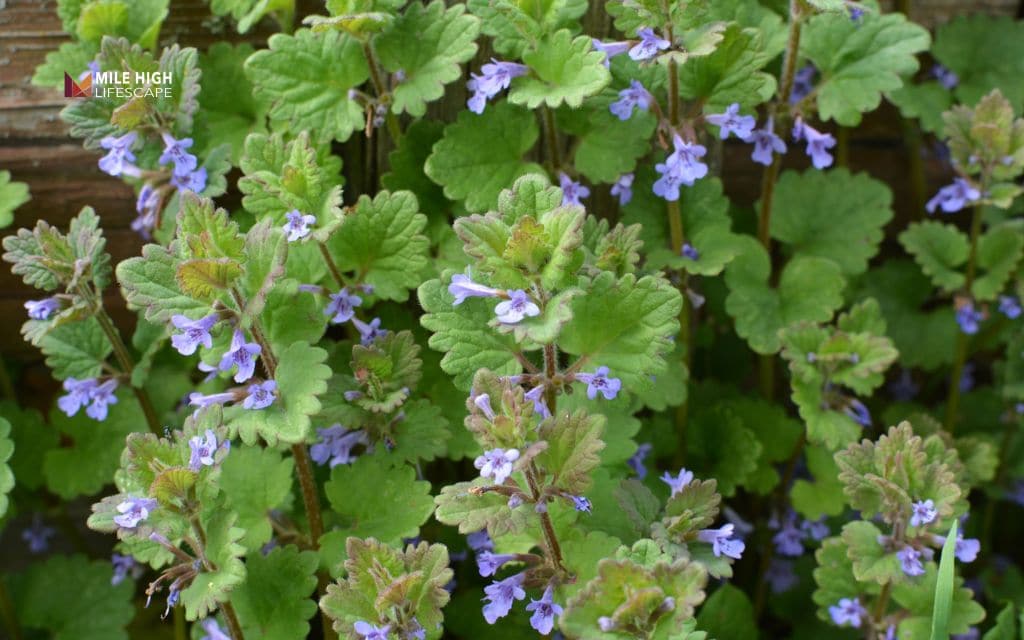
Ground ivy is a low growing lawn weed with round, scalloped leaves and distinctly square stems. It spreads through stolons, which are horizontal stems that root at nodes wherever they make contact with soil. You will find it most often in moist, shaded, or compacted lawn areas.
Crush a leaf and it releases a faint minty or musky smell. In spring it produces small purple flowers. By the time those flowers appear, the plant is usually already well established across a large area.
English ivy (Hedera helix)
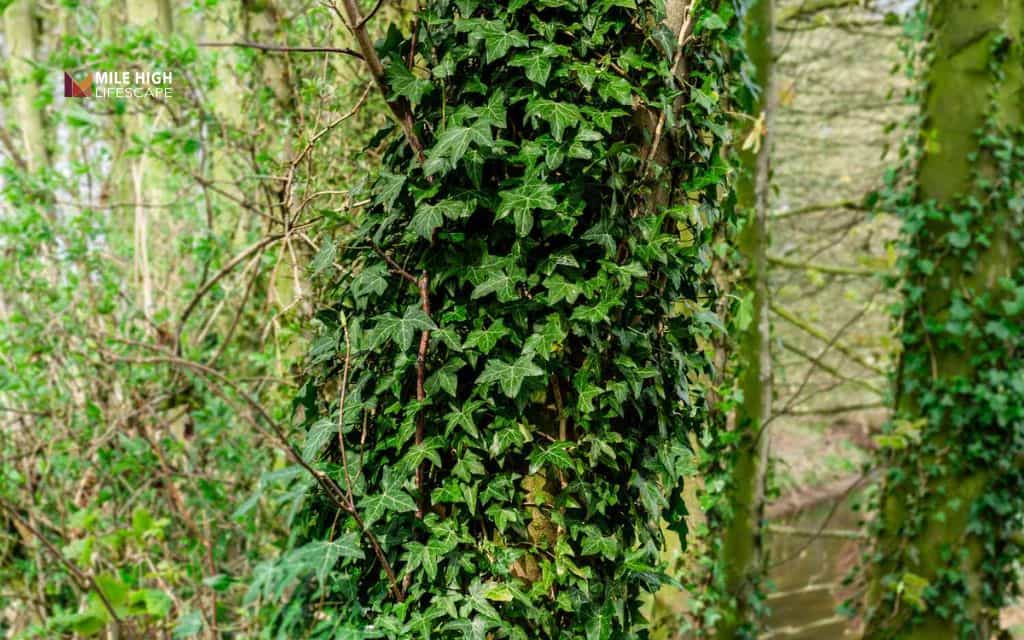
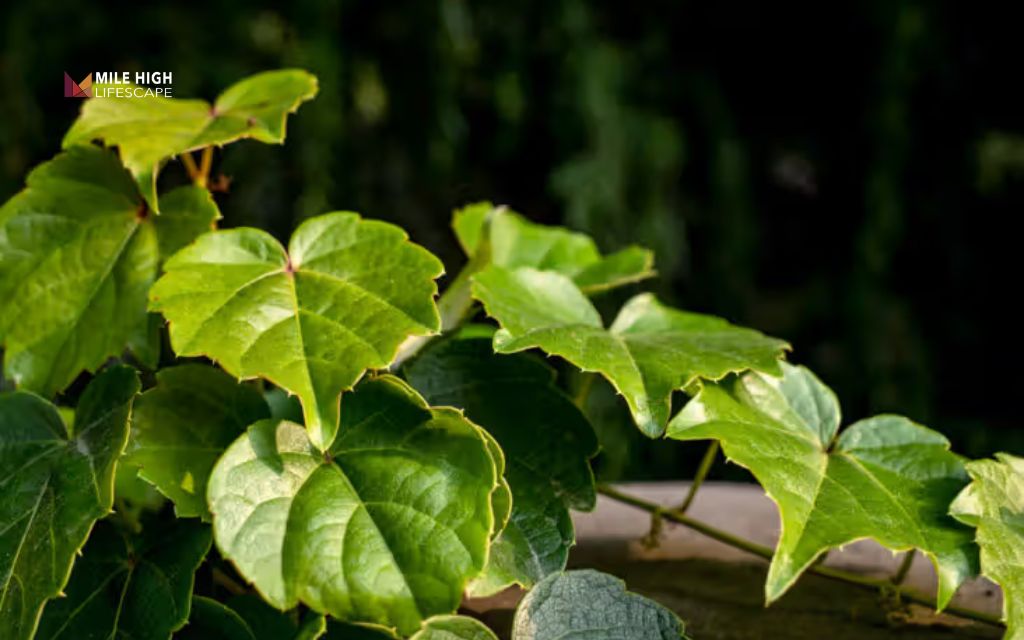
English ivy is a woody evergreen vine with dark green, waxy, lobed leaves. Instead of stolons, it uses aerial roots, which are tiny rootlets that grip and anchor to bark, fences, concrete, and any surface they contact. This is what allows English ivy on trees to climb dozens of feet without any additional support.
English ivy is listed as invasive in many U.S. states because it spreads rapidly and crowds out native plants. Birds eat the berries and spread seeds across wide areas, which is why a cleared patch can develop new seedlings far from any remaining vines. The berries are toxic to humans and should not be handled without gloves.
Why is ivy so hard to remove?
Struggling with ivy is not your fault. These plants are biologically designed to survive disturbance, and understanding why they persist makes the removal process far less frustrating.
- Ground ivy re-roots from any node left in the soil after pulling. Even a short stem fragment with a single node is enough to start a new plant within weeks.
- English ivy has a shallow but wide spreading root system. Any crown or root fragment left behind will re-sprout, often sending up multiple new shoots from a single point.
- English ivy berries are dispersed by birds, which can deposit seeds in cleared areas long after a successful removal session.
- Both types adapt easily to a wide range of soil conditions, light levels, and moisture levels. You cannot simply change the environment to starve them out.
Complete removal almost always requires more than one session. Most successful clearances take consistent follow-up across 1 to 2 growing seasons. That is not failure. That is how ivy removal works, and planning for it from the start makes the process much more manageable.
Tools and safety gear you will need
Tools
- Heavy-duty garden gloves, thick rubber or leather
- Hand pruners or clippers
- Flat spade or edging shovel
- Garden rake
- Wheelbarrow or heavy-duty yard waste bags
- Weed whacker or brush cutter for large, overgrown areas before manual removal
Safety notes
- English ivy sap contains falcarinol, which can trigger a skin rash similar to poison ivy. Wear long sleeves, long pants, and gloves for every session without exception.
- Wear rubber boots if the ground is wet or muddy.
- Wash your hands, tools, and clothing after each work session.
- Do not compost pulled ivy. Even small fragments can re-root in a compost pile. Use sealed yard waste bags only.
- Avoid touching your face while working. The sap is the primary irritant.
When is the best time to remove ivy?
Late winter or early spring is the best window for English ivy. The plant stays green while surrounding vegetation is dormant, making it easy to identify and isolate. If poison ivy is also present nearby, it loses its leaves in winter, which reduces the risk of accidental contact.
Work the day after rain. Softened soil allows roots to pull out more completely, which directly reduces regrowth from fragments left behind. Avoid working on frozen ground. Roots snap off rather than pull out whole, leaving fragments that will re-sprout.
For ground ivy in lawns, fall and spring are the most effective periods. The plant is actively growing during both seasons, and any spot treatments absorb most efficiently when the plant is in active growth.
How to remove ivy from the ground
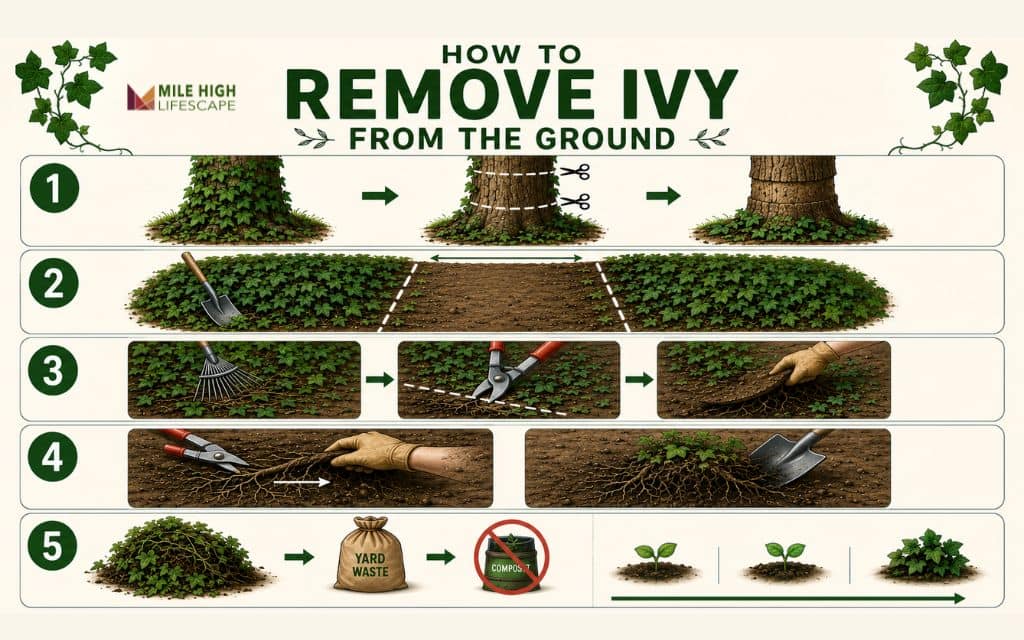
Step 1: Prep the area
Before pulling a single vine, walk the area and remove any debris hidden under the ivy mat: branches, rocks, and logs that create tripping hazards or block clean removal.
If English ivy is climbing trees in the area, address it before starting on the ground. Cut through the vine at waist height and again near the base, removing a complete ring of stem around the trunk. Do not pull the ivy off the tree. Pulling live ivy off bark risks tearing the bark and damaging the tree.
Step 2: Divide into strips
Do not attempt to clear the entire area at once. Use a flat spade to mark two parallel cuts roughly 4 feet apart, then work within those defined sections. This keeps vines from tangling across a large surface and makes the physical work far more manageable.
Working in strips also helps you track progress clearly. Completing one strip at a time gives you natural stopping points and prevents the sense of overwhelm that leads people to abandon the job partway through.
Step 3: Cut, rake, and peel
Rake leaves off the defined strip, then use clippers to cut across it at or just below soil level, perpendicular to the parallel cuts. Pull cut vines back toward you as you go. This cut and peel motion frees large sections efficiently.
For thick English ivy mats, peel sections back like a rolled carpet. Start at the highest point on any slope and work downhill. As you lift, check for vines still rooted to the soil. Grab them close to where they enter the ground and pull firmly upward.
Step 4: Pull or dig out the roots
This is the single most important step for preventing regrowth. After removing the vine mat, go back through the strip and address the roots directly.
Work clippers gently under shallow roots to loosen them before pulling horizontally to free the root ends. For thick, stubborn original planting crowns that have been in the ground for years, use a shovel to dig them out fully.
Getting the roots out completely is the most critical factor in stopping ivy from coming back.
Step 5: Bag everything and follow up
Immediately place all pulled vines, roots, and leaves into yard waste bags. Do not add any ivy material to a compost pile. Even a single node can re-root and establish a new plant within the pile, which will then reintroduce ivy wherever that compost is spread.
Once the area is cleared, walk it monthly for the first 2 growing seasons. Young regrowth from surviving roots is easy to pull when caught early. Skipping this follow-up is the single most common reason ivy returns after a successful initial removal.
After removing ivy: How to keep it from ever coming back
1. Mulching
Apply 3 to 4 inches of wood chip mulch immediately after manual clearing. Mulch suppresses regrowth, retains soil moisture, and helps the soil recover. Mulching alone will not kill established ivy, but it is highly effective as a prevention layer after the main removal work is complete.
2. Boiling water
Boiling water poured directly onto exposed roots and crowns can kill surface growth. Its penetration into the soil is limited, which reduces effectiveness on deep roots. This method works best as a targeted follow-up treatment on small regrowth patches rather than as a primary removal approach.
3. Smothering with tarps or cardboard
A thick black plastic tarp or overlapping layers of cardboard blocks all sunlight and gradually depletes root energy reserves. This method is slow: it can take up to two years to fully exhaust an established root system. It works best on large, open flat patches and is not suitable near existing trees or shrubs.
4. Repeated mowing
Mowing removes ivy leaves repeatedly, forcing roots to spend stored energy regenerating foliage. Over multiple seasons this can exhaust root reserves. It is a slow method with no guaranteed timeline and is most practical as a maintenance tool for keeping juvenile English ivy from producing seeds, not for eliminating an established infestation.
5. Herbicides
Glyphosate-based herbicides are largely ineffective on mature English ivy because the waxy leaf surface sheds liquids before absorption. Two targeted applications do work, however.
- Spot-spray immature, bright green spring leaves before the waxy coating develops. These young leaves absorb contact herbicides most effectively.
- For large root stumps that cannot be dug out, paint concentrated glyphosate directly onto the freshly cut root surface using a cotton swab or brush. This minimizes spray drift and targets the root system directly.
Tips to prevent ivy from coming back
The most common reason ivy returns after removal is that the cleared area is left bare and unplanted. These steps address long-term prevention directly.
After you have removed the ivy, here is how to stop it from growing back. These methods focus on prevention and long-term control, not initial removal.
- Mulch cleared areas immediately. Apply 3 to 4 inches of wood chip mulch right after clearing to suppress regrowth and discourage new seedling establishment.
- Plant competitive native ground covers. Bare soil is an open invitation for reinvasion. Replace ivy with low-growing natives suited to your site: wild ginger in shade, creeping phlox in sun, Pennsylvania sedge, or native ferns. A dense healthy planting outcompetes ivy seedlings before they can establish.
- Monitor and pull early. Walk cleared areas monthly for the first two growing seasons. Young ivy regrowth from surviving roots is far easier to remove than established runners.
- Check for bird-dispersed seedlings. Look for single-leaf English ivy seedlings near bird perches and fence lines. Remove them immediately before a root system develops.
- Improve lawn conditions to resist ground ivy. Aerate compacted soil, adjust pH toward 6.0 to 7.0, and overseed bare patches with appropriate grass varieties. A dense, healthy lawn is the most sustainable long-term defense against creeping Charlie.
- Address neighboring property sources. If ivy is spreading from an adjacent property, install a physical root barrier along the boundary or discuss the issue with the neighbor. Clearing your side without addressing the source creates a maintenance cycle with no end point.
Conclusion
Removing ivy takes patience, but each session gets easier as the root system weakens and depletes. The most important things to remember are to remove the roots completely, bag every scrap of material right away, and return regularly over the following seasons. Those three habits account for the difference between a cleared yard and a yard that fills back in within a year.
Once the ivy is gone, replant or mulch the cleared area quickly. Empty soil is the fastest route back to an ivy problem. Fill the space with something intentional and the ivy loses its foothold for good. The cleared space is now an opportunity. With the right ground cover or planting in place, you will not just have removed a problem. You will have built something better in its place.
About Mile High Lifescape
At Mile High Lifescape, we specialize in transforming Denver-area outdoor spaces into landscapes that are both beautiful and easy to maintain. From removing invasive plants like ivy to designing custom garden beds and seasonal cleanups, our experienced team handles every aspect of your yard with care and precision. Whether you are starting fresh or reclaiming an overgrown space, we bring the expertise to get it done right.
Our Tree Branch Removal service helps Denver homeowners safely clear damaged, dead, or overgrown branches before they become a larger problem. From selective branch removal to complete yard cleanup, Mile High Lifescape keeps your trees and outdoor spaces safe, healthy, and well maintained.
Contact us today to schedule a consultation and take the first step toward a healthier, more enjoyable yard.
Frequently asked questions (FAQs)
What kills ivy permanently?
No single treatment kills ivy permanently in one application. The most effective permanent solution combines thorough manual removal of all roots and crowns, immediate mulching of cleared areas, consistent monthly monitoring for regrowth over one to two growing seasons, and replacement planting with competitive native ground covers. Each of these steps is necessary. Skipping any one of them significantly increases the chance of ivy returning.
How do you kill ivy on the ground?
The most reliable way to kill ivy on the ground is manual removal: cut the vines at soil level, peel back the mat in strips, and dig out the roots. For follow-up, boiling water can be poured onto exposed root crowns, or concentrated glyphosate can be painted directly onto freshly cut root surfaces. The key is addressing the root system, not just removing the visible foliage.
How to get rid of ivy without digging?
If digging is not an option, smothering with a heavy black plastic tarp or overlapping layers of cardboard can exhaust the root system by blocking all sunlight. This process takes up to 2 years for an established plant. Repeated mowing also weakens the root system gradually by forcing it to expend energy on leaf regrowth. Neither method is as fast or reliable as manual removal, but both can work on open flat areas where digging is not practical.
How to get ivy roots out of the ground?
Work clippers or a garden fork gently under shallow roots to loosen them before pulling horizontally to free the root ends. For thick, established root crowns, a flat spade or shovel is more effective. Dig down and around the crown to free it from the soil rather than pulling straight up. Working the day after rain softens the soil and makes root removal significantly more complete.
What is the best killer for ivy?
For English ivy, the most effective targeted chemical treatment is concentrated glyphosate painted directly onto freshly cut root surfaces. This method minimizes spray contact with surrounding plants and directs the herbicide into the root system. Spraying herbicide on mature English ivy leaves is largely ineffective due to the waxy leaf coating. For ground ivy in lawns, spot-spraying young spring growth before the waxy coating develops is the most effective herbicide application window.