One cubic yard of mulch equals 27 cubic feet. That volume answers how many bags of mulch in a yard: 18 bags at 1.5 cubic feet each, 13.5 bags (buy 14) at 2 cubic feet each, and 9 bags at 3 cubic feet each.
Bag size, bed area, and mulch depth set the final count. This guide gives the conversions, coverage figures, and a formula for turning your own bed measurements into a bag count, so you order enough without leftovers or a second trip.
What a cubic yard of mulch measures
One cubic yard fills a cube that measures 3 feet on each side. Multiply 3 by 3 by 3 and you get 27 cubic feet. Suppliers sell bulk mulch by this unit, while bag labels list volume in cubic feet. One division connects the two.
Both units measure volume, not weight. Wet mulch weighs more than dry mulch, but a yard still holds 27 cubic feet. Check the volume printed on each bag, because sizes vary by brand and product.
How many bags of mulch in a yard
| Bag size | Bags per cubic yard | Bags to buy |
| 1.5 cu ft | 18 | 18 |
| 2 cu ft | 13.5 | 14 |
| 3 cu ft | 9 | 9 |
Divide 27 by the bag volume to find how many bags of mulch equal a cubic yard. Two cubic foot bags give 13.5, and you round up to 14 because stores sell whole bags. Smaller bags raise the count, and larger bags lower it.
To go the other way, divide the bag volume by 27. One 2 cubic foot bag holds about 0.074 cubic yard, a 1.5 cubic foot bag holds about 0.056, and a 3 cubic foot bag holds about 0.111. That is how many yards is a bag of mulch.
Choosing between 1.5, 2, and 3 cubic foot bags
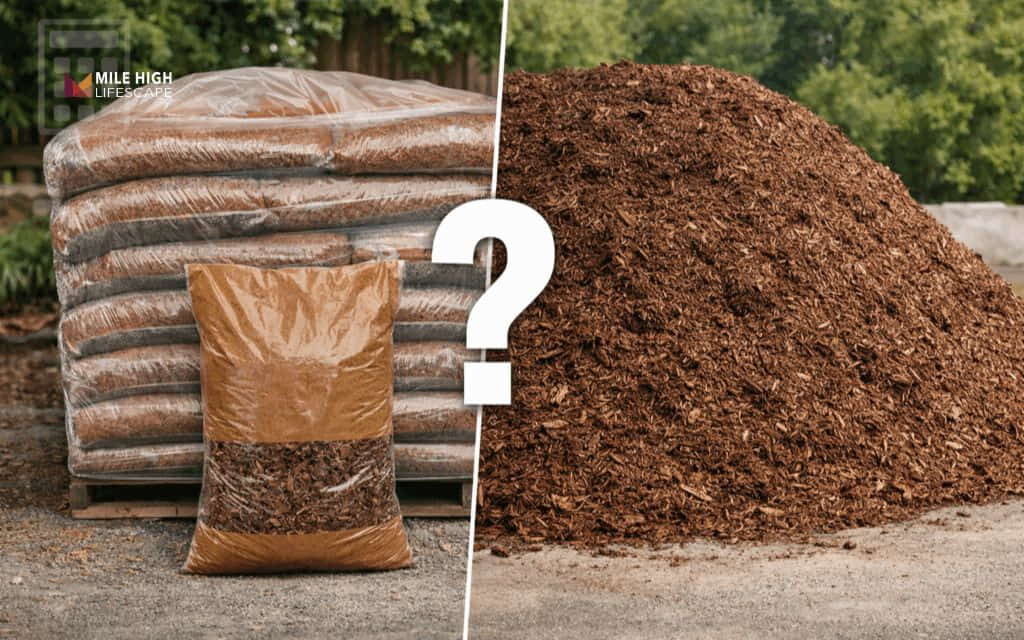
Larger bags cut the number of trips from the car to the bed, but each bag weighs more. Smaller bags suit tight spaces and lighter lifting. Compare price by volume, not by bag: divide the bag price by its cubic feet, then compare that figure across sizes.
The tables below convert common project sizes. Round up to whole bags when you buy. These conversions also answer how many bags is 3 yards of mulch: 81 cubic feet, or 41 bags of 2 cubic feet.
| Yards of mulch | 1.5 cu ft bags | 2 cu ft bags | 3 cu ft bags |
| 1 | 18 | 14 | 9 |
| 2 | 36 | 27 | 18 |
| 3 | 54 | 41 | 27 |
| 4 | 72 | 54 | 36 |
| 5 | 90 | 68 | 45 |
| 6 | 108 | 81 | 54 |
| Bags of mulch | Yards in 1.5 cu ft bags | Yards in 2 cu ft bags | Yards in 3 cu ft bags |
| 30 | 1.67 | 2.22 | 3.33 |
| 70 | 3.89 | 5.19 | 7.78 |
| 100 | 5.56 | 7.41 | 11.11 |
How much ground one cubic yard covers
Coverage depends on depth. One cubic yard covers 324 square feet at 1 inch deep. Double the depth and the area halves. At 2 inches it covers 162 square feet, at 3 inches 108 square feet, and at 4 inches 81 square feet.
Use the table to check your math. One 2 cubic foot bag covers 8 square feet at 3 inches, so a 100 square foot bed needs about 13 bags. Coverage figures assume an even layer over level ground.
| Depth | 1 cubic yard | 1.5 cu ft bag | 2 cu ft bag | 3 cu ft bag |
| 2 inches | 162 sq ft | 9 sq ft | 12 sq ft | 18 sq ft |
| 3 inches | 108 sq ft | 6 sq ft | 8 sq ft | 12 sq ft |
| 4 inches | 81 sq ft | 4.5 sq ft | 6 sq ft | 9 sq ft |
Steps to calculate the mulch your beds need
Measure each bed
Measure length and width in feet for rectangular beds, then multiply them to get square feet. For round beds, measure the radius and multiply 3.14 by the radius twice. Split irregular beds into rectangles and circles, calculate each shape, and add the results.
Subtract spaces mulch will not cover, such as pavers, boulders, and the bare ring around tree trunks. This step keeps your bag count honest for the space that actually gets mulch.
Turn area and depth into yards
Multiply square feet by the depth in inches, then divide by 324. The result is cubic yards. Multiply cubic yards by 27 to get cubic feet, then divide by the bag volume to get the bag count.
Take a 10 by 10 foot bed at 3 inches deep. The math is 100 × 3 ÷ 324, or 0.93 cubic yard. That equals 25 cubic feet, or 13 bags of 2 cubic feet each.
Adjust for existing mulch and add a buffer
Measure the mulch already in the bed, then subtract that depth from your target. Only the difference needs fresh material: a target of 3 inches over 1 inch of old mulch calls for 2 inches of new mulch, not 3.
Add about 10% to any total for settling, spillage, and uneven ground. The 10 by 10 foot bed at 3 inches deep grows from 25 to about 27.5 cubic feet with that margin, which rounds up to 14 bags of 2 cubic feet each.
Quick reference by bed size
Find the bed area closest to yours and read across to your depth. Each cell shows cubic yards and bags. Bag counts assume 2 cubic foot bags and round up to whole bags.
| Bed area | 2 inches deep | 3 inches deep | 4 inches deep |
| 50 sq ft | 0.31 yd / 5 bags | 0.46 yd / 7 bags | 0.62 yd / 9 bags |
| 100 sq ft | 0.62 yd / 9 bags | 0.93 yd / 13 bags | 1.23 yd / 17 bags |
| 200 sq ft | 1.23 yd / 17 bags | 1.85 yd / 25 bags | 2.47 yd / 34 bags |
| 500 sq ft | 3.09 yd / 42 bags | 4.63 yd / 63 bags | 6.17 yd / 84 bags |
Choosing the right mulch depth
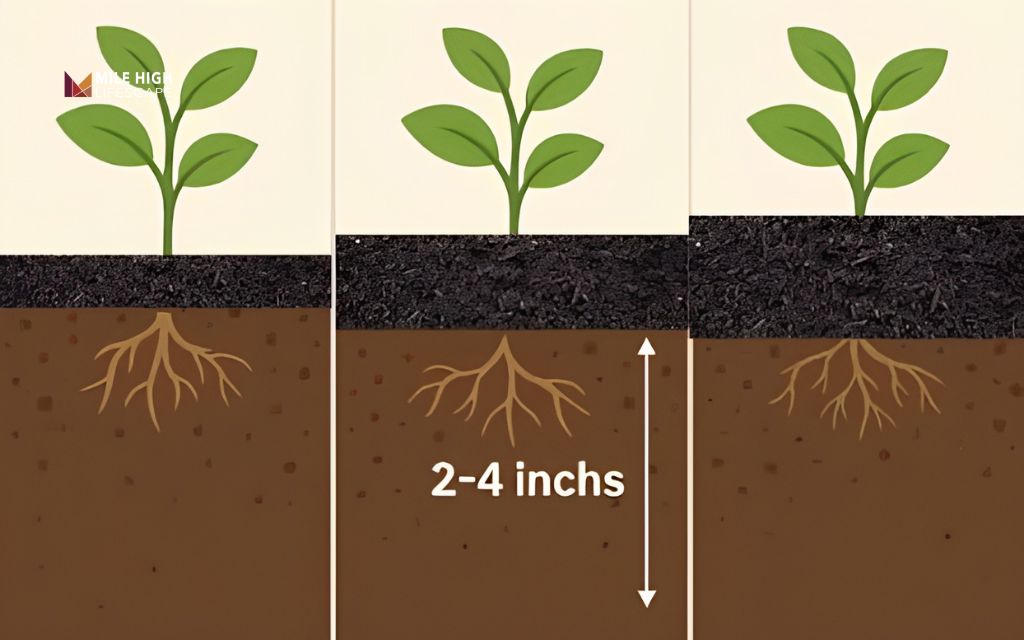
Extension guidance generally sets the range at 2 to 4 inches, adjusted for material, soil, and plants. Coarse mulches such as wood chips suit the upper end. Finely textured mulches, such as grass clippings or double-shredded bark, pack tighter and suit the lower end.
More is not better. Excess depth can waterlog soil, cut oxygen to roots, and encourage shallow rooting. Mulch piled against a trunk traps moisture against the bark, so pull it back and keep the root flare visible. Each extra inch also adds about 0.31 cubic yard per 100 square feet.
Bagged mulch or bulk delivery: How to decide
Compare cost by volume. Divide the bag price by its cubic feet, then divide the bulk price per yard by 27. Add the delivery fee to the bulk side. Bulk usually costs less per cubic foot, and the delivery fee spreads over more mulch as your order grows.
Bags fit small beds, phased projects, and tight access. Bulk fits orders that reach several yards, provided you have room for the pile and a plan to spread it soon. Check HOA rules on mulch type and delivery before you order bulk.
| Factor | Bagged | Bulk |
| Cost per cubic foot | Usually higher | Usually lower, before delivery fees |
| Handling | Carry and place bags where needed | Arrives as one pile, spread from there |
| Storage | Store under cover and apply later | Needs space for the truck and the pile |
| Waste | Empty plastic bags to discard | No bags to discard |
| Moisture and weight | Stays drier under cover | Can arrive wet and heavy |
| Material choice | More products to choose from | Depends on the supplier |
Conclusion
The answer to how many bags of mulch in a yard starts with 27 cubic feet: 18 bags of 1.5 cubic feet, 14 bags of 2 cubic feet, or 9 bags of 3 cubic feet. Multiply bed area by depth, divide by 324, and add a small margin to order the right amount.
Mile High Lifescape designs and builds landscapes for Denver homeowners. For help planning beds, sizing a mulch order, or handling mulch installation, call us at (303) 877-9091.
Frequently asked questions (FAQs)
How many bags of mulch equal a cubic yard?
It depends on bag size. One cubic yard equals 18 bags of 1.5 cubic feet, 13.5 bags (buy 14) of 2 cubic feet, or 9 bags of 3 cubic feet.
How many bags is 2 yards of mulch?
Two yards equal 54 cubic feet. That means 36 bags of 1.5 cubic feet, 27 bags of 2 cubic feet, or 18 bags of 3 cubic feet.
How many bags of mulch is 5 yards?
Five yards equal 135 cubic feet. That means 90 bags of 1.5 cubic feet, 68 bags of 2 cubic feet, or 45 bags of 3 cubic feet.
How many yards is 70 bags of mulch?
Seventy bags of 2 cubic feet equal 140 cubic feet, or about 5.19 cubic yards. The same count equals 3.89 yards in 1.5 cubic foot bags and 7.78 yards in 3 cubic foot bags.
How many yards is a bag of mulch?
One 2 cubic foot bag equals about 0.074 cubic yard, a 1.5 cubic foot bag equals about 0.056, and a 3 cubic foot bag equals about 0.111.
How much area does one bag of mulch cover?
One 2 cubic foot bag covers 12 square feet at 2 inches, 8 square feet at 3 inches, and 6 square feet at 4 inches.
Can I apply mulch thinner than 2 inches?
You can, but thin layers suppress weeds and hold moisture less well, and they need refreshing sooner. Finely textured mulches work best near the low end of the 2 to 4 inch range.