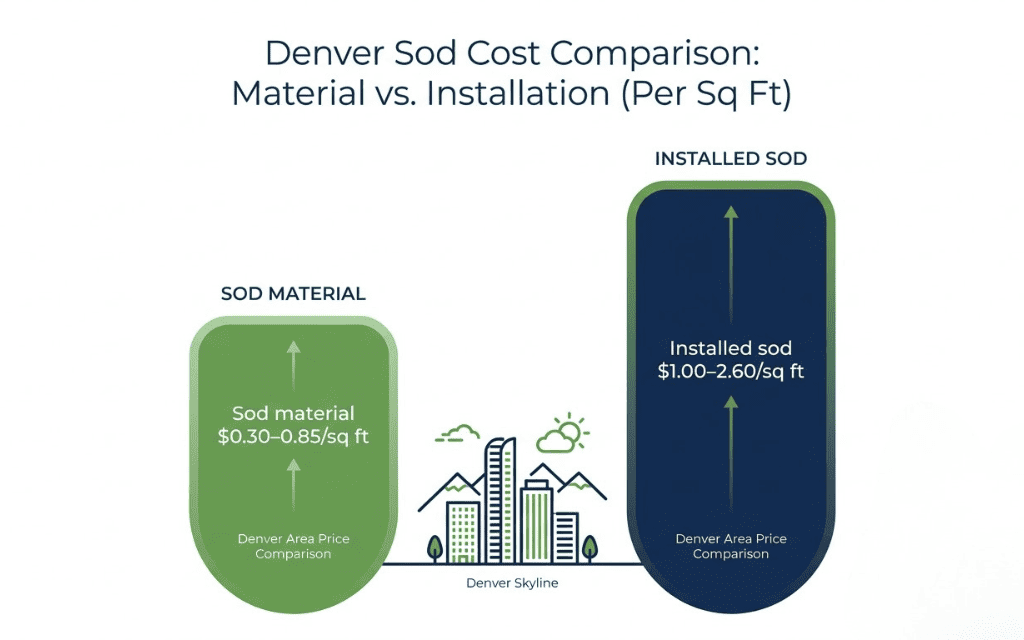
How much does sod cost for a Denver lawn? Sod material runs 0.30–0.85 per square foot, and installed sod runs 1.00–2.60. This guide shows Denver Metro homeowners how to price sod by grass type, pallet, yard size, and prep. You can then set a realistic budget, compare quotes line by line, and time your install around the 2026 watering rules.
How much does sod cost?
Sod costs 0.30–0.85 per square foot (3.20–9.15 per m²) for material and 1.00–2.60 per square foot (10.75–28 per m²) installed. Denver cost guides report 1.70–2.80 per square foot installed.
The gap between quotes comes from one place: site prep. On Denver Metro lawns, we see tear-out, grading, and compost cost as much as the sod itself.
Denver Water customers: As of October 1, 2026, Denver Water bans lawn watering and new-grass establishment until its board lifts the restriction. Price your project now, and schedule installation after the ban ends.
Sod cost at a glance: Material, delivered, installed, and full renovation
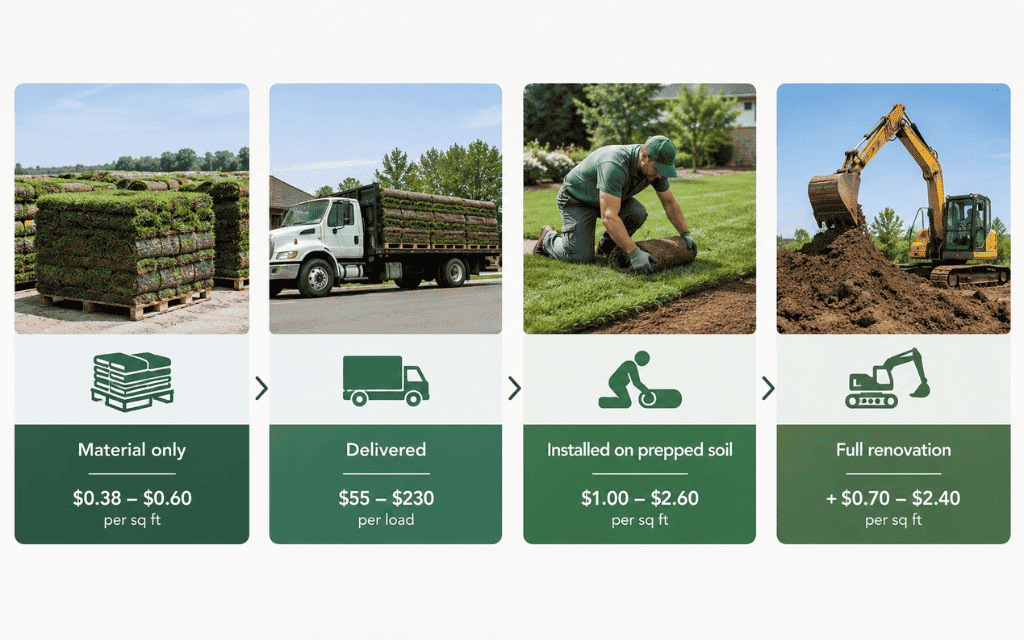
Sod quotes fall into 4 pricing levels. Each level adds a layer of work and a layer of cost.
| Pricing level | What the price covers | Typical cost |
| Material only | Sod cut at the farm; you haul and lay it | 0.38–0.60 per sq ft (on-farm average by species) |
| Delivered | Sod dropped at your curb | Material + 55–230 per load |
| Installed on prepped soil | Laying, seaming, rolling, and first watering | 1.00–2.60 per sq ft |
| Full renovation | Tear-out, grading, compost, sod, and install | Installed price + 0.70–2.40 per sq ft |
Ask each installer which level the price covers. A $1.20 quote and a $3.50 quote often describe two different jobs.
Sod price per square foot by grass type for the front range
Grass type sets your material cost, but Denver’s climate shortens the list. National price tables include St. Augustine, Bahia, and Centipede, which are Southern warm-season grasses that Front Range winters kill.
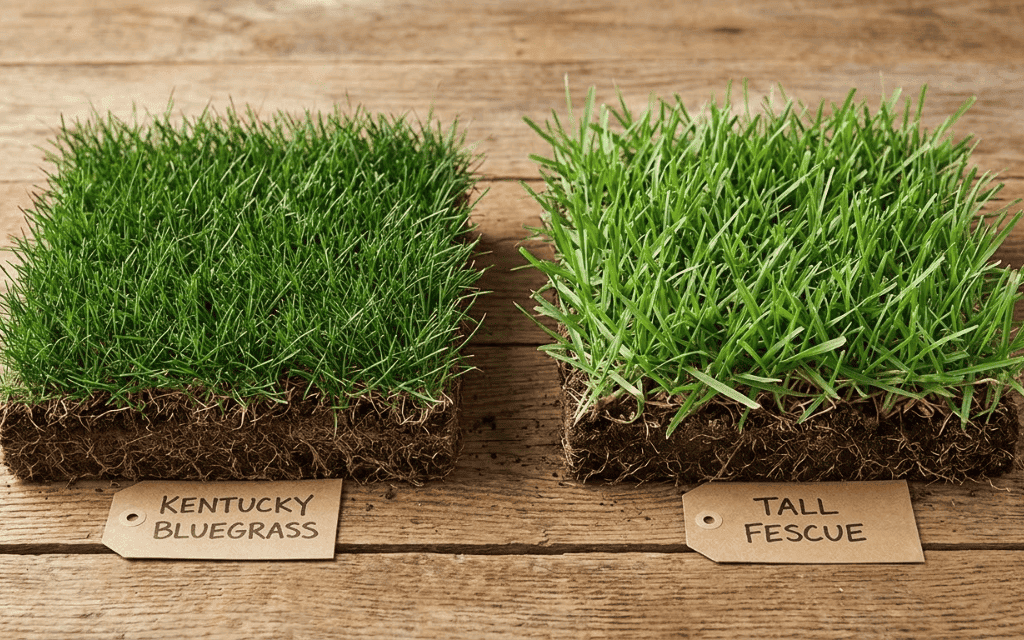
Kentucky bluegrass and texas hybrid bluegrass
Kentucky bluegrass is Denver’s standard lawn grass. NC State’s 2026 grower survey puts its on-farm average at $0.50 per square foot. Colorado retail rolls sell for $1.25 per square foot at Rivendell Distribution.
Texas hybrid bluegrass sells for 1.56–1.66 per square foot at retail. Breeders cross it for summer heat tolerance.
Tall fescue and fine fescue
Rhizomatous tall fescue (RTF) builds deep roots and handles drought better than bluegrass. Its on-farm average is $0.48 per square foot. Fine fescue suits shaded yards and sells for $1.66 per square foot at Colorado retail.
Compare the two in our guide to Kentucky bluegrass vs. tall fescue.
Water-wise warm-season options for colorado
Tahoma 31 bermudagrass uses 60% to 70% less water than bluegrass, according to Aurora Water. Bermuda sod averages $0.41 per square foot on-farm. It turns tan in winter dormancy.
Buffalograss ships as plugs, not sod. Price it per plug tray instead of per square foot.
How much is a pallet or roll of sod?
A pallet of sod costs 110–450 and covers 400–700 square feet (37–65 m²). Grass type, farm, and pallet size set the final price.
Pallet sizes vary, so compare price per square foot
Farms cut different pallet sizes. Sod Solutions lists 399, 452, and 503 square foot pallets, while Siouxland Sod sells 500, 600, and 700 square foot pallets.
Divide each pallet price by its coverage before you compare suppliers. Some farms also charge a refundable pallet deposit, such as $40 at Circle M Landscape.
Big rolls versus small rolls
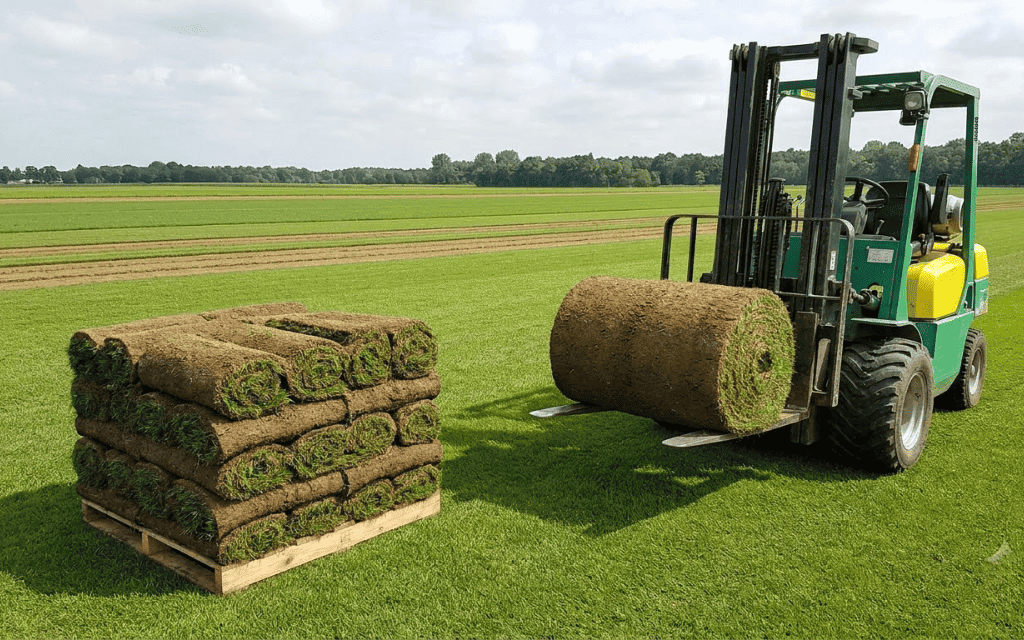
Small rolls cover about 10 square feet (0.9 m²) and cost 3–8 each. Big rolls cover more ground with fewer seams. Green Valley Turf in Littleton harvests big rolls 4 by 80 feet (1.2 by 24 m) and needs 8 feet (2.4 m) of access to place them.
Farm versus big-box store pricing
Big-box stores charge more per square foot. Home Depot lists a 500 square foot fescue pallet at $549, about $1.10 per square foot. Farm averages sit near 0.48–0.50.
Installed sod cost by yard size
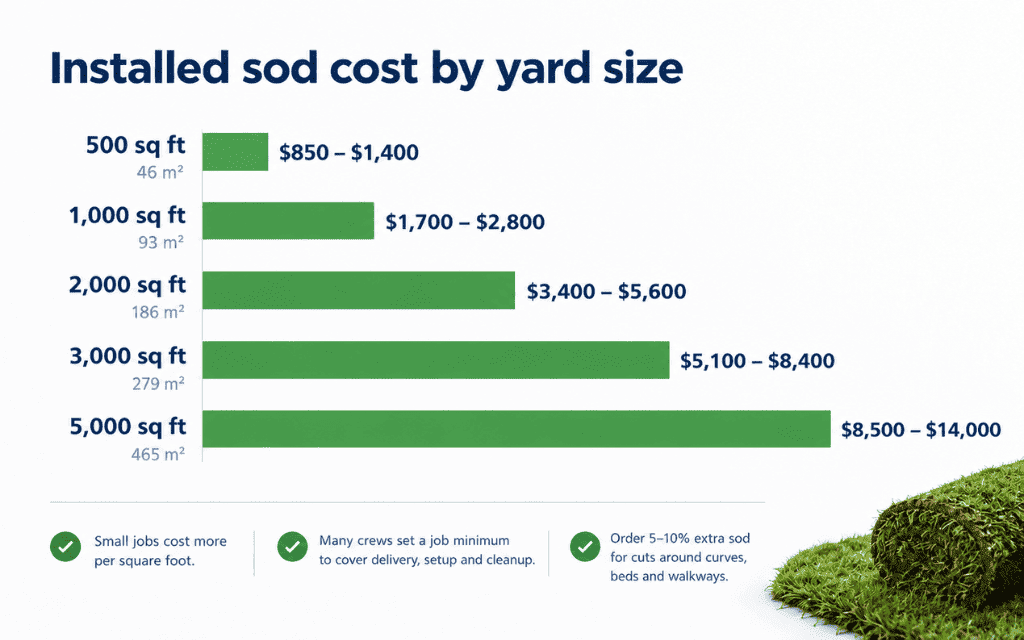
To estimate your total, multiply lawn area by the installed rate. This table uses the 1.70–2.80 per square foot Denver range.
| Lawn size | Metric area | Installed cost estimate |
| 500 sq ft | 46 m² | 850–1,400 |
| 1,000 sq ft | 93 m² | 1,700–2,800 |
| 2,000 sq ft | 186 m² | 3,400–5,600 |
| 3,000 sq ft | 279 m² | 5,100–8,400 |
| 5,000 sq ft | 465 m² | 8,500–14,000 |
Small jobs cost more per square foot. Many crews set a job minimum to cover delivery, setup, and cleanup. Order 5–10% extra sod for cuts around curves, beds, and walkways.
What drives your sod installation price
Seven factors move a sod quote: labor, tear-out, soil prep, grading, access, delivery, and irrigation. Prep items vary most from yard to yard.
Labor
Sod installation labor runs 0.35–1.00 per square foot (3.75–10.75 per m²), or about 37–78 per hour. Crews bill per square foot for full yards and hourly for small or complex areas. The rate covers laying the rolls, tight seams, and the first watering. Slopes, heavy cutting, and peak spring demand push labor toward the top of that range.
Old lawn removal: The cost to re-sod a yard
Re-sodding starts with stripping the old turf. Removal with a sod cutter, hauling, and disposal costs 0.50–2.00 per square foot. New sod needs bare soil to root, so it can’t go over an existing lawn.
Soil prep for colorado clay
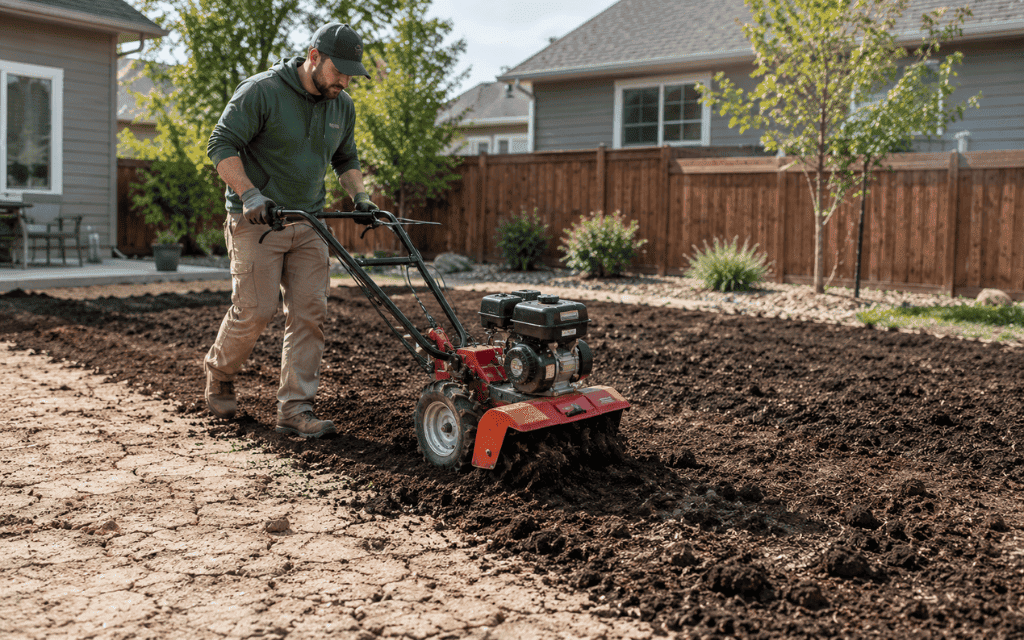
CSU Extension recommends 3–5 cubic yards of compost or other organic matter per 1,000 square feet, tilled 6–8 inches (15–20 cm) deep. That equals 2.3–3.8 m³ per 93 m².
At 45–75 per cubic yard for compost blends in Denver, material alone runs 135–375 per 1,000 square feet. Test your soil first, and use our guide to how much topsoil you need.
Grading and drainage
Grading slopes water away from your foundation and removes low spots where water pools. Grading and leveling add 0.40–2.00 per square foot (4.30–21.50 per m²), from hand raking at the low end to skid-steer regrading at the high end.
Access, slopes, and carry-in fees
Narrow gates and slopes add hand labor because crews must carry sod in instead of using a forklift. Green Valley Turf charges a 0.60 per square foot (6.45 per m²) carry-in fee where access is under 8 feet (2.4 m). Curved beds, trees, and play sets add another 15–20%, since each obstacle means more cuts and more waste.
Delivery fees and minimums
Sod delivery runs 55–230 per load, depending on distance, order size, and supplier policy. Some farms waive the fee on orders over 1,000 square feet (93 m²), while others require 2–6 pallets before they deliver. Ask about refundable pallet deposits and fuel surcharges, and schedule delivery for the morning you install, because sod heats up on the pallet.
Irrigation readiness
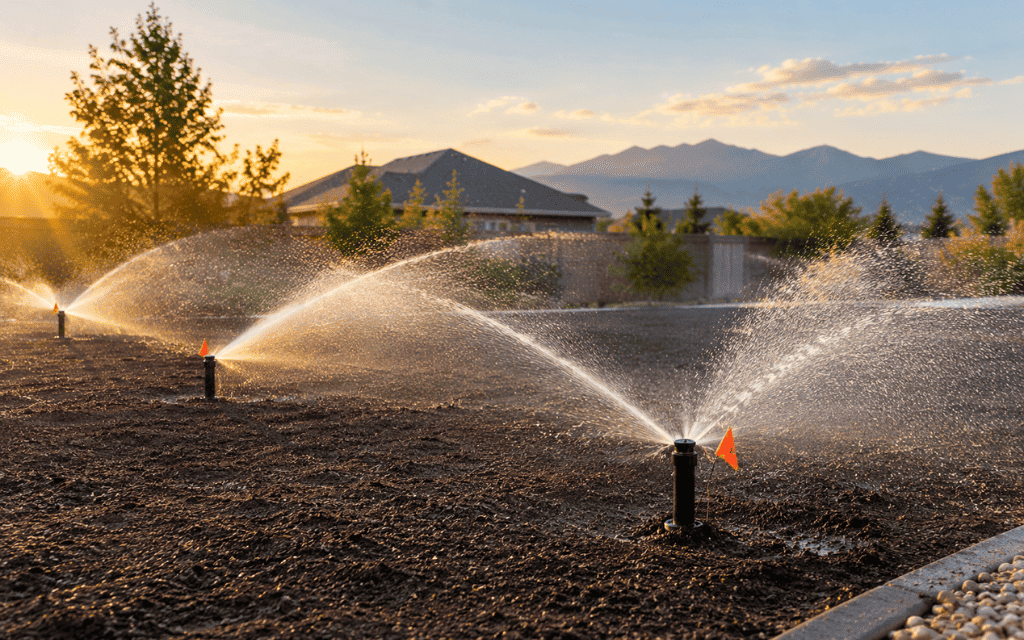
New sod dies first where sprinklers miss, so check head-to-head coverage and repair broken heads before you install. CSU Extension advises keeping new sod and the soil under it moist, not soggy, until roots knit in after 2–3 weeks. Denver Water still allows attended testing and repair during the 2026 ban, so our sprinkler installation team can audit or add zones now.
2026 Denver watering rules: How they affect sod cost and timing
Your water provider now decides when you can install sod. Denver Water and Aurora Water both restrict new turf in 2026.
Denver water’s lawn-watering ban
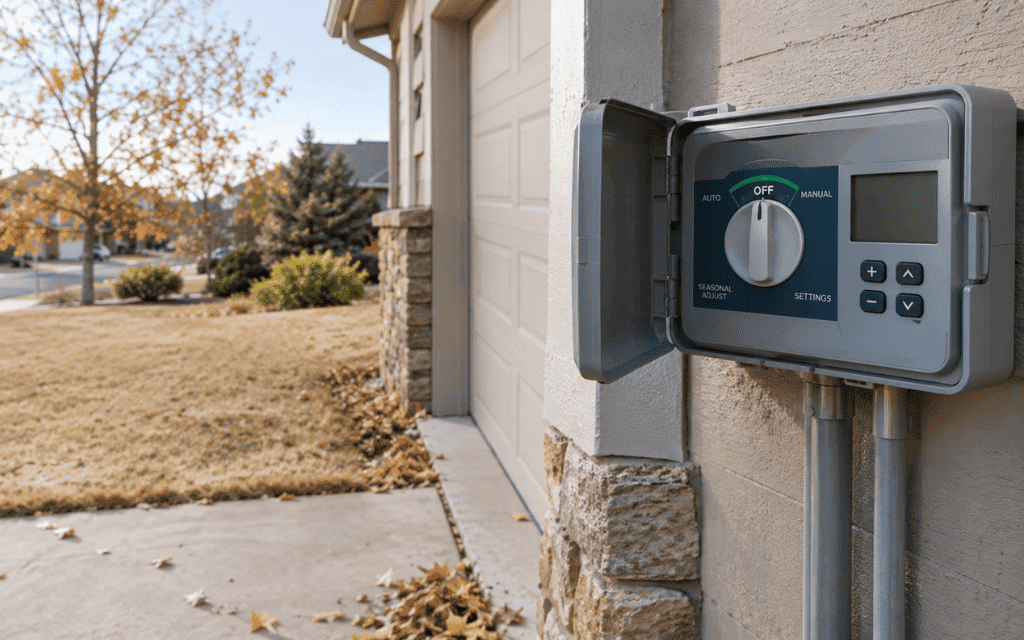
Starting October 1, 2026, Denver Water bans lawn watering and spray irrigation. It issues no watering exemptions for new turf, and grass establishment requires an approved variance.
Fines for single-family homes start at $500, then rise to $1,000, then $1,000 plus water shut-off. The ban lasts until the Board of Water Commissioners votes to lift it, so sprinklers may stay off in spring 2027.
Watering establishment permits
Before the ban, Denver Water let new sod water outside assigned days for up to 3 weeks under a Watering Establishment Permit. Normal rates and drought pricing still applied. Watch for the permit’s return before you book a 2027 install.
Aurora and other water providers
Aurora banned new cool-season turf, including Kentucky bluegrass and fescue, by ordinance on September 28, 2026. Rules follow your water provider, not your city name. Check your water bill before you buy sod.
First-month water cost
New sod needs about 600–900 gallons per 1,000 square feet per week (2,270–3,400 liters per 93 m²) during establishment, by HomeGPT’s estimate. Budget for drought pricing on that water.
What to do now
Use the off-season to plan. Measure the lawn, test the soil, fix grading, and repair sprinklers. Book sod once your provider allows establishment watering.
Sod vs. seed vs. water-wise alternatives: Cost comparison
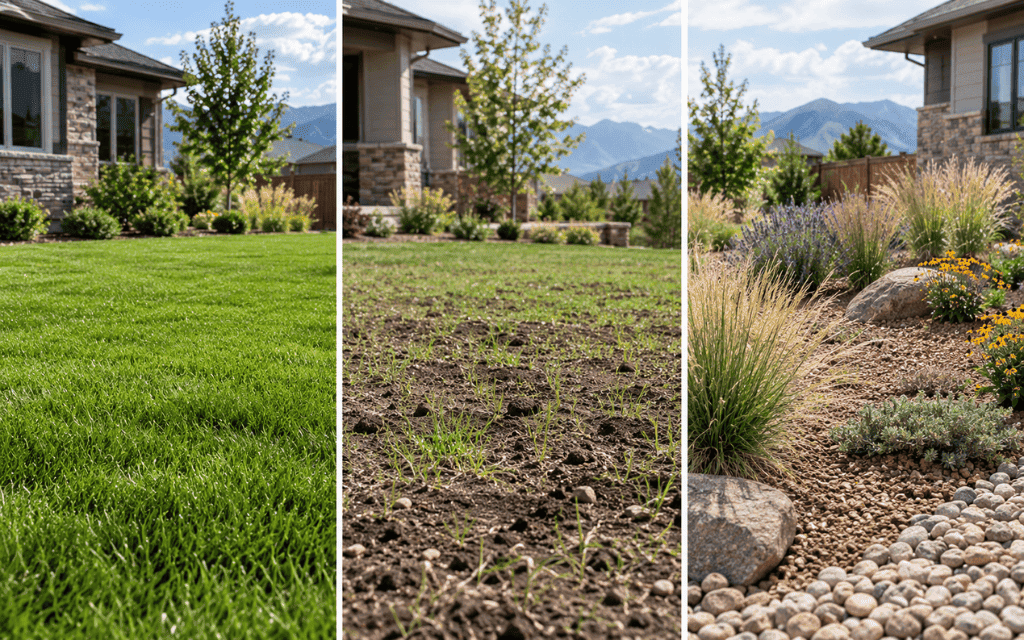
Sod buys speed, not savings. Seed costs less but takes months to fill in.
| Option | Upfront cost per sq ft | Time to usable lawn | Water demand |
| Sod | 1.00–2.60 installed | 2–3 weeks | High while rooting |
| Seed | 0.09–0.19 DIY | Several months | High while sprouting |
| Water-wise sod (RTF, Tahoma 31) | Similar to sod | 2–3 weeks | Lower once rooted |
| Xeriscape | Higher than sod | Immediate | Low |
If your lawn is thin but alive, aeration and overseeding costs less than replacement. If you want to cut water use for good, review our xeriscape landscaping service and xeriscape cost guide.
DIY vs. professional sod installation in Denver
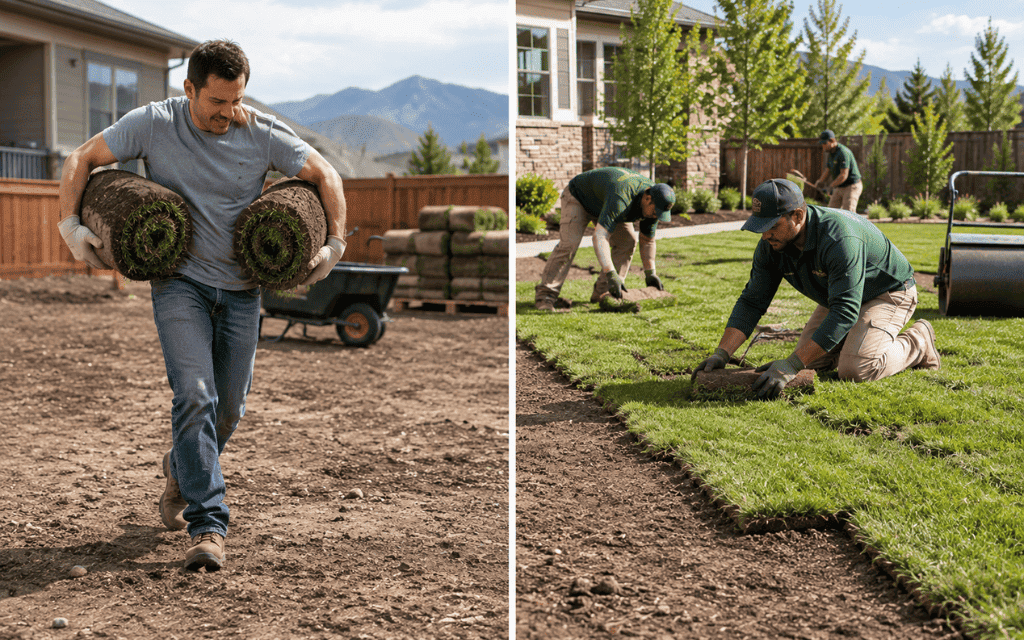
DIY removes the labor line of 0.35–1.00 per square foot. It adds 5 costs of its own:
- Equipment rental: Sod cutters rent for 75–125 per day.
- Delivery: Most farms charge per load unless you own a rated truck.
- Heavy lifting: One pallet weighs 1,500–3,000 lb (680–1,360 kg).
- Tight timing: Sod must go down within 24 hours of delivery.
- Re-do risk: Gaps and poor grading cause dry edges and dead strips.
DIY suits flat yards under 1,000 square feet with open access. Hire a crew for slopes, clay, drainage issues, or larger lawns.
How to lower your sod cost without risking the lawn
You can trim the budget in 5 places without cutting prep:
- Strip the old lawn yourself with a rented sod cutter.
- Buy farm-direct instead of from a big-box store.
- Sod the front yard and seed or xeriscape the back.
- Choose grass for your site so you never pay to replace it.
- Measure twice and order only 5–10% extra.
Mile High Lifescape sod installation service in Denver
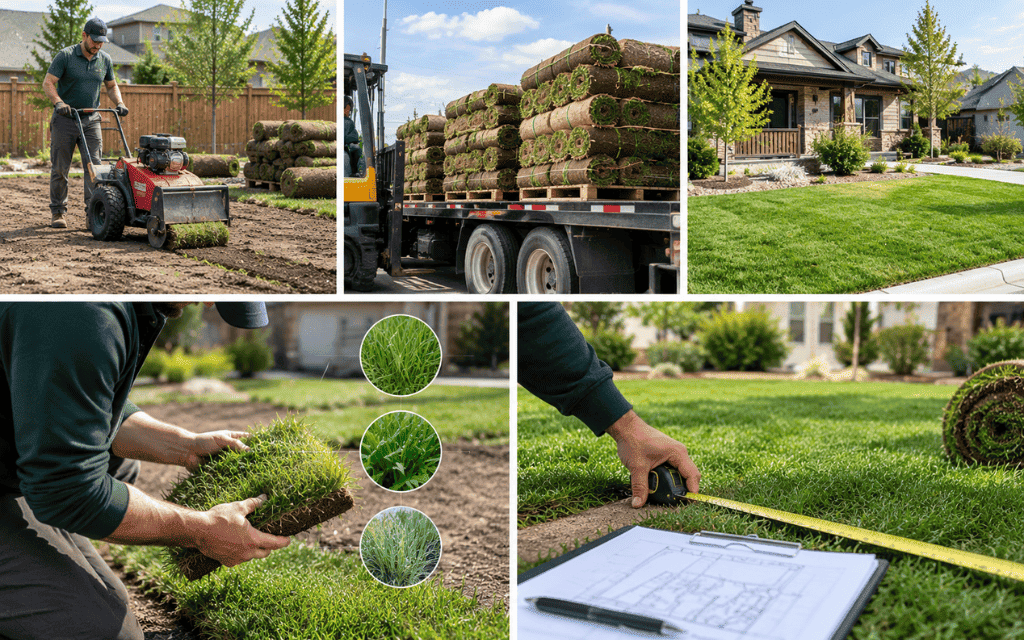
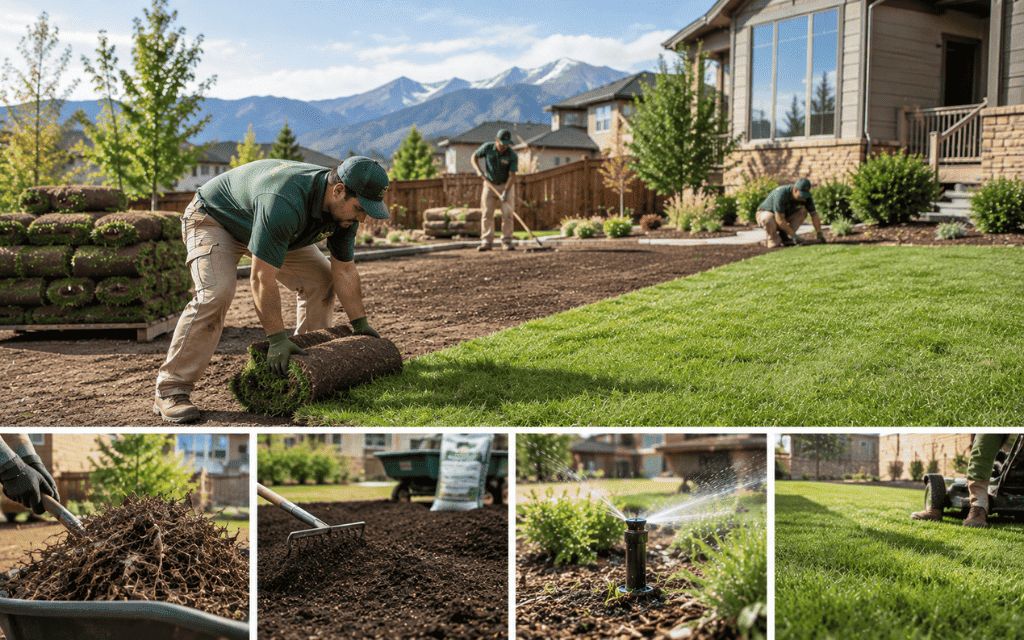
Mile High Lifescape provides Sod Installation across Denver Metro, including Lakewood, Littleton, Centennial, Broomfield, Thornton, Westminster, and Highlands Ranch. With over 20 years of experience, our crews handle each stage of a new lawn:
- Site preparation: We remove old plants, rocks, and debris.
- Soil enhancement: We add organic matter and fertilizer.
- Irrigation: We install or adjust sprinkler zones.
- Aftercare: We guide your watering, mowing, and lawn care.
We also time each install to your water provider’s current rules. To learn how much does sod cost for your exact yard, call (303) 877-9091 or request a free, itemized quote.
Frequently asked questions about sod cost
How much is a pallet of sod?
A pallet of sod costs 110–450 and covers 400–700 square feet (37–65 m²). Divide the price by coverage to compare farms.
How much does it cost to sod 1,000 square feet?
Sodding 1,000 square feet (93 m²) costs about 1,700–2,800 installed in Denver. Material alone runs 300–850 nationally.
How much does it cost to re-sod a yard?
Re-sodding adds 0.50–2.00 per square foot for old turf removal. Grading and compost add more on clay soil.
Is it cheaper to lay sod yourself?
Yes, DIY saves 0.35–1.00 per square foot in labor. Rentals, delivery, and redo risk cut into those savings.
Can I install sod in Denver this fall or winter?
No, not without a variance for Denver Water customers. The October 1, 2026, ban blocks new grass establishment until the board lifts it.
Is sod cheaper than seed?
No, seed costs 0.09–0.19 per square foot versus 1.00–2.60 for installed sod. Sod gives a usable lawn in 2–3 weeks.
How much does sod cost for my specific yard?
Your price depends on lawn size, grass type, and prep scope, because tear-out, grading, and compost can double a quote. For an itemized estimate, call Mile High Lifescape at (303) 877-9091.