When a mature shade tree starts losing branches or leafing out sparsely, the question that comes up almost every time is: can trees die of old age? The instinct is to assume that a tree, like a person, simply wears out after enough decades. That assumption does not hold up under closer inspection of how trees actually function. The real answer lies in how a tree ages at the cellular level, and understanding it changes how you should respond when a mature tree starts to struggle.
Do trees actually die of old age
Arborists and plant scientists rarely list age itself as a cause of tree death. Unlike animal cells, which lose the ability to divide effectively over time, tree cells at the growing points keep their regenerative capacity for the entire life of the plant. A tree that has stood for two hundred years still produces new leaves, new root tips, and new wood every growing season, using largely the same cellular processes it relied on as a young sapling decades earlier.
So does age play any role at all? Indirectly, yes. Older trees have simply had more time to accumulate storm damage, insect entry points, and root disturbances. Each wound heals more slowly than it would on a younger, more vigorous tree, and the backlog of unresolved damage eventually overwhelms the tree’s ability to compensate. Over enough seasons, that backlog becomes the real threat. The tree dies from that accumulated damage, not from a number attached to its age.
What is tree senescence
Tree senescence is the term arborists use for the gradual decline in a tree’s physiological efficiency as it matures. Growth slows, wound closure takes longer, and dead or decaying heartwood makes up a larger share of the trunk over time.
A senescent tree still photosynthesizes, still grows new leaves and roots, and still responds to the seasons. It just does these things at a reduced rate. That drop in efficiency weakens the tree’s defenses against pests, wounds, and drought, which is what actually raises its risk of dying.
Why trees age differently than humans and animals
Human and animal cells have a limited number of times they can divide before losing function. Trees work differently. Growth happens at specialized regions called meristems, found at the tips of roots and shoots and within the vascular cambium, a thin layer just beneath the bark. These cells stay functionally youthful for as long as the tree survives.
This is why a tree can be hundreds of years old and still grow new branches, flowers, and roots each season. The vascular cambium lays down a fresh ring of wood every year, building living tissue over the old growth at the tree’s core. That old wood becomes structurally important for support, even though it is no longer biologically active, while the outer layers keep functioning much as they did decades earlier.
Common causes of tree death
Rather than age, most trees that die do so from an identifiable external cause. The list below outlines the primary factors behind tree mortality and how each one takes hold once a tree’s natural defenses are compromised by prior damage or prolonged stress.
- Disease: Fungal and bacterial pathogens exploit existing wounds and weakened tissue, spreading through the vascular system and disrupting water and nutrient flow.
- Insect infestation: Bark beetles, borers, and similar pests tunnel into weakened wood, damaging nutrient transport and opening the door to secondary infections.
- Drought: Extended dry periods deplete a tree’s stored carbohydrates and water reserves, eventually pushing it into dormancy or outright failure.
- Structural damage: Storms, construction activity, and mechanical injury create wounds that older, slower-growing trees cannot close as quickly, leaving them exposed to decay.
- Root and soil problems: Compacted soil, poor drainage, and root rot cut off oxygen and water to the roots, often with no visible symptoms until the tree fails.
- Extreme weather: High winds, ice accumulation, and lightning strikes cause sudden, severe damage that a tree cannot recover from regardless of its age.
How to tell natural aging from unhealthy decline
Distinguishing ordinary maturity from a genuine health problem requires a closer look at growth patterns, bark condition, and canopy density. The comparison below highlights the clearest differences between the two.
| Natural aging | Unhealthy decline |
| Gradual slowing of height and trunk growth | Sudden dieback concentrated in the upper canopy |
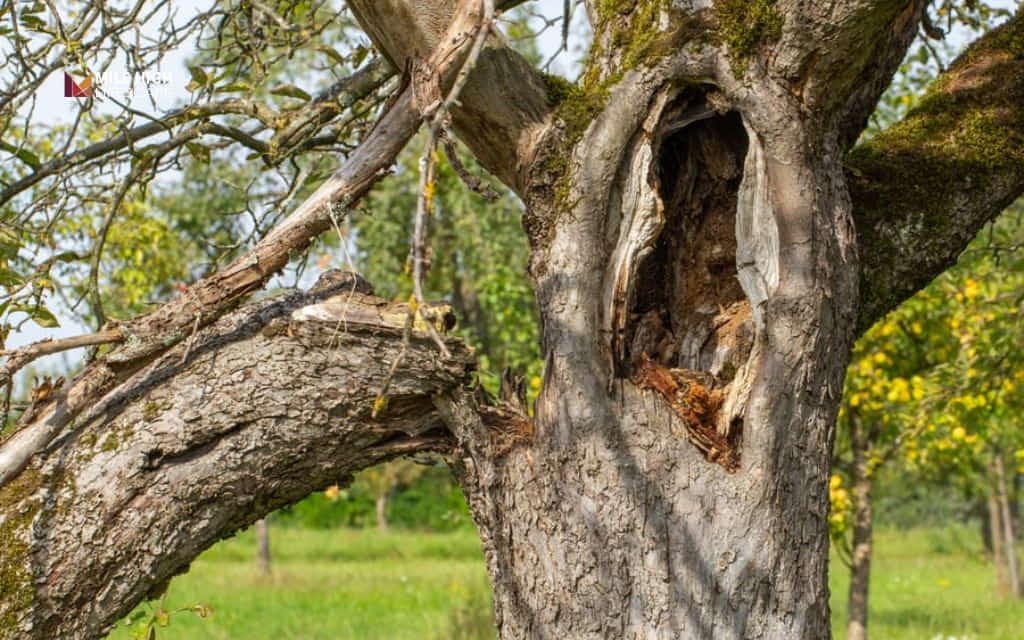
| Thicker bark and slower wound closure | Cracked, peeling bark or visible cavities |
| Reduced but consistent leaf production | Sparse, undersized, or discolored leaves |
| Deep, well-established root system | Mushrooms or fungal growth near the base or roots |
| Steady seasonal flowering or fruiting | Erratic or absent flowering across seasons |
How proper care extends a tree’s lifespan
Consistent maintenance narrows the gap between a tree’s biological potential and its actual lifespan by slowing the compounding damage that senescence makes harder to recover from.
- Pruning: Removing dead, damaged, or crossing branches reduces entry points for disease and redirects the tree’s energy toward healthy growth.
- Soil care: Aerating compacted soil and correcting drainage issues keeps roots supplied with the oxygen and water they need to stay resilient.
- Regular inspections: Identifying early signs of decay, pest activity, or structural weakness allows treatment while the problem is still manageable.
- Fertilization and mulching: Keeping nutrient and moisture levels steady reduces the physiological stress that opens the door to pests and disease.
None of these practices stop a tree from aging. What they do is reduce the frequency and severity of the damage that actually causes death. A well-maintained mature tree routinely outlives a neglected tree of the same species by decades, simply because it enters every storm, drought, and pest cycle in stronger condition.
Signs your tree needs a professional evaluation
Certain warning signs call for an ISA Certified Arborist rather than a wait-and-see approach. By the time signs like these appear, the real question is no longer can a tree die of old age, but whether professional care can still turn the decline around.
- Canopy dieback: Dead branches concentrated in the upper crown often point to root or vascular damage below ground.
- Trunk cavities or cracks: Visible splits or hollow sections compromise structural integrity and raise the risk of failure.
- Leaning or root plate movement: A tree that shifts position after a wind event may have a compromised root system that no longer anchors it securely.
- Fungal growth at the base: Mushrooms or conks emerging from the trunk or root flare typically indicate internal decay that is already well underway.
Conclusion
Can trees die of old age on their own? Rarely, since what actually shortens a mature tree’s lifespan is the buildup of disease, pest pressure, structural damage, and environmental stress that it recovers from more slowly than a younger tree would.
If a mature tree on your property in the Denver Metro area is showing signs of stress, Mile High Lifescape can help assess its condition and identify potential safety concerns. Our Tree Branch Removal Services can safely remove dead, weakened, or damaged limbs that may place additional stress on an aging tree or create hazards around your property.
Call (303) 877-9091 to schedule an evaluation and get a clear read on what your tree actually needs.
Frequently asked questions (FAQs)
Can trees die of old age?
Not in the way people or animals do. Trees rarely die simply because they reached a certain age. Death almost always traces back to disease, pests, structural failure, or environmental stress that becomes harder to recover from as a tree matures.
Do trees die of old age at a predictable point?
No. There is no fixed age at which a tree’s biology shuts down, and no species-wide deadline that guarantees death. Individual trees within the same species can live far longer or shorter than average depending on care, environment, and exposure to damage over their lifetime.
Does age make a tree more likely to die?
Age itself does not kill a tree, but older trees accumulate more wounds, more decay, and more cumulative stress over time, all of which raise their vulnerability to the actual causes of death.
Can neglect cause a tree to die faster than natural aging would?
A neglected tree is more likely to succumb to compounding issues like decay, pest infestation, and structural failure as it matures, though the underlying cause of death remains something other than age on its own.
What is the fastest way to check if a mature tree is healthy?
Look at canopy density, bark condition, and the base of the trunk. Thinning leaves, cracked bark, or fungal growth at the root flare are the clearest signs that a professional inspection is warranted.