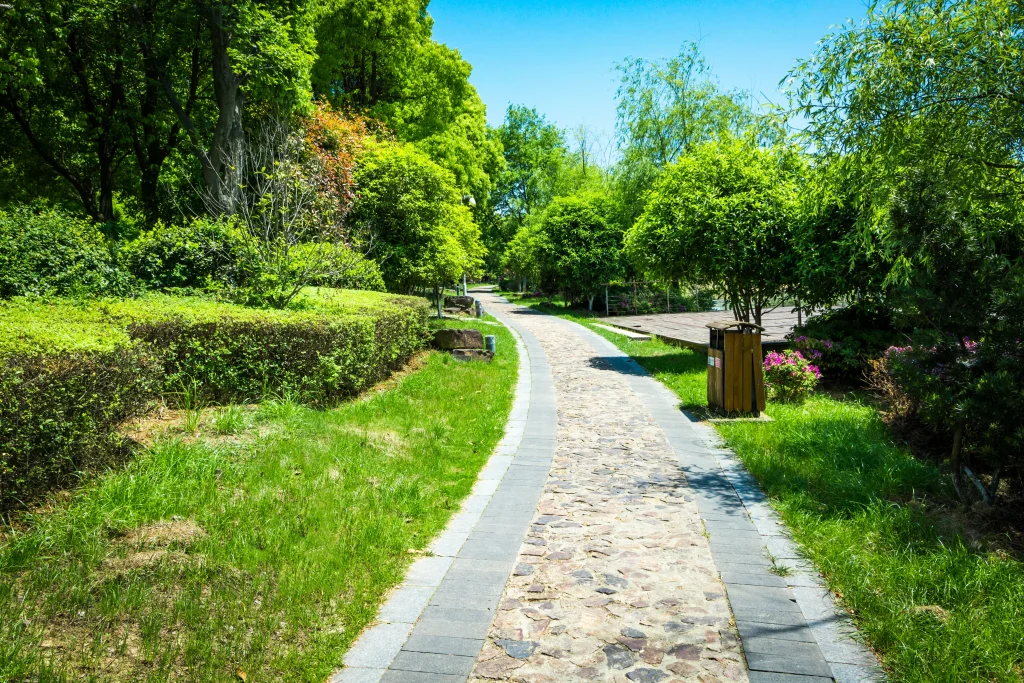
When done right, landscaping with small rocks creates a clean, modern, low-maintenance garden in Denver. Instead of fighting against our semi-arid climate, smart Denver homeowners are turning to small-rock gardens that actually thrive in our conditions.
This guide will walk you through everything you need to know:
- Best types of small rock for Denver’s climate and your specific needs
- 10 proven small-rock garden designs that work in both front and backyard spaces
- Proper installation techniques including depth requirements, edging strategies, and weed prevention
- Common mistakes that cause rock migration, weed invasions, and that “unfinished” look
Whether you’re converting a tired lawn patch, filling in that awkward side yard, or adding visual interest to your backyard, you’ll find practical solutions that actually work.
Common small rock types (by size)
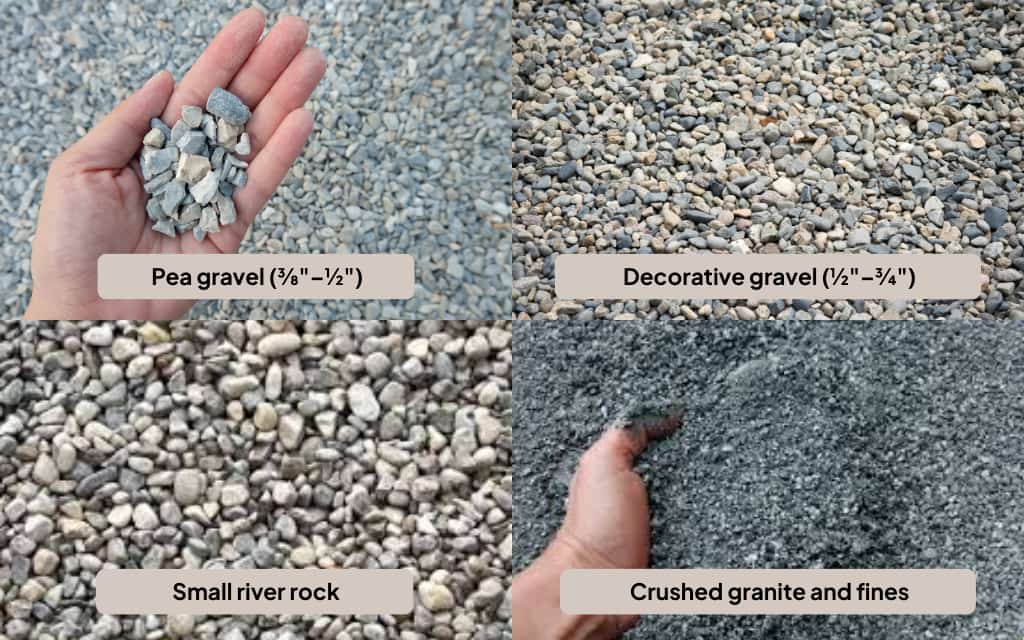
Understanding your options makes all the difference when you landscape with small rocks. Here’s what you’ll find at Denver-area suppliers, organized by size:
Pea gravel (⅜”–½”)
The smallest option, pea gravel features smooth, rounded stones about the size of peas. It’s affordable and creates a soft, walkable surface.
The smooth texture is comfortable underfoot, making it popular for pathways and play areas. However, its light weight means it can shift in our winds, especially when applied too thin.
Decorative gravel (½”–¾”)
This size hits the sweet spot for many small rock gardens. Larger than pea gravel but still fine enough to create a smooth appearance, decorative gravel comes in various colors including buff, red, and tan. It stays put better than pea gravel while still allowing for easy plant installation.
Small river rock (¾”–1½”)
These naturally rounded stones offer a more substantial presence without overwhelming small spaces. River rock creates beautiful texture and catches light beautifully throughout the day.
The larger size means less migration in wind, and they’re excellent around plants since they won’t compact soil as tightly.
Crushed granite and fines
Unlike rounded rocks, crushed granite has angular edges that lock together, creating a stable surface that resists movement. When compacted properly, crushed granite with fines (the dusty particles) forms an almost solid surface.
This makes it ideal for pathways and slopes where you need maximum stability. It’s widely available in Denver at similar prices to decorative gravel.
Choosing the right small rock for Denver conditions
Sun, heat, and wind reality check
Denver gets over 300 days of sunshine annually, and at 5,280 feet elevation, UV intensity is about 25% higher than at sea level. This matters tremendously when you landscape with small rocks.
Light vs. dark stone heat reflection
Light-colored rocks (buff, tan, white river rock) reflect more sunlight and stay cooler, making them ideal next to your home’s foundation or around heat-sensitive plants. Dark rocks (black lava rock, dark river rock) absorb heat and can raise soil temperatures by 10-15°F on hot days. While this can benefit some heat-loving plants, it can stress others and make adjacent patios uncomfortably hot.
Why tiny gravel blows and migrates
Here’s what separates successful small rock gardens from frustrating ones: anything smaller than ⅜” is prone to Denver’s wind issues.
During our spring winds, lightweight pea gravel can migrate across your yard, end up in neighbors’ yards, or collect in corners. If you love the look of very small gravel, plan to install it at least 3″ deep with solid edging, or choose slightly larger decorative gravel instead.
For wind-prone areas, prioritize these strategies:
- Use decorative gravel or small river rock (½” minimum)
- Install metal or concrete edging that rises at least 2″ above rock surface
- Consider crushed granite in high-wind zones; its angular shape locks together
- Avoid pea gravel in exposed areas unless you’re prepared for seasonal maintenance
Drainage and soil considerations
Most Denver yards share one challenge: heavy clay soil that drains poorly and expands/contracts through freeze-thaw cycles. This is where landscaping with small rocks becomes a real advantage.
Clay soil benefits from gravel layers
Small rocks improve drainage in two ways:
- First, they create air space above clay, allowing water to evaporate rather than pooling.
- Second, when you excavate and install rocks over landscape fabric, you’re essentially creating a permeable cap that prevents clay from compacting further.
For areas where water tends to collect, a 3-4″ layer of small river rock over a gravel base creates excellent drainage.
When crushed rock beats rounded rock
Rounded rocks (river rock, pea gravel) don’t compact well, which is fine for decorative beds but problematic for surfaces you’ll walk on. Crushed granite, decomposed granite, or crushed rock with fines compact into a stable, nearly solid surface.
Use crushed materials for:
- Garden pathways where you want firm footing
- Gently sloped areas where you need stability
- Transition zones between different landscape materials
- Under river rock as a base layer (crushed rock bottom, decorative rock top)
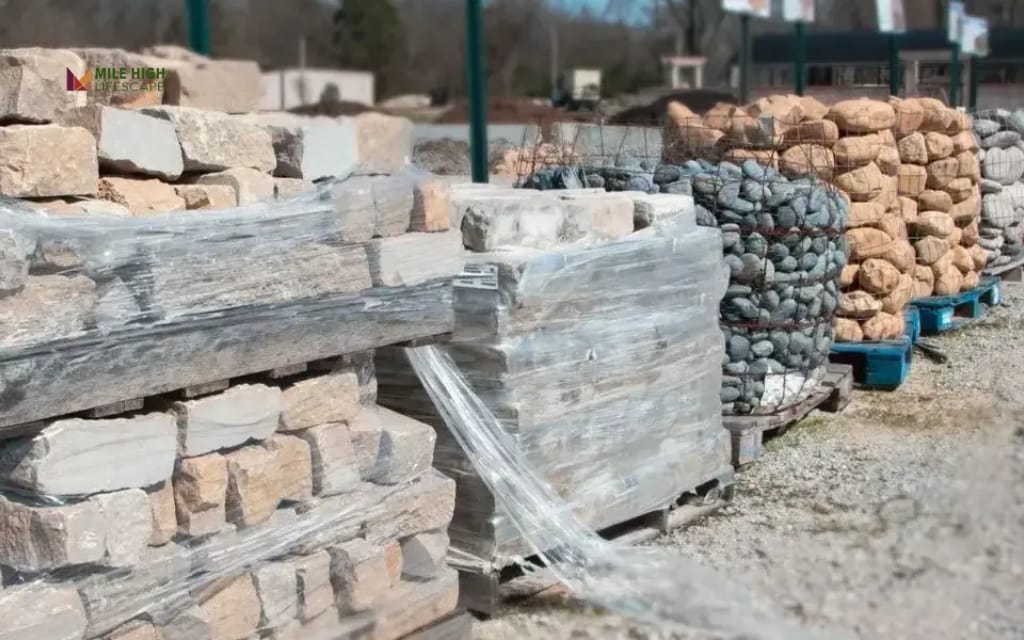
Where to use (and not use) small rocks
Best uses:
- Small garden beds: Perfect for those 3’x6′ beds flanking your front door or corner beds in the backyard. Small rocks provide clean definition, suppress weeds, and reduce water loss through evaporation – critical when you’re trying to establish native plants or shrubs.
- Paths and transitions: Creating visual flow between lawn and hardscape, or connecting patio to garden beds, small rocks form natural-looking pathways that feel intentional. Crushed granite pathways through a backyard rock garden provide stable walking surfaces that look organic.
- Courtyards and side yards: These often-neglected spaces shine with small rock landscaping. Side yards become elegant pass-through galleries with river rock, architectural plants, and good lighting. Interior courtyards gain a modern, resort-like feel with decorative gravel and carefully placed boulders.
Avoid:
- Steep slopes without stabilization: On slopes greater than 15%, small rocks will migrate downhill over time, especially after heavy rain or snowmelt. If you must use small rocks on slopes, install terracing, use crushed granite that compacts, or employ a grid system beneath the rock layer.
- High-traffic walking surfaces: While crushed granite works well for moderate foot traffic, loose pea gravel or decorative rock makes an unstable walking surface. For main pathways, choose flagstone, pavers, or crushed granite that compacts rather than loose small rocks.
Landscape with small rocks – 10 proven Denver designs
Small front yard rock garden with native plants
- Rock size: Pea gravel (⅜”–½”) or decorative gravel (½”–¾”)
- Maintenance level: Low
- Denver tip: This is the most popular small rock garden idea for Denver front yards
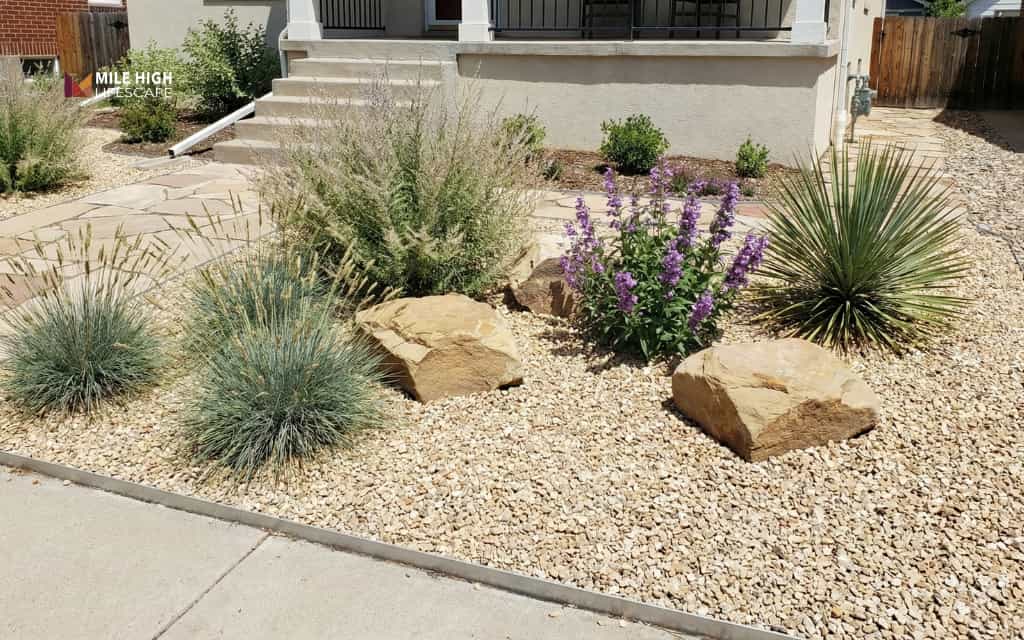
Replace that water-guzzling front lawn strip with buff or tan decorative gravel (3″ deep) punctuated with native plants: blue grama grass clumps, Apache plume, penstemon, and yucca.
Edge with metal or stone for clean lines. The result looks tended, meets water-wise landscaping goals, and requires maybe 15 minutes of maintenance monthly.
Choose light-colored gravel to keep heat down near your home’s foundation. Add 3-5 accent boulders (12″ – 24″) for vertical interest. This design passes muster with strict HOAs because it looks intentional and well-maintained, not like “you gave up on grass.”
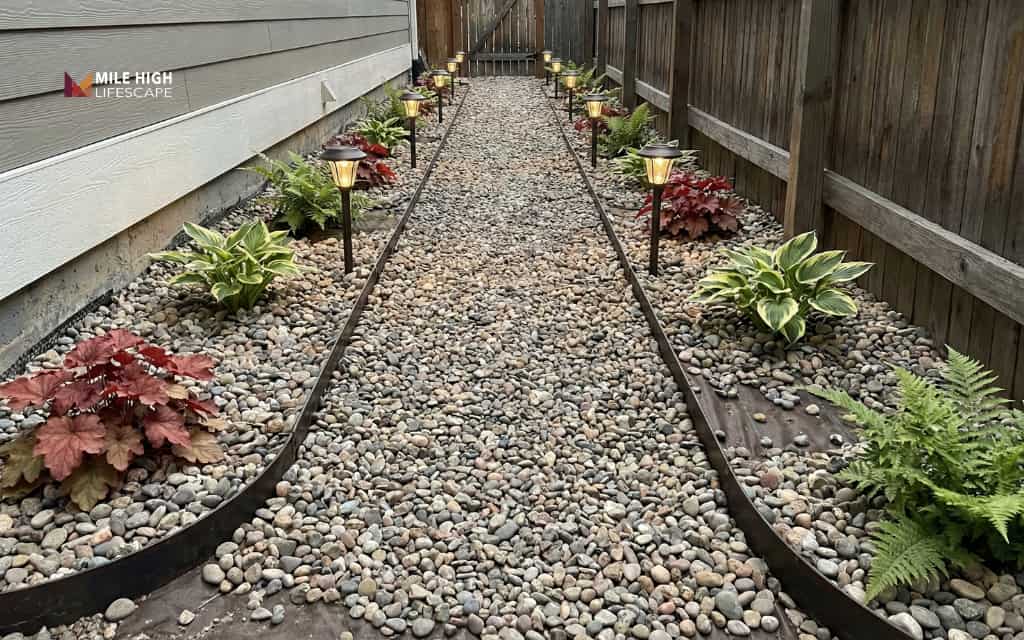
Tiny rock garden for side yards
- Rock size: Small river rock (¾”–1″) or decorative gravel (½”–¾”)
- Maintenance level: Very low
- Denver tip: This turns wasted space into an asset
Side yards are difficult – often shaded, narrow, and forgotten. A tiny rock garden solves this beautifully. Install quality landscape fabric, add 3″ of small river rock, and incorporate shade-tolerant plants at intervals (coral bells, hostas, ferns if you can keep moisture up).
The key is edging. Use metal landscape edging on both sides to contain the rock – side yards often act as wind tunnels, and without edging, you’ll find rock scattered everywhere.
Add solar path lights every 8-10 feet for nighttime navigation and visual interest.
Backyard rock garden with small river rock
- Rock size: Small river rock (¾”–1½”)
- Maintenance level: Low
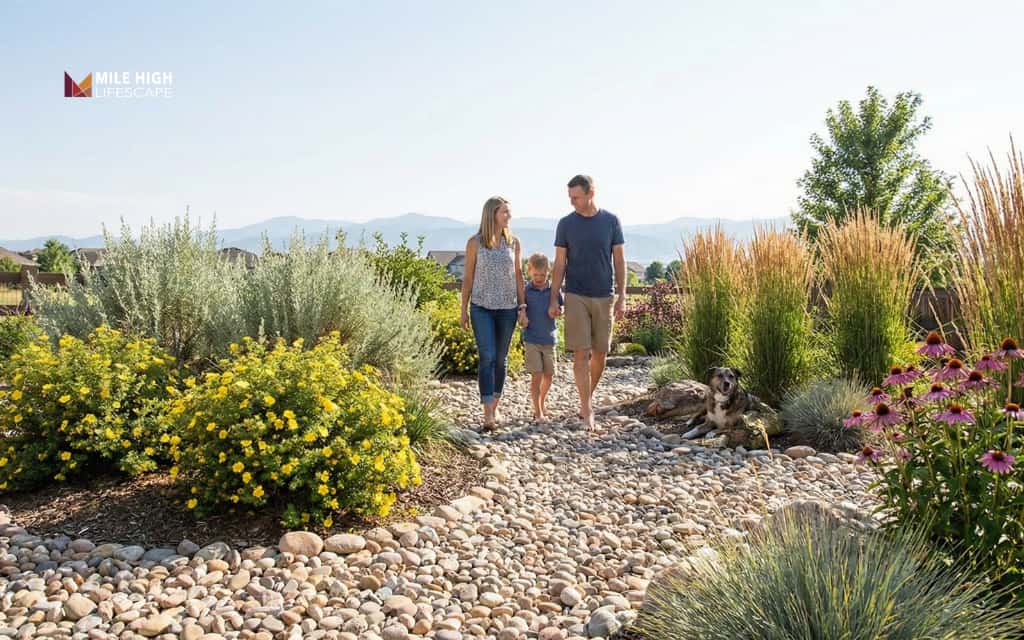
- Denver tip: Best backyard rock garden idea for families
Small river rock creates soft, rounded visual texture that works beautifully with shrubs (potentilla, rabbitbrush), ornamental grasses (blue oat grass, Karl Foerster), and perennials. The rounded stones are comfortable to walk on barefoot.
Design this as “islands” of rock between planted areas rather than one solid rock field. This prevents the heat-buildup issue and gives plants room to spread. Aim for 60% rock coverage, 40% planted areas. River rock in buff or mixed earth tones blends beautifully with Denver’s natural landscape.
Modern small rock garden with clean lines
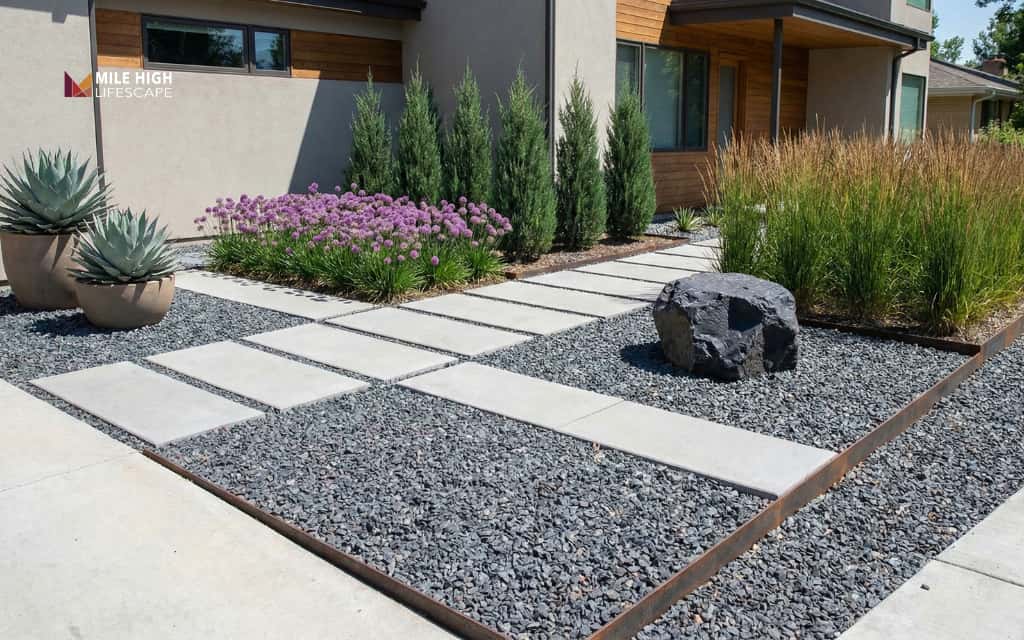
- Rock size: Crushed granite or angular decorative rock (½”–¾”)
- Maintenance level: Very low
- Denver tip: Perfect for modern builds in Stapleton, Lowry, or new developments
This design embraces architectural precision. Use crushed granite in white, gray, or black, install geometric metal edging, and select sculptural plants: agave (protect in winter), ornamental onion, vertical junipers, or single-species grass masses.
The angular nature of crushed granite contributes to the modern aesthetic and stays put better than rounded rock. Add concrete pavers as stepping stones or create a grid pattern. Accent with large specimen boulders in contrasting colors.
This style demands precision during installation, even small irregularities show, but the payoff is a striking, gallery-like space.
Small rock garden around a patio or deck
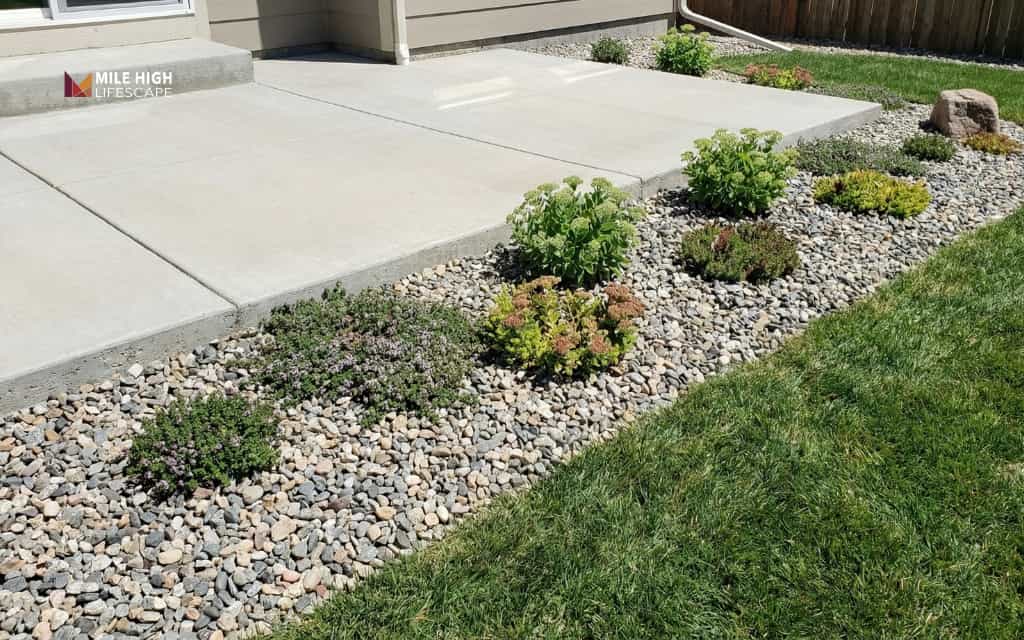
- Rock size: Decorative gravel (½”–¾”) or small river rock (¾”–1″)
- Maintenance level: Low
- Denver tip: Solves drainage issues common with Denver’s clay soil
That awkward transition between patio and lawn? Small rocks solve it elegantly. Install a 2-3 foot wide border of decorative gravel around your patio or deck.
This creates visual breathing room, prevents mud splatter during rainstorms, and provides excellent drainage – critical around concrete that can trap water against your home’s foundation.
Plant low groundcovers (creeping thyme, sedum) within the rock for softness, or keep it pure rock for ultra-low maintenance. This small rock garden design also reduces grass trimming time – no more edging tight against patio edges.
Rock garden small enough for townhomes
- Rock size: Mixed – decorative gravel base with river rock accents
- Maintenance level: Minimal
- Denver tip: When space is limited, every element must work hard
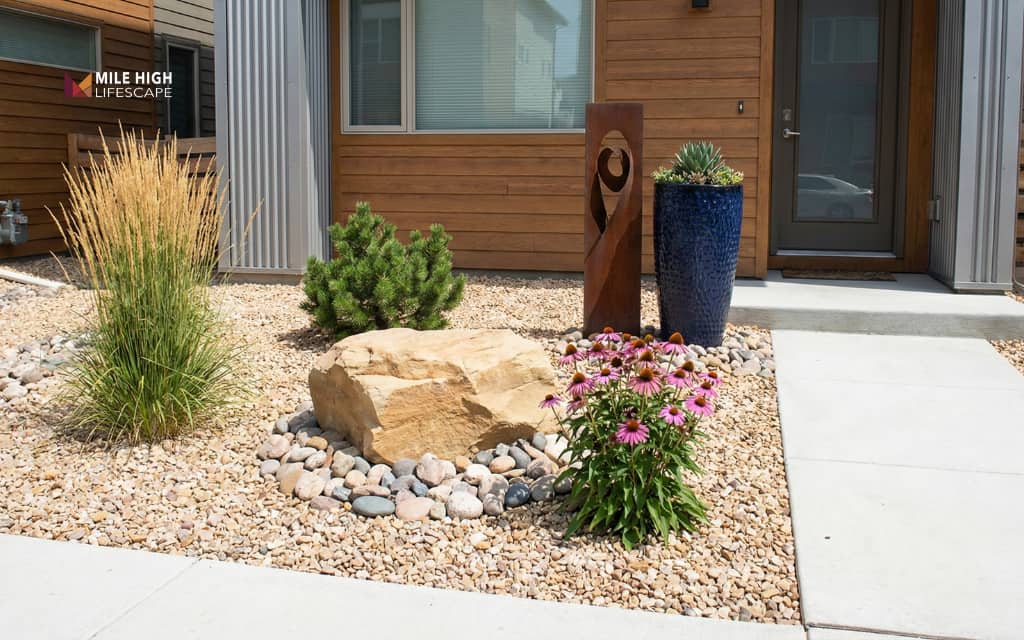
Townhome yards demand efficiency. Create a compact rock garden with a minimal plant palette – maybe 3 types maximum (one ornamental grass, one evergreen shrub, one seasonal perennial). Use primarily one rock type (buff decorative gravel) with a few accent rocks or one beautiful boulder as a focal point.
Install this in a prominent corner or along your front entry where it’s highly visible. The key is intentional restraint: better to have one perfect small rock garden than multiple half-finished ideas competing for attention. Add one or two dramatic elements like a ceramic pot, steel sculpture, or artistic edging.
Small rock garden designs for corners
- Rock size: Pea gravel (⅜”–½”) or decorative gravel (½”–¾”)
- Maintenance level: Low
- Denver tip: Curved shapes soften tight angles and make spaces feel larger
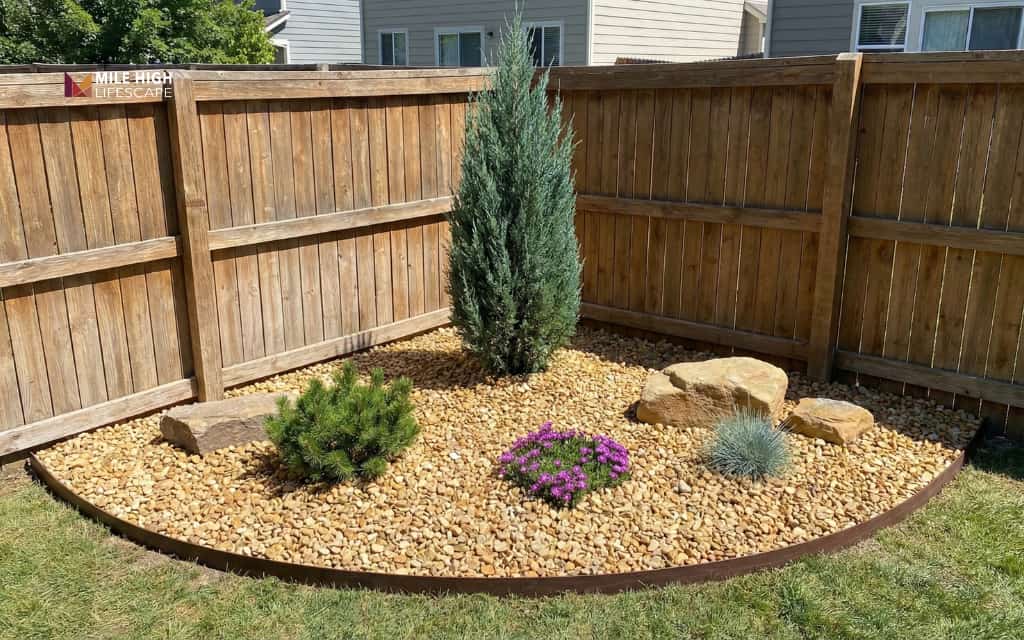
Corners feel awkward when left as grass because they’re hard to mow and often die out anyway. Small rock gardens with curved shapes transform these problem spots into intentional design features. Sweep the rock bed out from the corner in a gentle arc, using flexible metal edging to create smooth curves.
Plant the corner itself with a vertical element (upright juniper, dwarf spruce, or tall ornamental grass) to draw the eye up. Surround with decorative gravel and add 2-3 smaller plants at the curve’s outer edge.
This simple trick makes your entire yard feel more finished and professional.
Backyard ideas with rocks and groundcovers
- Rock size: Decorative gravel (½”–¾”) with exposed areas
- Maintenance level: Medium initially, low once established
- Denver tip: Combines rock durability with living texture
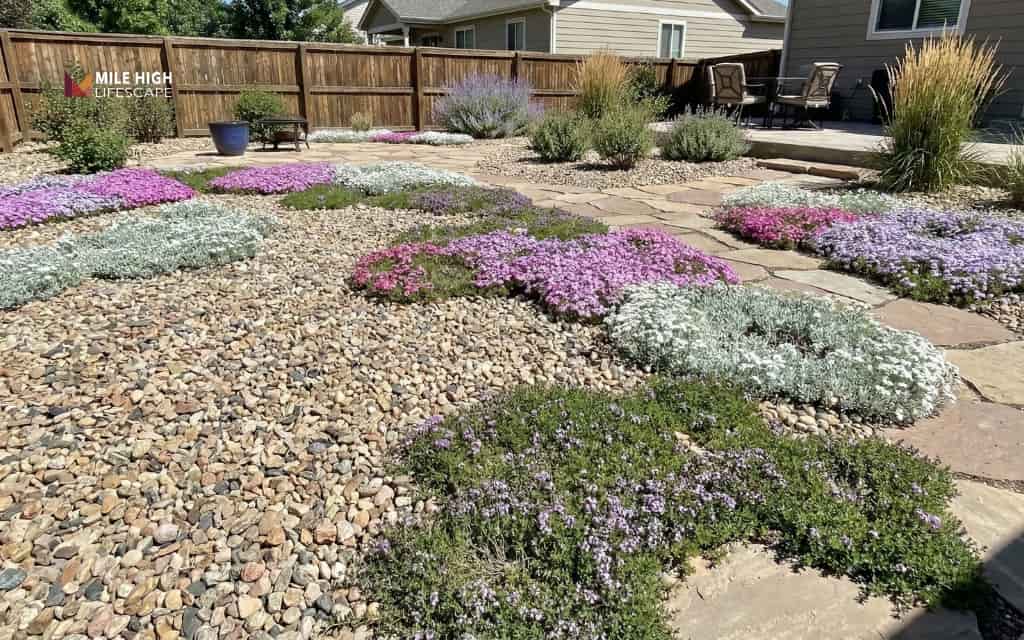
Pure rock can feel harsh in large backyard areas, and it intensifies heat on summer days. The solution: rock + creeping plants in a thoughtful blend.
Install your base layer of decorative rock, then plant pockets of spreading groundcovers (creeping phlox, snow-in-summer, creeping thyme) that will fill gaps.
Within 2-3 seasons, you’ll have a dynamic tapestry where rock provides the structure and groundcovers add color, texture, and living movement.
The plants help cool the surface while rocks handle the areas around patios and paths where foot traffic would damage plants.
Small rock garden plans for slopes
- Rock size: Crushed stone base + decorative rock top layer
- Maintenance level: Very low after proper installation
- Denver tip: Critical for hillside properties in Green Mountain, Morrison, or Highlands Ranch areas
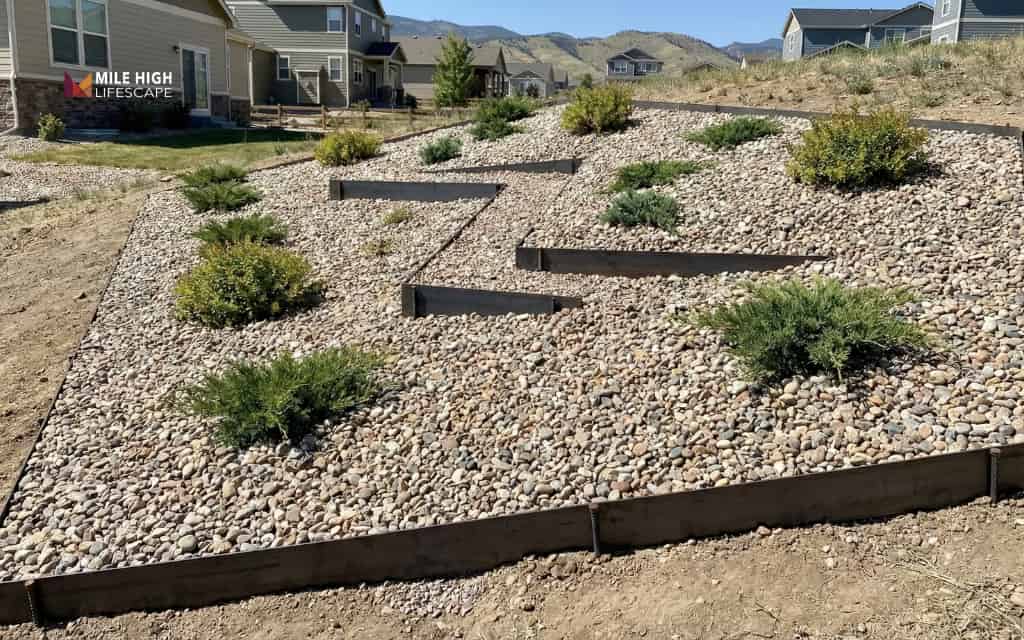
Slopes require a two-layer approach. First, install a 2″ base of crushed granite or crusher fines. This compacts into a stable foundation. Top with your decorative layer (1-2″ of small river rock or decorative gravel). This prevents the top layer from sliding while maintaining visual appeal.
Stabilized edging is non-negotiable on slopes. Use commercial-grade metal edging anchored with 12″ stakes every 2-3 feet, or install rock/timber terracing at grade changes.
Add low shrubs (kinnikinnick, juniper) at strategic points to help hold everything in place with root systems. Skip this design entirely on steep slopes (over 15%) that requires professional terracing or retaining walls.
Mixed-size small rock garden for depth
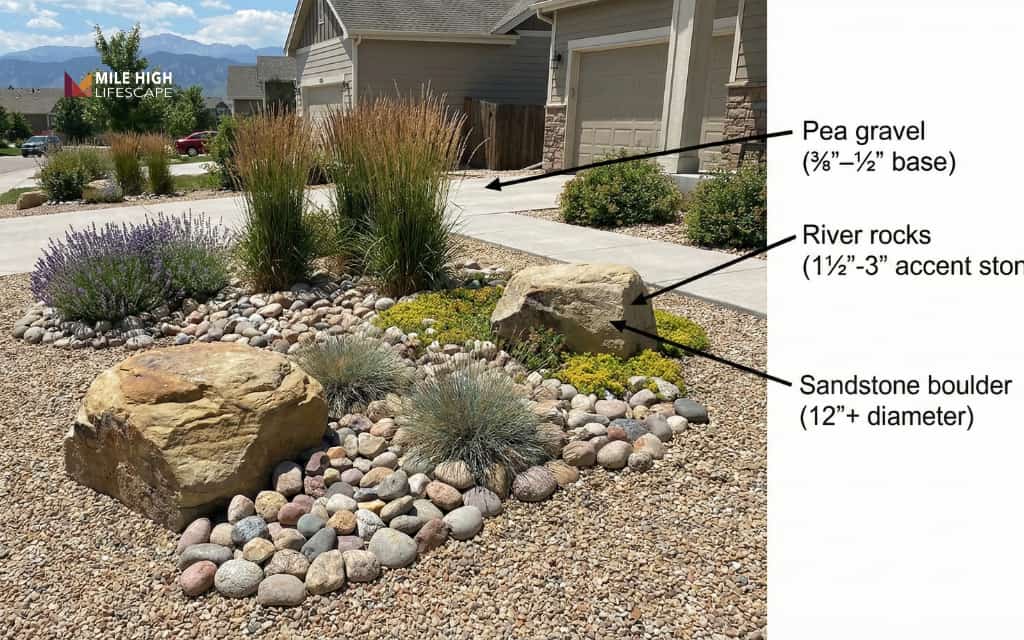
- Rock size: Fine gravel base (⅜”–½”) + accent stones (1½”–3″)
- Maintenance level: Low
- Denver tip: Prevents that “flat” or “unfinished” look common in single-rock-size gardens
Using just one rock size can look monotonous, especially across larger areas. This small rock garden design layers textures: start with a fine gravel base (pea gravel or small decorative gravel) throughout the bed, then add clusters of slightly larger river rocks (1½”–3″) in natural-looking groupings.
This mimics what you see in nature – dried riverbeds and mountain valleys always show mixed materials. Place larger accent stones at the base of plants, along curves, or in corners where the eye naturally lands.
The contrast creates depth and makes the space feel more intentional. You can even add a few statement boulders (12″+ diameter) as punctuation points.
How to install small rock landscaping correctly
Step 1: Prep and weed control
Proper preparation determines whether your small rock garden looks great for years or becomes a weedy mess within months.
Remove roots and debris
Clear everything organic from your project area: grass, weeds, roots, old mulch, sticks. Dig down 4-6″ across the entire space, shaking soil from roots as you go.
This is tedious work, but Denver’s persistent weeds (bindweed, crabgrass, dandelions) will push through rock if you leave roots behind. For bindweed, you may need to dig down 8-10″ to get the taproots.
If you’re dealing with extensive grass removal, consider using a sod cutter to make the job faster and more uniform.
Grade for drainage
Denver’s clay soil doesn’t drain well, so proper grading matters. Slope your prepared area away from your home’s foundation – minimum 2% grade (drops 2″ per 10 feet of distance). Use a 4-foot level and shims to check grade, adjusting soil as needed.
In low spots where water tends to collect, consider excavating an additional 2-4″ and filling with gravel base before adding your decorative rock. This creates a French-drain effect without formal installation.
Step 2: Fabric: When to use it (and when not to)
Landscape fabric is one of the most misunderstood elements when you landscape with small rocks.
Quality fabric vs. cheap plastic
Commercial-grade woven polypropylene fabric is worth every penny over big-box store plastic sheeting.
Quality fabric allows water and air to pass through while blocking light. Cheap plastic sheets trap water, cause anaerobic conditions, and deteriorate within 2-3 years – then you’ve got shredded plastic mixed into your rock.
Look for fabric rated at 3-5 oz. per square yard with 15-20 year warranties. Overlap seams by 6-12″ and use landscape staples every 3 feet along edges and every 4-6 feet in the field.
Why fabric alone doesn’t stop weeds
Here’s the truth: fabric prevents weeds from growing up through it, but windblown seeds land on top of your rock and germinate in dust and organic debris that accumulates between stones. Within 2 years, you’ll have some weeds regardless of fabric quality.
The solution is proper rock depth (see next section) and occasional maintenance. Fabric significantly reduces weeding but doesn’t eliminate it entirely. In areas with severe weed pressure, some Denver landscapers skip fabric entirely and rely instead on 4″+ rock depth and pre-emergent herbicide applications in early spring.
Step 3: Install at the right depth
This is where most DIY small rock gardens fail: skimping on depth to save money. It always backfires.
Minimum depth rules (2–3″)
- For pea gravel and decorative gravel (up to ¾”): 3″ minimum depth
- For small river rock (¾”–1½”): 2½” minimum depth
- For pathways and high-traffic areas: 4″ depth regardless of rock size
These minimums assume you’re installing over landscape fabric. Without fabric, add another inch.
Step 4: Edging to prevent rock migration
In Denver’s windy climate, edging isn’t optional – it’s the difference between a polished installation and rock spreading into your lawn or neighbor’s yard.
Metal, stone, or concrete options
Metal Landscape Edging
Professional-grade aluminum or steel edging with commercial stakes creates clean, permanent borders. The edging should rise 2-3″ above the rock surface and extend 4-6″ into the ground.
This is the gold standard for landscaping with small rocks in Denver – it’s nearly invisible, extremely durable, and handles freeze-thaw cycles without shifting.
Natural Stone Edging
Moss rock or flagstone pieces set on edge create beautiful, rustic borders. Dig a trench, set stones so they extend 3-4″ above grade, and backfill with soil or concrete to hold them firm. More expensive and time-intensive than metal, but stunning with naturalistic designs.
Concrete Curbing
Poured or pre-formed concrete edging provides maximum stability. This works especially well for curves and slopes where rock migration is most problematic. Denver companies specialize in continuous-pour decorative concrete edging that looks like stone but offers concrete’s strength.
Critical for small rocks in wind
If you use pea gravel or fine decorative gravel in an exposed location without proper edging, expect to spend every spring re-distributing rock that’s migrated.
Install edging during initial construction – retrofitting it later requires partially removing and replacing rock, doubling your work.
For large projects, combine edging types: use metal along most borders for cost-efficiency, then add decorative stone edging in highly visible areas like front entries or around patios for visual impact.
Conclusion
When you landscape with small rocks using proper planning and installation, the benefits extend beyond appearance. Water use drops because rock mulch reduces evaporation. Maintenance simplifies to occasional weeding and edge refreshing. Even the smallest yard gains visual impact when rock gardens replace struggling lawn areas.
For homeowners who want polished results without trial-and-error, Mile High Lifescape brings nearly two decades of experience designing and installing rock gardens throughout the Denver Metro area. Professional planning prevents the mistakes that turn rock gardens from assets into maintenance headaches.
Mile High Lifescape has been proudly serving the Denver Metro area with comprehensive landscape rock service in Denver and throughout the Front Range. Our experienced team ensures your small rock landscaping is installed correctly from day one, with proper depth, professional-grade materials, and techniques that prevent rock migration and weed invasion.
Contact Mile High Lifescape:
- Phone: (303) 877-9091
- Email: hello@milehighlifescape.com
- Address: 1007 S Federal Blvd Ste A, Denver, CO 80219
Frequently asked Questions (FAQs)
Is landscaping with small rocks low maintenance?
Yes, when installed correctly with proper depth and edging. Rock gardens need weeding 2-4 times per season – far less than traditional beds. Replenish rock every 3-5 years as wind gradually scatters pieces. Denver’s climate makes rock an ideal low-water alternative to grass.
What’s the best small rock for a Denver backyard?
¾-inch to 1-inch decorative gravel works best for most Denver backyards. This size resists wind movement while providing good ground coverage. Choose tan or gray tones to reflect heat during summer. Avoid rocks smaller than ½ inch in exposed areas. Spring winds scatter these sizes easily.
How deep should small rocks be for landscaping?
Apply 3 inches minimum depth for ¾-inch gravel, 4 inches for pea gravel. Measure settled depth after rocks compress naturally. Insufficient depth allows weeds to push through within one growing season. Order extra material – rock settles 15-20% as pieces nest together.
Do small rock gardens get too hot?
They can, depending on rock color and placement. Dark rocks (black, dark brown) can raise surrounding soil temperature. Light-colored rocks (buff, tan, white river rock) reflect more heat and stay cooler. Keep rocks at least 12-18″ away from heat-sensitive plant stems, and consider mixing in spreading groundcovers to cool the overall surface.
How do I stop small rocks from moving?
Three critical steps prevent rock migration: (1) Use rocks ½” or larger in exposed areas – pea gravel is too light for Denver’s wind, (2) Install metal or concrete edging that rises 2-3″ above rock surface, and (3) Apply rock at proper depth (3″+) so there’s enough weight to resist wind.