Rock landscaping ideas for the front of the house offer a transformative solution that’s perfectly suited to Denver’s challenging climate. Instead of fighting against our semi-arid conditions, you can work with them to create a landscape that thrives year-round with minimal intervention.
This comprehensive guide will equip you with everything you need to transform your front yard:
- How rock landscaping performs in Denver’s unique conditions
- Best rock types for your project
- 12 proven front yard rock landscaping ideas ranging from modern minimalist to naturalistic Colorado-style designs
By the end, you’ll have the confidence to create a stunning, sustainable front yard that enhances your home’s value while dramatically reducing maintenance and water consumption.
Choosing the right rocks for your front yard
The success of your rock landscaping front yard design hinges on selecting appropriate materials. Not all rocks perform equally in Denver’s climate, and the wrong choice can create maintenance headaches or visual disappointment.
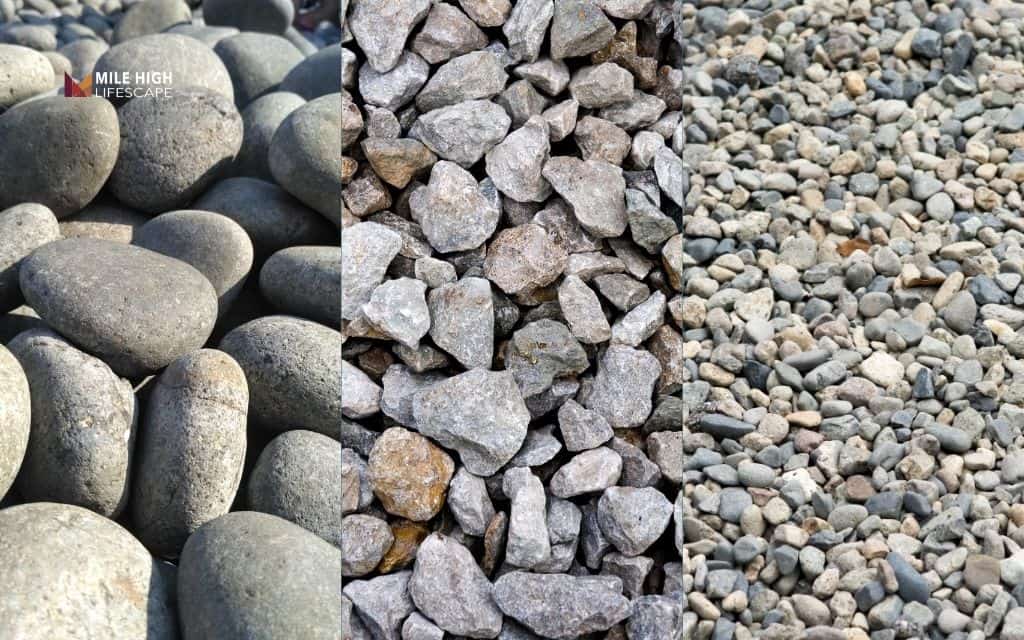
River rock vs crushed rock vs gravel
Each rock type serves distinct purposes in front yard landscaping:
River rock
These smooth, rounded stones create natural, flowing designs that mimic Colorado’s mountain streams and riverbeds. River rock works beautifully for front yard river rock landscaping in informal, organic layouts. The smooth edges won’t snag clothing or scratch bare feet, making river rock family-friendly for high-traffic areas.
Crushed rock
These sharp-edged fragments lock together when compacted, providing superior stability for front yard landscaping with rocks that include pathways, borders, and structural elements. The angular edges interlock mechanically, preventing migration and creating firm walking surfaces. This material is ideal for pathways, driveway edges, and areas where you need rocks to stay put.
Gravel
The most budget-friendly option, gravel encompasses small, loose stones typically ½-inch to 1-inch in size. Pea gravel and crushed granite gravel offer easy installation and simple refreshing over time.
Gravel works well for low maintenance front yard landscaping with rocks when covering large areas. It’s easier to spread than larger rocks and settles into a relatively stable surface.
Color and size considerations
Rock color impacts your landscape’s visual temperature, maintenance needs, and microclimate effects:
Light-colored rocks (white, cream, tan, light gray)
These reflect rather than absorb Denver’s intense sunlight, keeping surrounding areas cooler. Light rocks create bright, airy designs that make small spaces feel larger. They’re excellent choices for modern rock garden designs where clean, crisp aesthetics are priorities.
However, they show dirt, organic debris, and algae growth more readily, requiring occasional rinsing to maintain their fresh appearance.
Dark-colored rocks (charcoal, brown, rust, dark gray)
These absorb and radiate heat, creating warmer microclimates that benefit cold-sensitive plants in spring and fall. Dark rocks hide dirt and organic debris effectively, requiring less maintenance to look good. They create dramatic contrast with light-colored plants and architecture.
Size mixing
Professional-looking rock garden front yard landscaping incorporates varied rock sizes for visual depth and functional benefits.
Use larger rocks (3-6 inches) as visual anchors and to slow erosion, medium rocks (1-3 inches) for primary coverage, and smaller gravel or crushed rock for gaps and transitions.
This layering mimics natural streambeds and mountainsides while improving drainage and preventing small rocks from washing away during heavy rains.
A common ratio is 60% medium rock, 25% large rock, and 15% small rock or gravel for infill.
How much rock do you really need?
Underestimating rock volume is one of the most common mistakes in DIY front yard rock landscaping. Rocks spread thinner than anticipated, especially on uneven ground.
- Small decorative gravel: 2 – 3 inches minimum depth
- River rock and crushed rock: 3 – 4 inches depth for adequate coverage and weed suppression
- Larger decorative rock (3-6 inches): 4 – 5 inches depth to ensure ground isn’t visible between stones
- Boulder accents: Set 1/3 to 1/2 of boulder height below grade for natural appearance and stability
Rock landscaping ideas for front of house: 12 proven designs
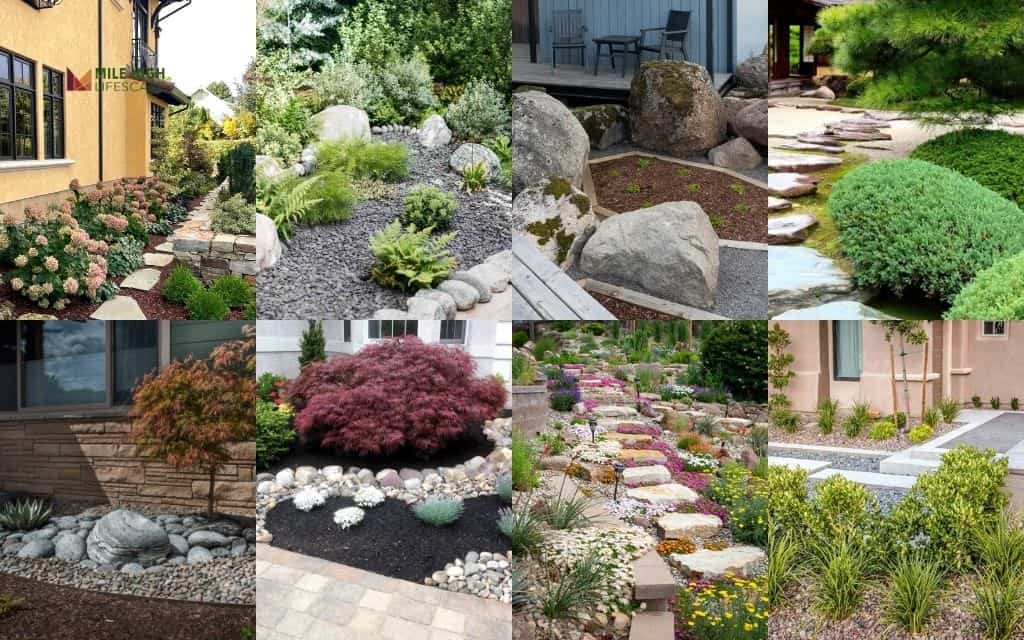
These front yard rock landscaping ideas range from naturalistic Colorado-style designs to modern minimalist approaches.
Each includes specific rock recommendations, maintenance expectations to help you choose designs that match your home’s architecture, your lifestyle, and your budget.
River rock front yard with native plants
- Best for: Homeowners seeking a natural, Colorado-appropriate aesthetic that conserves water while supporting local ecosystems.
- Rock type: Mixed-size river rock (1-4 inches) in natural tones (tan, brown, gray, and rust shades).
- Maintenance level: Very low once established.
River rock front yard designs work by replacing traditional turf with sweeping expanses of smooth river rock punctuated by strategic groupings of native plants like Russian sage, blanket flower, penstemon, and ornamental grasses. The rocks flow around plant groupings in natural, curving patterns rather than rigid geometric shapes.
This design creates flowing, organic layouts that mimic Colorado’s natural mountain environments.
Low-maintenance front yard landscaping with rocks and mulch
- Best for: Budget-conscious homeowners transitioning from traditional landscaping who want reduced maintenance without completely eliminating organic elements.
- Rock type: Crushed stone or pea gravel base (1-2 inches) with limited mulch pockets around shrubs and perennials.
- Maintenance level: Low.
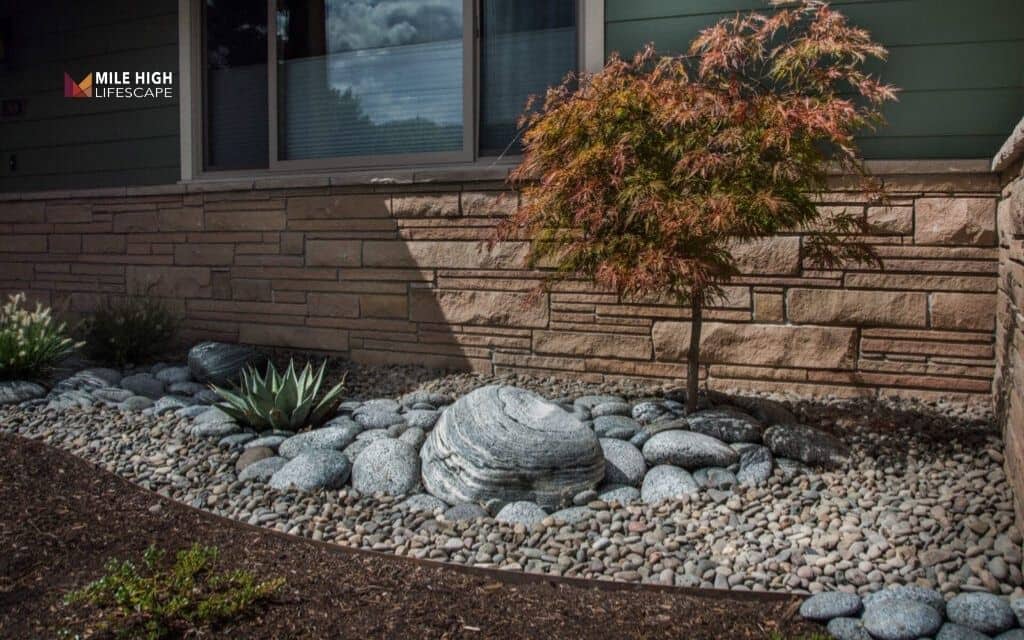
This hybrid approach combines the durability of low maintenance front yard landscaping with rocks with the soil-enriching benefits of organic mulch in targeted areas. The majority of your yard is covered in rock, reducing weeds and water use by 60-70%, while strategic mulch pockets around existing shrubs and trees provide organic matter as they decompose.
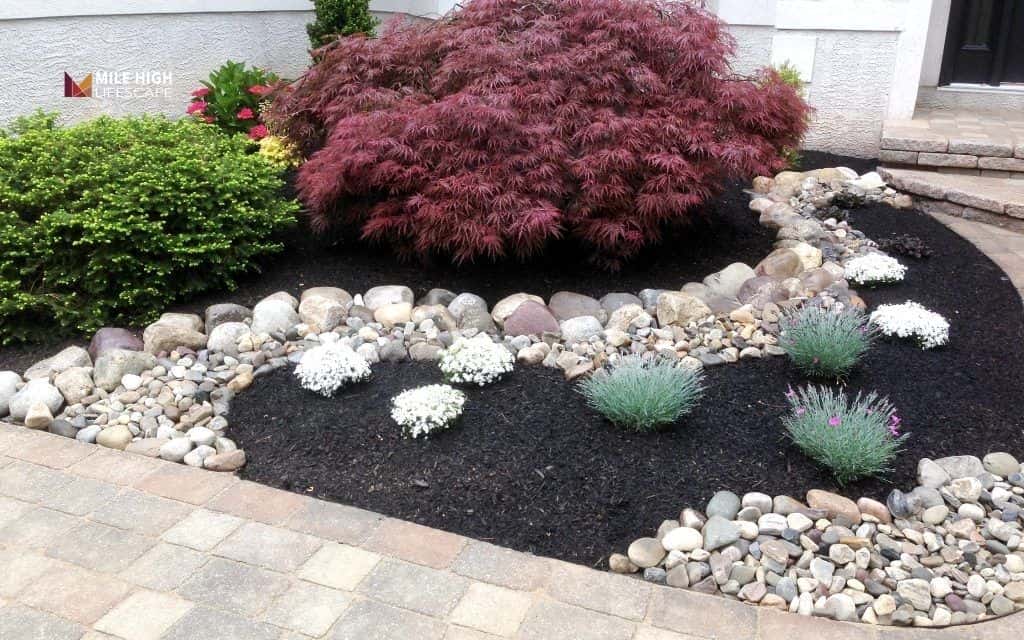
Front yard rock garden replacing lawn areas
- Best for: Homeowners with struggling grass in problem zones – steep slopes, heavy shade under mature trees, compacted clay areas, or spots with poor drainage.
- Rock type: Mixed decorative rock (2-4 inches) with accent boulders and drought-tolerant perennials.
- Maintenance level: Low to moderate.
Rather than fighting impossible lawn conditions, front yard rock garden designs strategically eliminate grass in areas where it never thrives. This approach typically replaces 40-70% of front lawn, keeping grass only in ideal zones while converting problem areas to attractive, low-water rock gardens.
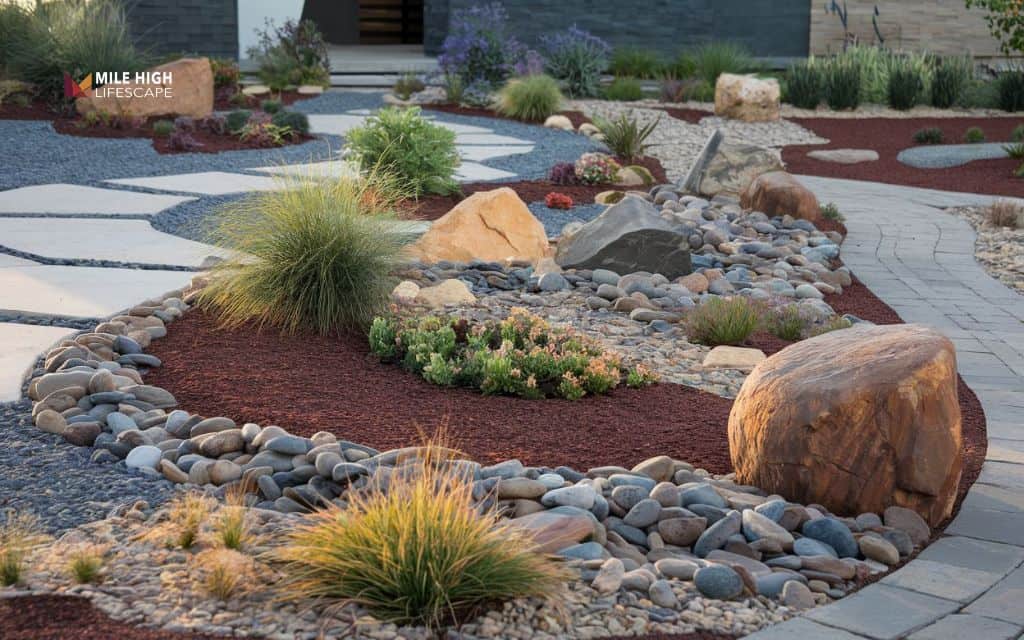
Modern rock garden with clean lines
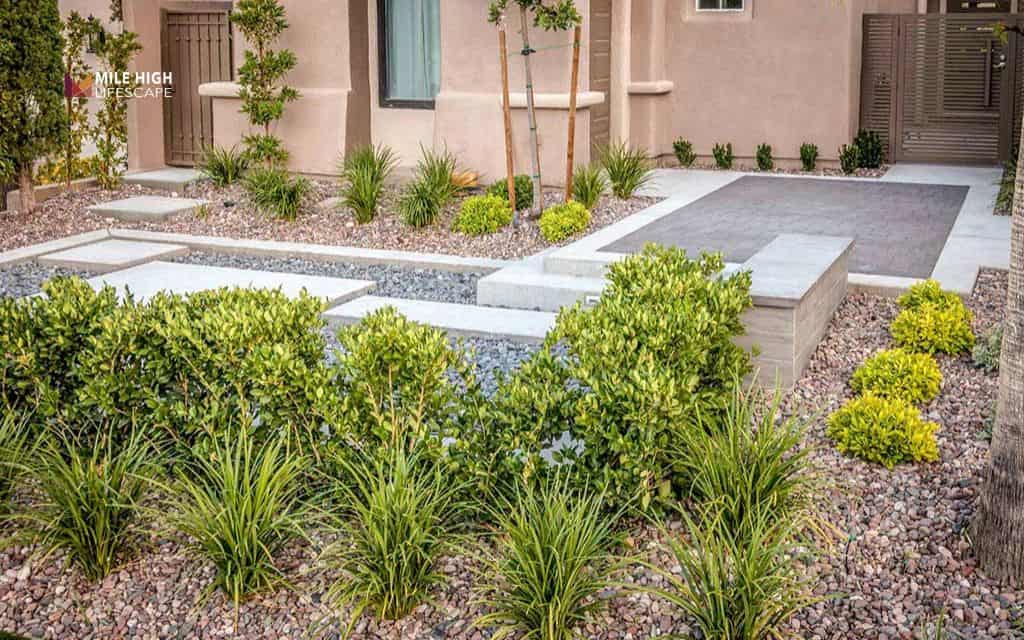
- Best for: Contemporary and mid-century modern homes where geometric simplicity and architectural form take priority over naturalistic designs.
- Rock type: Uniform-sized decorative gravel or crushed rock in single colors (often white, black, or gray) with sculptural specimen plants.
- Maintenance level: Moderate.
This front yard landscaping ideas modern rock garden ideas approach emphasizes minimalism, repetition, and intentional negative space. Designs feature geometric planting beds bordered by clean metal or concrete edging, filled with monochromatic rock.
Plant selections focus on architectural forms (agaves, yuccas, ornamental grasses, or carefully pruned evergreens) placed with precision rather than abundance.
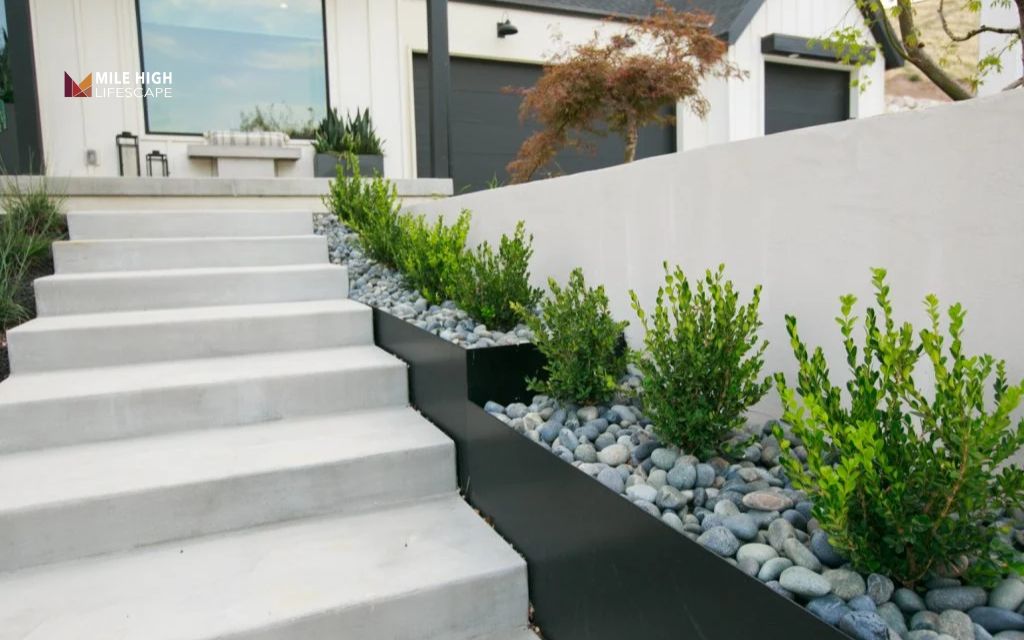
Rock flower bed in front of house
- Best for: Homeowners who love flowers but want to reduce maintenance compared to traditional mulched beds.
- Rock type: Small to medium river rock or decorative stone (1-3 inches) in colors complementing your home and flowers.
- Maintenance level: Moderate.
Transform traditional foundation plantings into rock flower bed in front of house designs where decorative rock replaces mulch around shrubs, roses, and perennial flowers. The rock provides clean, permanent coverage that won’t wash away, blow away, or need annual replacement like organic mulches.
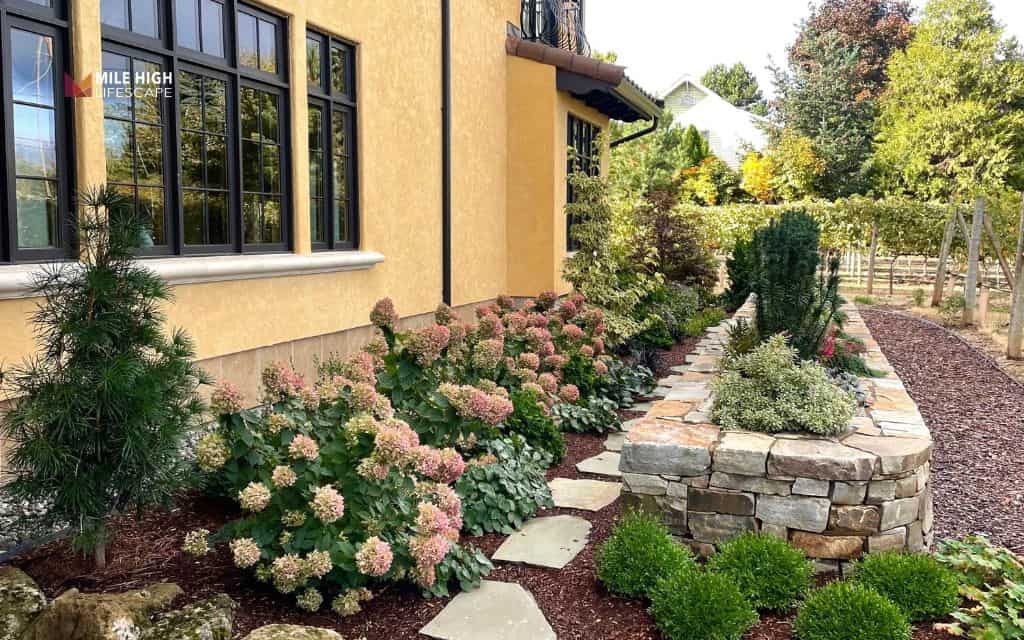
Small rock garden ideas for front of house
- Best for: Townhomes, courtyard entries, and compact urban lots where space is limited but visual impact matters.
- Rock type: Carefully selected rock sizes scaled to space, generally 1-2 inch primary coverage with accent rocks no larger than 6-8 inches.
- Maintenance level: Low.
Small front yard landscaping ideas with rocks require strategic design to maximize impact without overwhelming limited square footage.
Focus on vertical elements (upright grasses, columnar evergreens), varied textures, and layered rock sizes to create depth perception. Small spaces benefit from focal points – a statement boulder, dramatic specimen plant, or water feature – that draws the eye and provides visual interest.
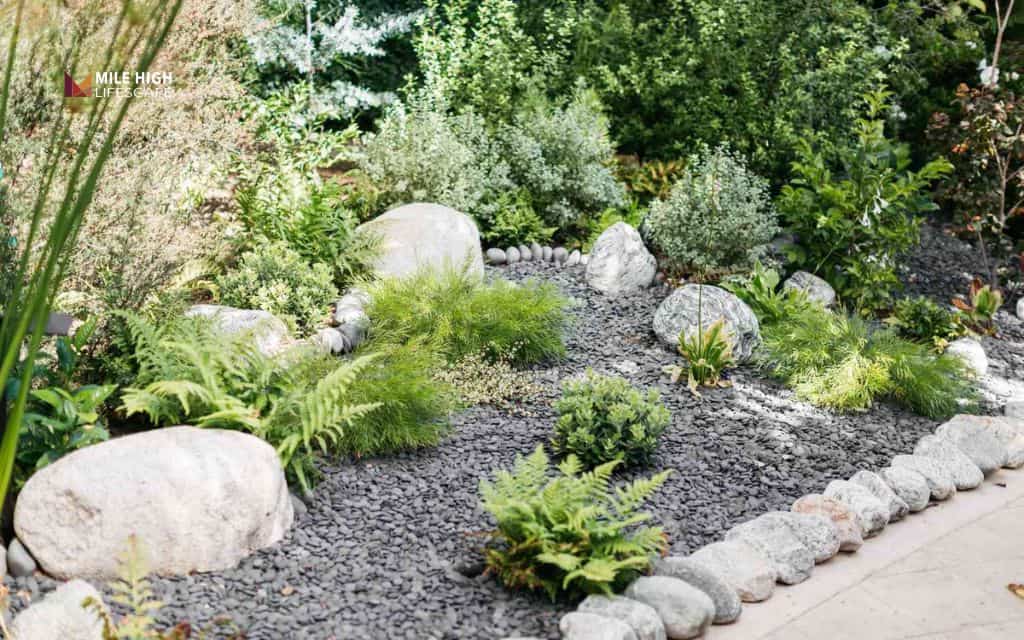
Front yard river rock landscaping along walkways
- Best for: Defining entry routes, managing drainage, and creating visual flow from street to front door.
- Rock type: River rock in medium sizes (2-3 inches) that won’t create tripping hazards or get kicked onto walkways.
- Maintenance level: Very low.
Front yard river rock landscaping along pathways creates graceful transitions between hardscape and planted areas while solving common drainage problems. Design rock bands 18-36 inches wide on both sides of concrete or flagstone walkways. The rock catches runoff from impervious surfaces, allows infiltration, and prevents erosion along path edges.
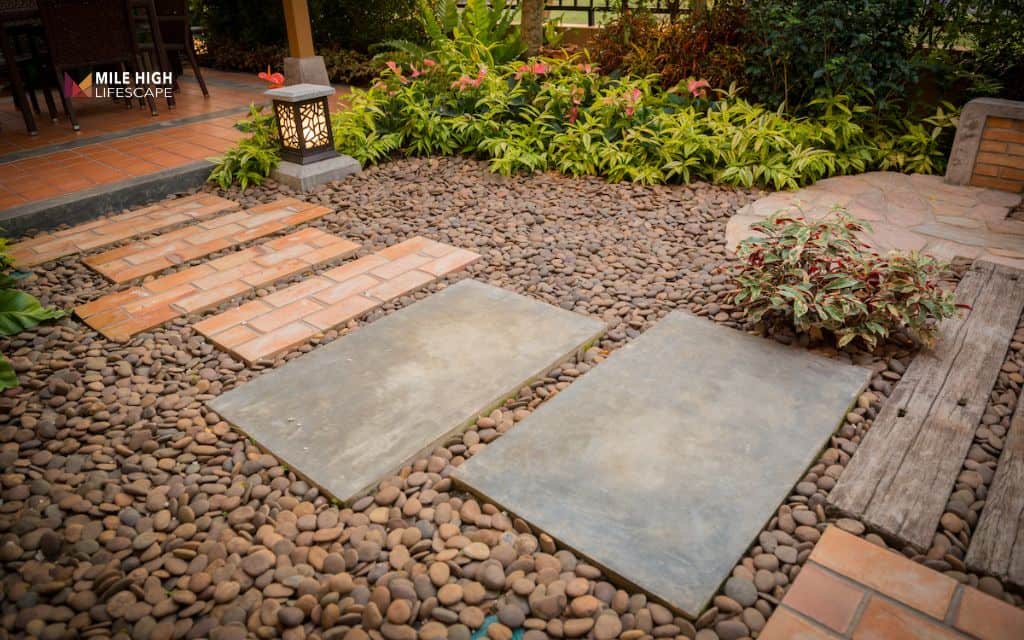
Rock landscaping with boulder accents
- Best for: Adding focal points, anchoring slopes, and creating authentic Colorado character in any front yard style.
- Rock type: Large accent boulders (18-36+ inches) in native Colorado stone – moss rock, red sandstone, or weathered granite – combined with complementary smaller rock coverage.
- Maintenance level: Minimal.
Strategic boulder placement transforms generic rocks in front of house designs into distinctive landscapes with personality and presence.
Boulders serve as visual anchors, provide elevation changes in flat yards, and create naturalistic compositions that echo Colorado’s mountain environments.
Place boulders individually as statement pieces, in clusters of odd numbers (3 or 5), or nestled into slopes where they appear to have always existed.
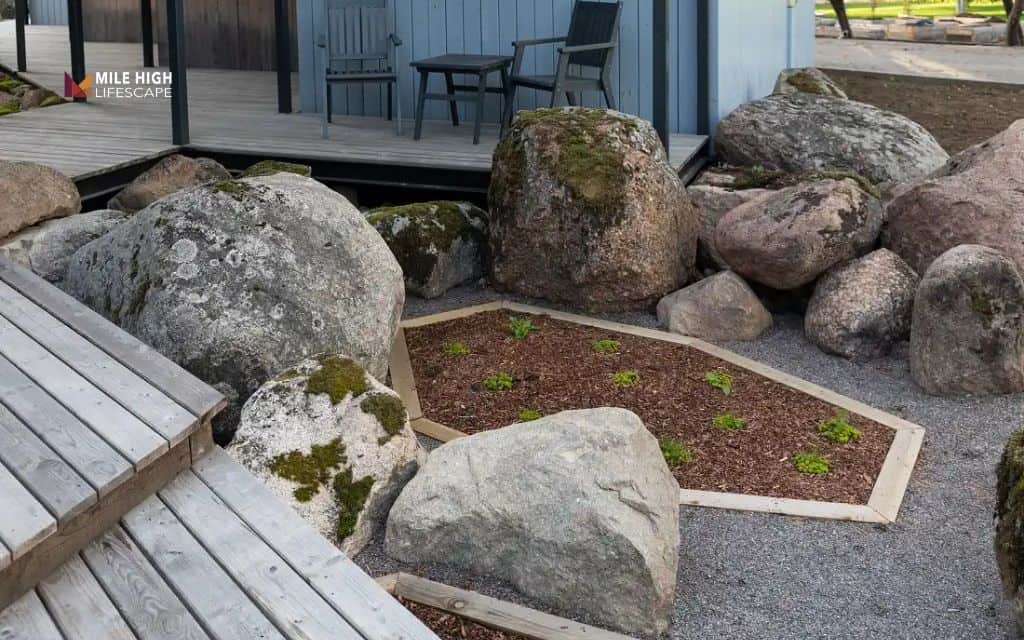
Front lawn rock gardens as “islands”
- Best for: Large front yards where complete lawn removal feels too drastic but maintaining expansive turf is burdensome.
- Rock type: Mixed decorative rock (2-4 inches) that contrasts with surrounding grass, creating clear visual separation.
- Maintenance level: Moderate.
Front lawn rock gardens designed as islands strategically reduce maintained turf by 30-50% while breaking up monotonous lawn expanses. Create kidney-shaped or irregular island beds throughout the yard, each filled with rock and drought-tolerant plantings.
The islands interrupt irrigation zones, add visual interest, and provide opportunities for seasonal color and texture variation.
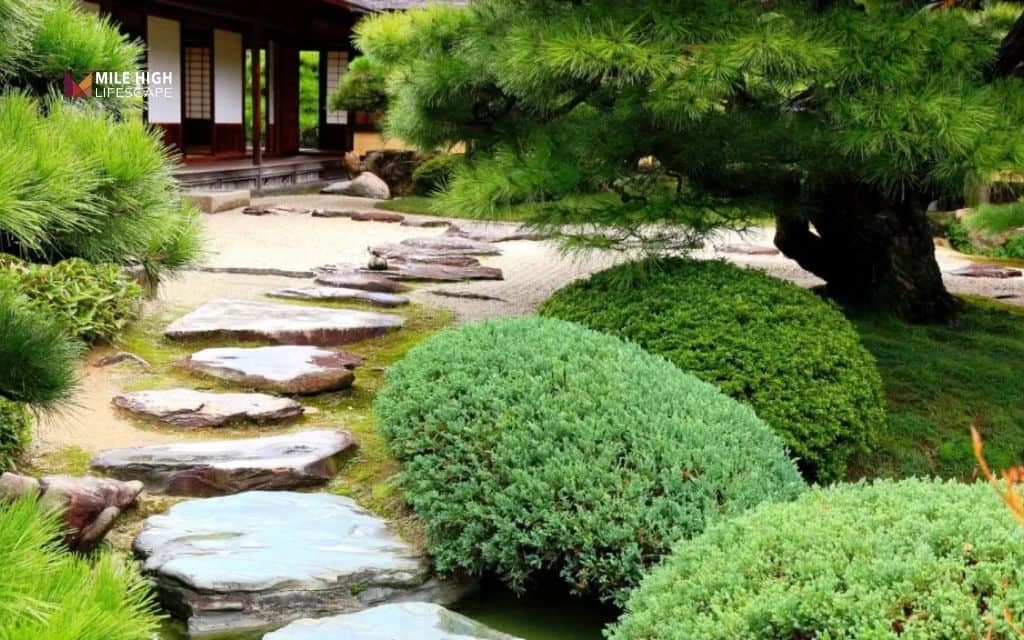
Front yard landscaping with rocks and groundcovers
- Best for: Softening hardscape-heavy designs and adding living texture without traditional lawn maintenance.
- Rock type: Larger rock spacing (4-6 inches between stones) that allows groundcovers to weave between rocks.
- Maintenance level: Moderate.
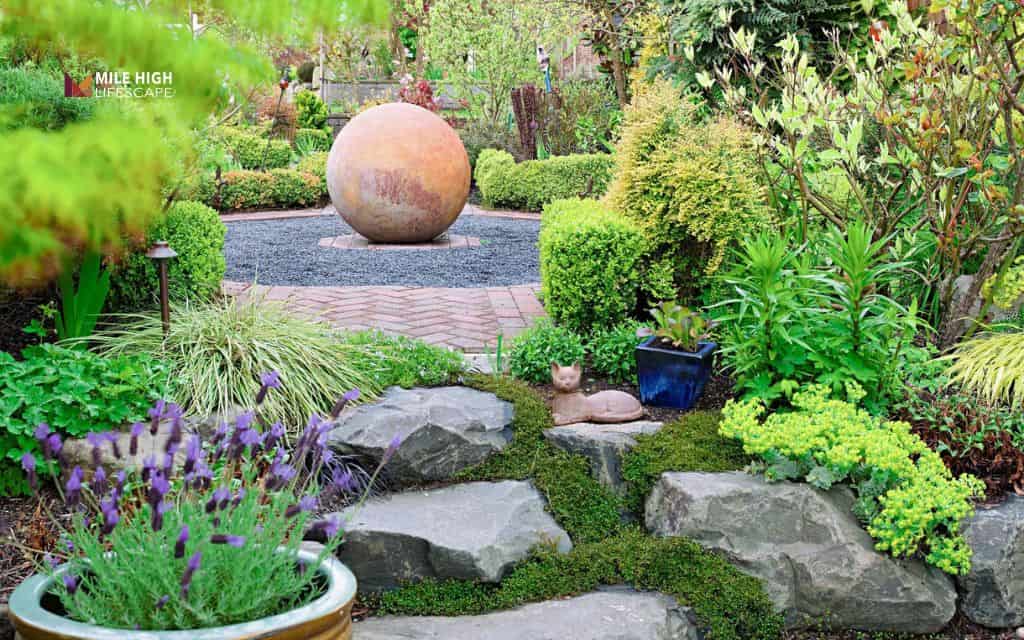
This front yard landscaping with rocks approach combines mineral and living elements by allowing low-growing, spreading plants to colonize spaces between rocks.
Suitable groundcovers include creeping thyme, blue star creeper, creeping sedum varieties, or native choices like kinnikinnick. The result is a tapestry effect – rock provides structure and weed suppression while groundcovers add softness, seasonal color, and living texture.
Rock garden front yard landscaping for slopes
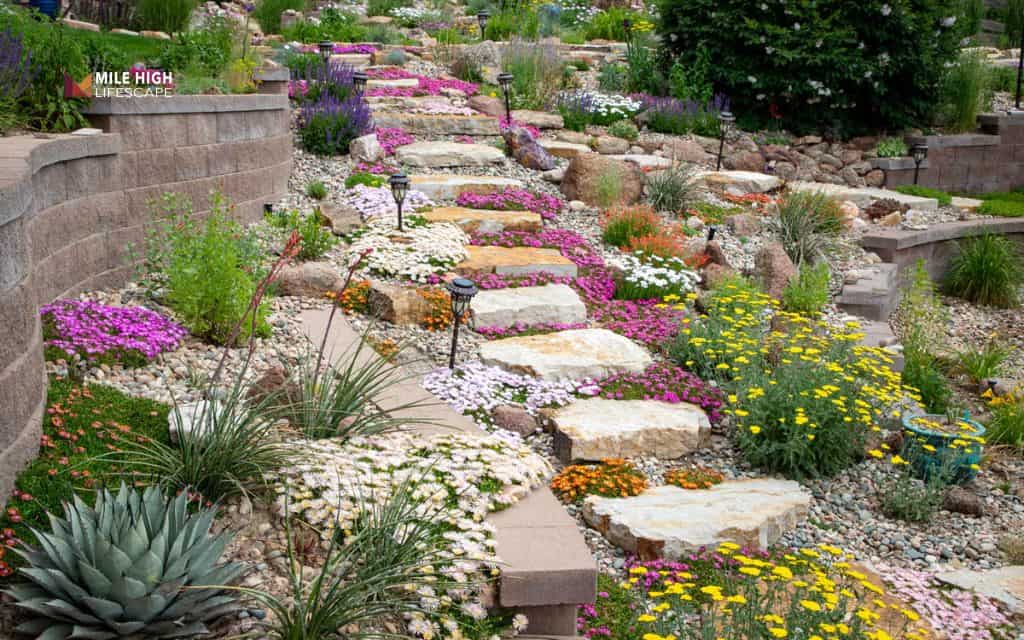
- Best for: Erosion control, visual interest on challenging terrain, and reducing maintenance on hills that are difficult to mow.
- Rock type: Combination of crushed rock or small gravel (for stability on slopes) and strategic boulder placement (to slow water and create terraces).
- Maintenance level: Very low once established.
Sloped rock landscape ideas for the front yard transform problematic terrain into landscape assets. Rock gardens excel on slopes by controlling erosion, eliminating dangerous mowing situations, and creating multi-level visual interest. Design incorporates horizontal rock terraces, strategic boulder placement to slow runoff, and deep-rooted plants that stabilize soil between rock areas.
HOA-friendly rock landscaping design
- Best for: Homeowners in planned communities with architectural review requirements or landscaping standards.
- Rock type: Natural earth tones (tans, browns, grays) in medium sizes that appear intentional rather than industrial or unfinished.
- Maintenance level: Low to moderate.
HOA-governed communities often have explicit or implicit expectations about front yard appearance.
Rock garden front yard landscaping can satisfy these requirements by emphasizing clean borders, intentional layouts, defined planting zones, and maintained appearance.
Success requires understanding your HOA’s specific regulations about percentage of living plants required, acceptable ground cover materials, and maintenance standards.
How to landscape your front yard with rocks
Successful landscape front yards with rocks projects require methodical planning and proper installation techniques. Follow this step-by-step process for professional-quality results that last decades.
Step 1: Plan layout and drainage
Before purchasing materials or removing grass, invest time in comprehensive site analysis:
- Identify slopes and drainage patterns: Walk your yard during and after heavy rain to observe where water flows, where it pools, and where soil erosion occurs. Take photos for later reference. Your rock landscaping should work with these patterns, not against them. Locate downspouts and their discharge points.
- Map sun exposure throughout the day: Note which areas receive full sun (6+ hours), partial sun (3-6 hours), or shade. This determines appropriate plant selections.
- Decide planted versus rocked areas: Mark existing plants you’ll keep, areas that will become rock-covered, and zones needing new plantings. Consider access paths for maintenance, mature plant sizes, and seasonal interest.
- Denver-specific consideration: Our clay soil creates drainage challenges. Plan for rock layers to improve infiltration and direct water away from foundations. If your yard slopes toward your home, plan swales, French drains, or graded rock channels to redirect water before installation begins.
Step 2: Remove grass and prep the base
Thorough site preparation prevents most long-term problems:
Sod removal options:
- Manual removal: Use a flat spade or sod cutter to remove grass in sheets. Cuts 2 – 3 inches deep, removing grass roots and most weed seeds. Labor-intensive but cost-effective for small areas (under 500 square feet). Removed sod can be composted or repurposed elsewhere.
- Sod cutter rental: Motorized sod cutters handle larger areas efficiently. Requires physical effort to operate and creates disposal challenges – rent a dumpster or plan multiple loads to disposal facilities.
- Herbicide application: Non-selective herbicide (glyphosate) kills grass in 1 – 2 weeks without digging. Lower labor but requires a waiting period and doesn’t remove dead material. Not suitable if you’re concerned about chemical use near edible plants or in areas accessed by children and pets.
- Sheet mulching: Smother grass under cardboard and mulch over 3 – 4 months.
Grade and level the base: After grass removal, rake thoroughly to remove roots, rocks, and debris. Fill low spots and smooth high spots to create even surfaces. Proper grading now prevents visible depressions in finished rock coverage later.
Landscape fabric: Landscape fabric creates a barrier between soil and rock, significantly reducing weed germination.
However, it’s not a perfect solution. Wind-blown debris settles on fabric and creates a soil layer where weeds can germinate above the fabric within 2-3 years. Fabric also prevents beneficial soil organisms from accessing rock mulch and makes adding plants later very difficult.
Alternative to fabric: For long-term weed prevention without fabric’s drawbacks, excavate 4-5 inches and install a 1-2 inch base layer of crushed rock or coarse sand. This compacts into a semi-permeable barrier that suppresses weeds while allowing soil biology to function. Top with your decorative rock.
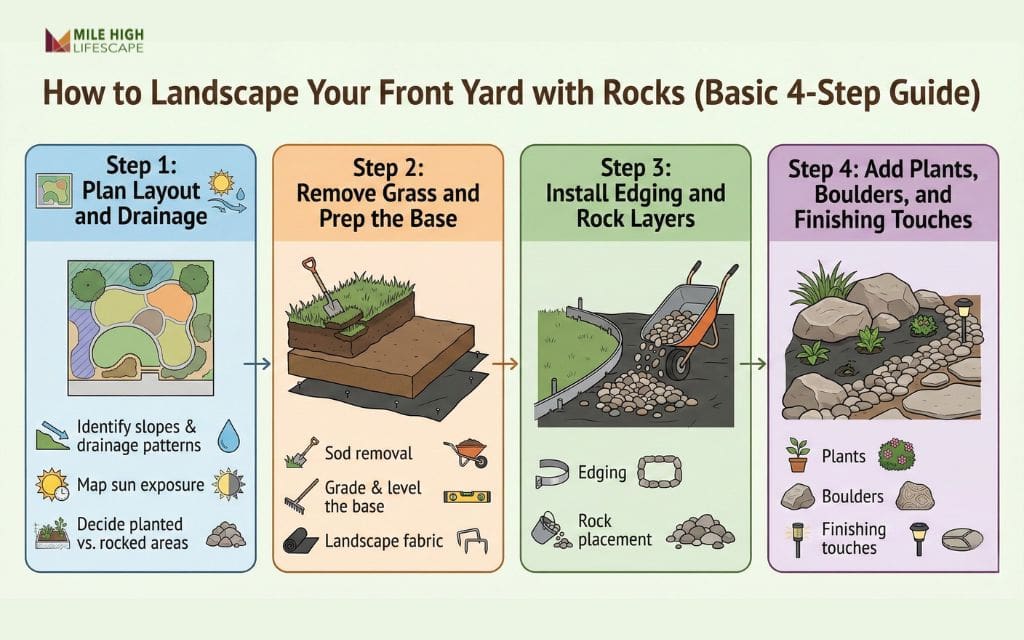
Step 3: Install edging and rock layers
Professional appearance depends on clean edges and proper rock depth:
Edging options:
- Metal edging: Steel or aluminum edging creates crisp, modern lines and handles curves smoothly. Costs $3-5 per linear foot installed. Powder-coated finishes prevent rust. Best for contemporary designs and areas where you mow adjacent to rock.
- Stone or concrete borders: Natural stone or concrete pavers create substantial, traditional-looking edges. More expensive ($8-15 per linear foot) but extremely durable. Suits classic architecture and formal designs.
- Plastic edging: Budget option ($1-2 per linear foot) but degrades in Denver’s UV exposure within 3-5 years and looks cheap. Avoid unless cost is critical and you plan updates soon anyway.
Rock placement method: Avoid dumping and spreading – this creates uneven coverage. Instead:
- Spread rock in wheelbarrow loads, distributing evenly across the area
- Rake to consistent depth, typically 3-4 inches for decorative rock
- In planting areas, keep rock 2-3 inches from plant stems to prevent moisture problems and heat stress
- Crown rock slightly toward centers of beds so rain sheds toward edges rather than pooling
Step 4: Add plants, boulders, and finishing touches
Final details transform functional rock coverage into cohesive landscape design:
- Plant spacing guidelines: Space based on mature plant width, not current nursery pot size. Shrubs typically need 3-5 feet between centers, perennials 12-24 inches depending on variety, and ornamental grasses 18-36 inches.
- Plant installation in rock beds: Dig planting holes through landscape fabric if present (cutting X-shaped slits), removing 2-3 times the root ball width of rock to work. Amend clay soil with compost to improve drainage and root establishment. Plant at the same depth as a nursery pot. After planting, pull rock back around plant stems but maintain 2-3 inch clearance for air circulation. Water thoroughly.
- Irrigation considerations: Install drip irrigation before final rock placement if possible. Retrofit is possible but requires moving rock to place tubing. Drip irrigation delivers water directly to root zones without waste. Run drip zones on separate timers from any remaining lawn areas since water needs differ dramatically.
- Final visual balance check: Step back and evaluate from multiple viewing angles – street view, driveway, front door. Adjust rock coverage if thin spots are visible. Reposition plants that appear cramped or lost in the design. Add final boulder accents if areas feel empty.
- Finishing touches: Sweep rock off hardscape surfaces (walkways, driveways, patios). Clean up any soil on rocks or edging. Water plants thoroughly. Add a layer of rock over any landscape fabric edges that are visible. Stand back and admire your transformation!
Conclusion
With thoughtful planning, rock landscaping ideas for the front of the house can dramatically transform your Denver property. These designs cut water use by 50-80%, eliminate weekly lawn maintenance, and provide year-round curb appeal that remains attractive through all four seasons. Unlike grass that struggles in Denver’s clay soil and semi-arid climate, rock landscapes work with our environmental conditions rather than fighting them.
For nearly two decades, Mile High Lifescape has been proudly serving the Denver Metro area as the go-to landscape company. With a reputation for excellence, we offer a comprehensive range of friendly and professional landscaping services, especially landscape rock service.
Count on us to transform your outdoor space into a beautiful oasis that exceeds your expectations.
Contact Mile High Lifescape:
Phone: (303) 877-9091
Email: hello@milehighlifescape.com
Address: 1007 S Federal Blvd Ste A, Denver, CO 80219, United States
Frequently asked questions (FAQs)
Is river rock good for front yard landscaping?
Yes, river rock works excellently in front yards, especially for natural, flowing designs. The smooth edges are family-friendly and won’t snag or scratch. However, rounded stones can shift on slopes, so use edging to contain them or choose crushed rock for sloped areas where stability matters more.
How much maintenance does a front yard rock garden need?
Front yard rock gardens require minimal maintenance – typically 1-2 hours monthly during growing season for occasional weeding, plant trimming, and debris removal. Unlike lawns needing weekly mowing and constant watering, rock gardens largely maintain themselves after proper installation with landscape fabric or adequate base preparation.
Are rock gardens cheaper than grass lawns?
Rock installation costs more upfront ($6-12 per square foot versus $2-4 for sod), but total ownership costs favor rock within 3-4 years. Denver grass lawns cost $600-1,400 annually for water, mowing, and treatments, while rock landscapes eliminate virtually all ongoing expenses except minimal plant care.
Do rocks increase heat around my house?
Dark rocks can raise temperatures 5-15°F near foundations during Denver’s intense summer sun. Choose light-colored rocks (tan, white, cream) for areas adjacent to buildings, leave 12-18 inch gaps between rock and foundations, and use plants to provide shade and cooling where heat buildup is a concern.
Can I mix rocks and plants in a front yard design?
Absolutely. Combining rocks and plants creates the most attractive and sustainable designs. Rock provides structure and reduces maintenance while plants add living texture and seasonal color. Use drought-tolerant varieties like Russian sage, ornamental grasses, and native perennials. Install drip irrigation before adding rock and maintain 2-3 inches of clearance around plant stems.