When selecting grass for your Denver lawn, two varieties often top the list: Kentucky Bluegrass and Tall Fescue. Each grass type offers unique benefits that address Colorado’s challenging climate conditions.
Tall Fescue is generally considered a better option than Kentucky Bluegrass in Denver’s challenging climate with its exceptional drought resistance, lower water requirements, and minimal maintenance needs. However, Kentucky bluegrass is often favored for its attractive look and soft feel, but it does demand more upkeep and attention.
At Mile High Lifescape, we’ve installed and maintained both grass types throughout Denver and surrounding areas for almost two decades. This comparison will help you understand the strengths and limitations of each grass variety, enabling you to make an informed decision for your property.
What is Kentucky bluegrass?
Kentucky bluegrass (Poa pratensis) is one of the most recognizable and beloved lawn grasses in the United States, particularly across the northern and transitional zones. Despite its name, it is actually native to Europe and Asia, but it has become the gold standard for premium lawns in cooler climates across the country.
Key characteristics
- Cool-season grass known for its soft, dense, fine-textured turf that feels luxurious underfoot
- Spreads through underground stems called rhizomes, giving it a remarkable ability to self-repair bare or damaged patches over time
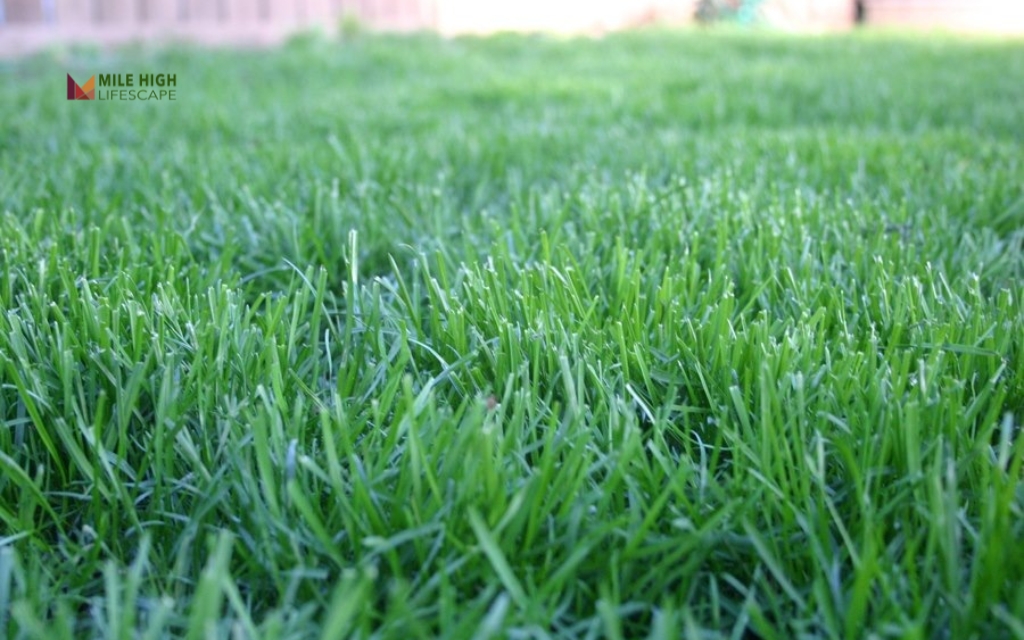
- Produces a deep blue-green color that creates the classic, polished look commonly associated with golf courses, sports fields, and upscale residential properties
Because of its rhizomatous growth habit, Kentucky bluegrass creates a tight, interlocking turf. When a section of lawn gets damaged by foot traffic, drought stress, or disease, the grass can gradually fill in those gaps on its own – something that most other cool-season grasses simply cannot do.
What Kentucky bluegrass needs to thrive
- Full sun exposure, at least 6 to 8 hours of direct sunlight per day is essential
- Consistent, deep watering, especially during dry summer stretches
- Regular fertilization, typically 3 to 4 applications per year for best results
- Mowing every 5 to 7 days during peak growing season, kept at a height of 2.5 to 3.5 inches
- Cooler climates with cold winters and mild summers where it can green up fully in spring and fall
Kentucky bluegrass germinates relatively slowly, taking anywhere from 14 to 30 days, and can take a full season or two to establish properly. Once it is established, though, it delivers one of the most stunning lawns you can grow in a cool-season climate.
Pros and cons of Kentucky bluegrass
| Pros | Cons |
| Creates a dense, lush, fine-textured turf with a premium blue-green color | Requires frequent watering, not drought-tolerant without irrigation |
| Self-repairs bare or damaged patches through rhizomes, no manual reseeding needed | Performs poorly in shade; needs at least 6 to 8 hours of direct sunlight daily |
| Excellent cold hardiness; stays green longer into fall and greens up early in spring | High fertilizer demand, typically 3 to 4 applications per year to maintain color |
| Blends well with other cool-season grasses for improved performance in mixed-seed lawns | Slow germination (14 to 30 days) and slow establishment in the first season |
| High traffic recovery due to rhizomatous spreading ability | Susceptible to summer heat and may go dormant or thin out in hot, dry conditions |
| Ideal for high-visibility, showcase lawns and upscale landscapes | Higher maintenance commitment overall compared to most other lawn grass options |
What is tall fescue?
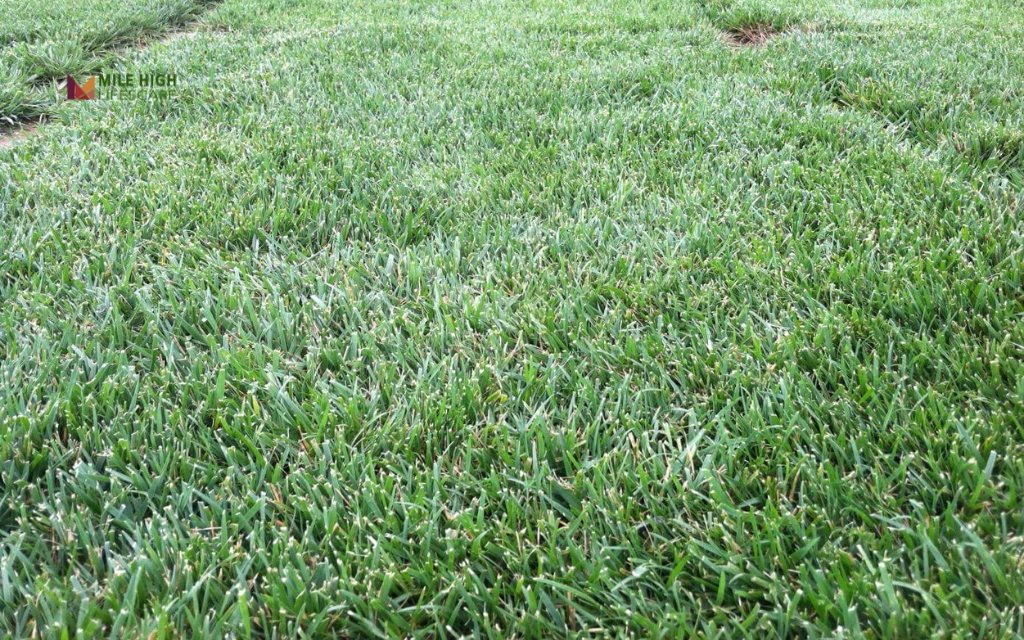
Tall fescue (Festuca arundinacea) has come a long way from its origins as a rough pasture grass. Modern turf-type tall fescue varieties have been carefully bred to offer homeowners a durable, attractive lawn that can hold up in challenging conditions that would stress other grasses, including Kentucky bluegrass.
Key characteristics
- Cool-season bunch grass with an exceptionally deep root system, often reaching 2 to 3 feet into the soil
- More tolerant of drought and heat stress than Kentucky bluegrass because its deep roots can access moisture lower in the soil profile
- Requires significantly lower maintenance compared to bluegrass – less water, less fertilizer, and fewer mowing sessions
Because tall fescue is a bunch of grass, it grows in clumps rather than spreading laterally through rhizomes. That means it does not self-repair the way Kentucky bluegrass does if a bare patch develops, you will need to overseed it manually. That said, its initial establishment is much faster, with germination typically occurring in just 7 to 14 days.
What tall fescue needs to thrive
- Moderate watering – its deep roots make it far more drought-resilient once established
- Light to moderate fertilization, typically 1 to 2 applications per year is often sufficient
- Mowing every 7 to 10 days during the growing season, maintained at a height of 3 to 4 inches
- Tolerates partial shade better than Kentucky bluegrass, making it a practical option for yards with trees or structures
- Adaptable to a wider range of climates, including areas that experience hotter summers
Modern turf-type tall fescue varieties have narrower leaf blades and a darker color than older pasture varieties, giving your lawn a much more refined, finished appearance. While it may not match the ultra-dense, velvety look of Kentucky bluegrass, it provides an attractive, healthy lawn without the intensive upkeep.
Pros and cons of tall fescue
| Pros | Cons |
| Deep root system (2 to 3 feet) delivers strong drought and heat tolerance | Bunch-type growth means it cannot self-repair; bare spots must be reseeded manually |
| Handles partial shade well – a practical choice for yards with trees or structures | Coarser leaf texture compared to Kentucky bluegrass – less of a premium, polished feel |
| Low to moderate water and fertilizer needs, reducing overall lawn care costs | Can appear clumpy or uneven if not overseeded regularly to maintain turf density |
| Fast germination (7 to 14 days) and quick establishment compared to Kentucky bluegrass | Does not blend as seamlessly with other grass species in mixed-seed lawns |
| Tolerates a wider range of soil types and climates, including transitional zones | May thin out over time in high-traffic zones without periodic overseeding |
| Good traffic durability – holds up well under everyday use from kids and pets | Less visually refined, not the best choice for formal, showcase-style lawn aesthetics |
Difference Between Kentucky Bluegrass vs. Tall Fescue
Kentucky Bluegrass creates that classic, carpet-like lawn with its dense growth and rich color, while Tall Fescue provides exceptional drought tolerance and durability in our semi-arid environment. Your choice between these two popular grass types ultimately depends on your specific lawn needs, maintenance capacity, and priorities for your outdoor space.
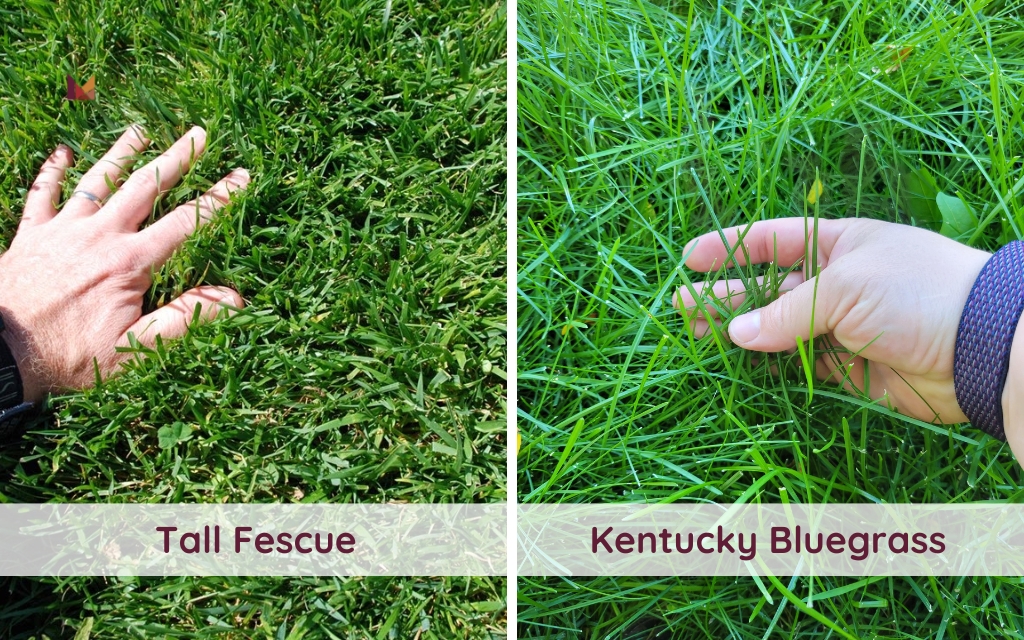
Compare these two popular grass types at a glance to understand their key differences and determine which best suits your Denver lawn conditions and maintenance preferences.
Feature | Kentucky Bluegrass | Tall Fescue |
| Growth Pattern | Spreads via rhizomes | Bunch-type grass (limited spreading) |
| Water Requirements | High (needs regular irrigation) | Moderate to low (drought-resistant) |
| Heat Tolerance | Moderate (goes dormant in extreme heat) | High (stays green in heat) |
| Cold Tolerance | Excellent | Good |
| Shade Tolerance | Poor to moderate | Good to excellent |
| Recovery from Damage | Excellent (self-repairs) | Poor (may need overseeding) |
| Blade Texture | Fine, soft | Coarse, sturdy |
| Color | Deep blue-green | Medium to dark green |
| Establishment Time | Slow (21-28 days) | Faster (14-21 days) |
| Traffic Tolerance | Moderate | High |
| Maintenance Level | High | Moderate |
Climate Compatibility
Kentucky Bluegrass:
- Thrives in cool-season regions like Denver’s higher elevations
- Struggles during extended heat periods above 90°F
- May require dormancy protection during drought restrictions
- Performs exceptionally during spring and fall in Colorado
Tall Fescue:
- Excels in transitional climate zones
- Maintains color during Denver’s hot summers
- Handles temperature fluctuations effectively
- Better adapts to Colorado’s semi-arid conditions
For Denver’s climate specifically, Tall Fescue generally offers better year-round performance due to its heat tolerance and lower water requirements. Kentucky Bluegrass shines during our cooler months but may struggle through July and August without supplemental irrigation.
Drought and Heat Tolerance
Kentucky Bluegrass:
- Requires 1.5-2 inches of water weekly during peak summer
- Enters dormancy (turns brown) during drought conditions
- Recovers well from drought when water returns
- Often needs irrigation systems for consistent appearance
Tall Fescue:
- Needs only 1-1.5 inches of water weekly during summer
- Maintains green color during moderate drought periods
- Root system accesses deeper soil moisture
- Handles water restrictions better than most cool-season grasses
Tall Fescue clearly outperforms Kentucky Bluegrass in drought and heat tolerance—a critical factor for Denver homeowners facing water restrictions and conservation efforts. The water savings alone often makes Tall Fescue the more economical long-term option.
Disease and Pest Resistance
Kentucky Bluegrass:
- Susceptible to summer patch, necrotic ring spot, and rust
- May develop dollar spot in humid conditions
- Attracts some grub species
- Requires preventative fungicide treatments in vulnerable areas
Tall Fescue:
- Resistant to most common lawn diseases
- Less prone to insect damage
- Occasional brown patch issues during humid periods
- Generally requires fewer chemical interventions
Tall Fescue’s superior disease resistance translates to lower maintenance costs and fewer chemical treatments throughout the growing season, making it the healthier choice for many environmentally-conscious homeowners.
Maintenance & Mowing
Kentucky Bluegrass:
- Mow at 2.5-3 inches during spring/fall
- Raise to 3-3.5 inches during summer
- Requires regular fertilization (4-5 times yearly)
- Thatch management needed every 1-2 years
- Benefits from annual aeration
Tall Fescue:
- Mow at 3-4 inches year-round
- Needs less fertilizer (2-3 applications yearly)
- Minimal thatch development
- Less frequent aeration (every 2 years)
- Overseeding recommended to maintain density
Kentucky Bluegrass demands more frequent maintenance interventions than Tall Fescue, translating to higher ongoing costs and time investments. Homeowners with limited time for lawn care often prefer Tall Fescue’s more forgiving nature.
Aesthetic Appeal & Texture
Kentucky Bluegrass:
- Creates the classic “perfect lawn” appearance
- Fine blade texture feels soft underfoot
- Dense, carpet-like uniformity
- Rich blue-green color provides striking visual appeal
- Excellent for showcase front yards
Tall Fescue:
- Coarser texture but modern varieties are much improved
- Slightly less uniform appearance
- Consistent green color throughout the growing season
- Maintains appearance better during environmental stress
- Ideal for functional family spaces
Kentucky Bluegrass wins the pure aesthetics competition, creating that magazine-worthy lawn appearance. However, Tall Fescue’s ability to maintain its appearance through harsh conditions offers practical beauty for busy households.
Which is Better: Kentucky Bluegrass or Tall Fescue?
Tall fescue is typically seen as a superior choice compared to Kentucky bluegrass in Denver’s tough climate, thanks to its outstanding drought tolerance, reduced water needs, and low maintenance requirements. On the other hand, Kentucky bluegrass is popular for its appealing appearance and soft texture, although it requires more care and attention.
However, both Kentucky Bluegrass and Tall Fescue offer substantial benefits for Denver homeowners, with neither representing a universal “best” choice. Your decision should align with your specific property conditions, aesthetic preferences, water availability, and maintenance capacity. Consider these factors when making your decision:
Choose Kentucky Bluegrass if:
- Visual appearance is your top priority
- You have a full-sun yard
- You’re willing to invest in regular maintenance
- Your property has an irrigation system
- You need excellent cold tolerance
- You want a self-repairing lawn that handles foot traffic
Choose Tall Fescue if:
- Water conservation is important to you
- Your yard has partial shade areas
- You prefer lower maintenance requirements
- You need excellent heat and drought tolerance
- Your soil conditions are challenging
- You’re establishing a lawn with children and pets
Consider a Blend if:
- Your yard has varied sun/shade conditions
- You want balance between appearance and durability
- You’re looking for some self-repair capabilities with drought tolerance
- Your lawn usage changes seasonally
Many Denver homeowners achieve ideal results with specialized blends that capitalize on the strengths of both grass types while minimizing their weaknesses.
Conclusion
Kentucky Bluegrass delivers unmatched visual appeal and self-repair capabilities but demands more resources and attention. Tall Fescue offers exceptional drought tolerance and stress resistance with more modest maintenance requirements but won’t create that classic “carpet lawn” appearance.
Many Denver homeowners achieve optimal results by strategically using both grasses—Kentucky Bluegrass in showcase areas and Tall Fescue in functional spaces or challenging environments. This approach maximizes the strengths of each grass type while minimizing their limitations.
Need personalized guidance for your specific lawn conditions? Contact Mile High Lifescape for expert consultation and professional lawn care services tailored to your property’s unique needs. Our team brings nearly two decades of experience with both grass types throughout the Denver metro area.
Frequently Asked Questions (FAQs)
Can Kentucky Bluegrass and Tall Fescue be mixed together?
Yes, specialized seed blends combine these grasses to leverage the strengths of both varieties. These mixtures typically contain 70-80% Tall Fescue for drought tolerance and 20-30% Kentucky Bluegrass for self-repair capabilities. Professional turf managers often recommend these blends for Denver’s challenging climate.
How long does it take to establish each type of grass from seed?
Tall Fescue typically germinates within 7-14 days and establishes a usable lawn within 4-6 weeks. Kentucky Bluegrass takes longer, with germination occurring at 14-21 days and full establishment requiring 8-12 weeks. For faster results, consider sod installation, which provides an instant lawn regardless of variety.
Which grass type requires less water?
Tall Fescue consistently outperforms Kentucky Bluegrass in water efficiency. Its deeper root system requires approximately 30% less irrigation to maintain comparable appearance. This translates to significant water savings during Denver’s hot, dry summers and better performance during water restrictions.
Is one grass type better for families with pets?
Both grasses can work well with pets, but they offer different advantages. Kentucky Bluegrass self-repairs from damage but may show more visible urine spots. Tall Fescue resists urine damage better but requires overseeding to repair worn paths. For most families with active pets, Tall Fescue’s durability and lower maintenance typically provide the edge.
Which grass type is better for shady areas?
Tall Fescue significantly outperforms Kentucky Bluegrass in shade tolerance. While Kentucky Bluegrass requires 6-8 hours of daily sunlight, Tall Fescue can thrive with just 4 hours. For properties with mature trees or buildings creating significant shade, Tall Fescue represents the clearly superior option.
What looks better, Kentucky bluegrass or tall fescue?
Kentucky bluegrass generally looks better, delivering a finer texture, denser turf, and a richer blue-green color that gives lawns a polished, golf-course-quality appearance. Tall fescue, particularly modern turf-type varieties, still produces a clean, attractive lawn – but its slightly coarser blades and clumping growth make it harder to achieve the same uniform, lush result. That said, a thriving tall fescue lawn will always look better than a drought-stressed Kentucky bluegrass lawn that is not getting enough water or care.
What grass seed do professional landscapers use?
Most professional landscapers in cool-season climates use Kentucky bluegrass for premium, high-visibility lawns, and turf-type tall fescue for practical, lower-maintenance properties – especially in transitional zones or partially shaded yards. However, the most common professional choice is a blended seed mix that combines Kentucky bluegrass with perennial ryegrass and/or fine fescue to balance appearance, durability, and adaptability.