Compost as a mulch delivers double duty. It improves soil structure while protecting the surface. It feeds plants while conserving water. In Denver’s demanding climate, this combination approach saves time, money, and effort.
This guide shows you exactly how to use composted mulch in your yard.
You’ll learn the real difference between compost and mulch, when each method works best, and how to apply compost as a top layer that thrives in Colorado’s clay soils and conditions.
Compost vs mulch – What’s the difference?
What is compost?
Compost transforms your soil from the inside. It breaks down organic matter into a dark, crumbly substance rich in nutrients and beneficial microbes.
When you dig compost into the ground, it improves soil structure, increases water retention in sandy areas, and loosens heavy clay. The biology in finished compost feeds plants and builds long-term soil health.
What is mulch?
Mulch protects your soil surface like a protective blanket. It blocks weeds, reduces water evaporation, moderates soil temperature swings, and prevents erosion.
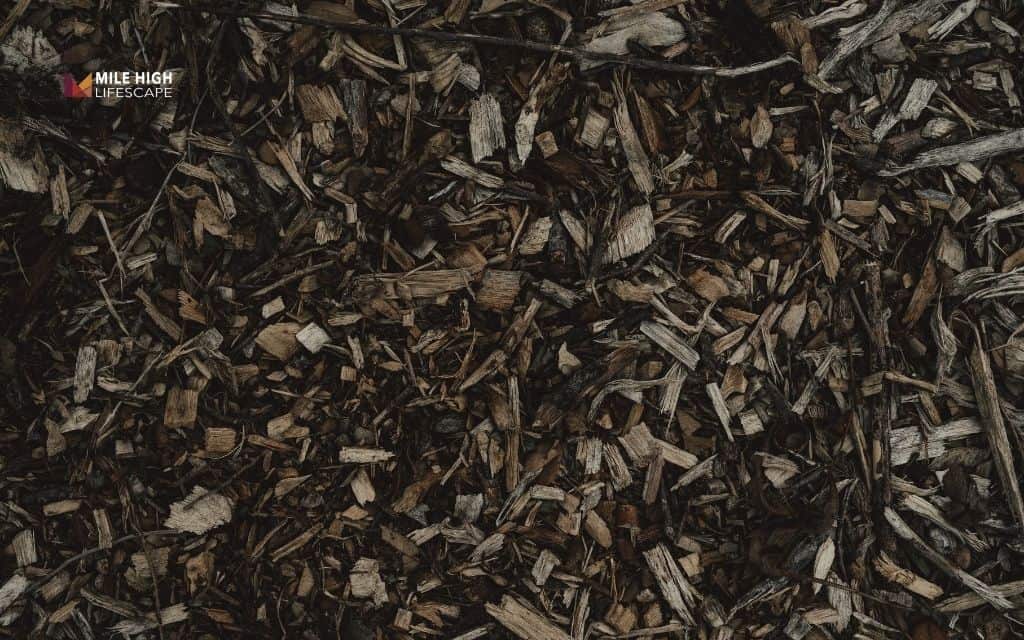
Traditional mulches – wood chips, bark, straw, or leaves – sit on top of your soil without adding much nutrition. They focus on surface protection rather than soil improvement.
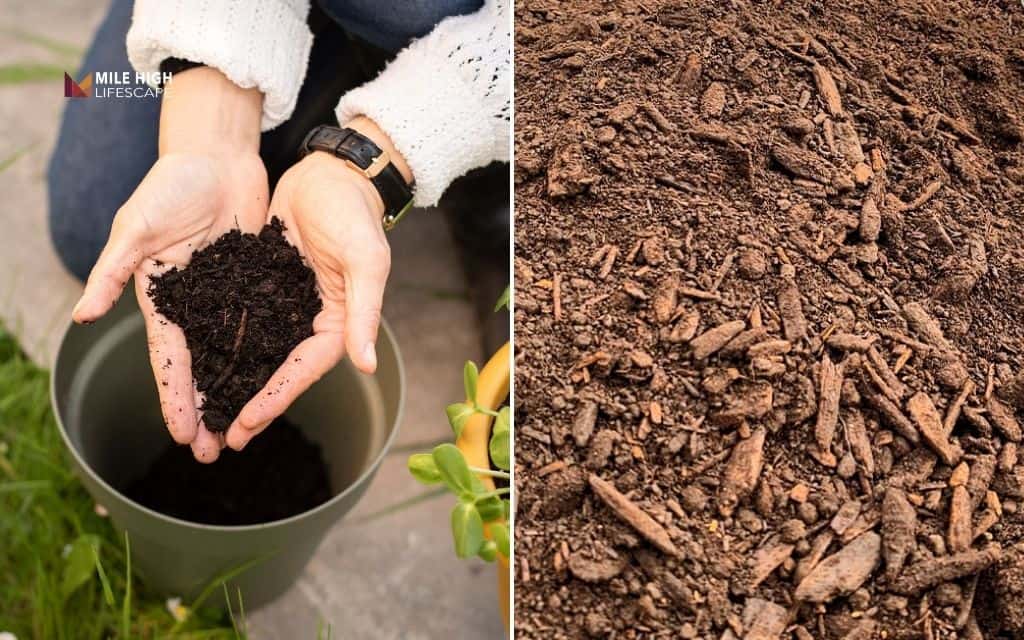
So can compost be used as mulch?
Yes. A layer of finished compost spread on top of your soil functions as both mulch and slow-release fertilizer.
Gardeners call this approach “composted mulch” or simply “compost mulching.” The dark material blocks light to suppress weeds while feeding soil biology from above. As rain and water moves through the compost layer, nutrients leach downward to plant roots. Earthworms and other soil organisms pull compost particles deeper, gradually improving your topsoil.
Benefits of using compost as a mulch
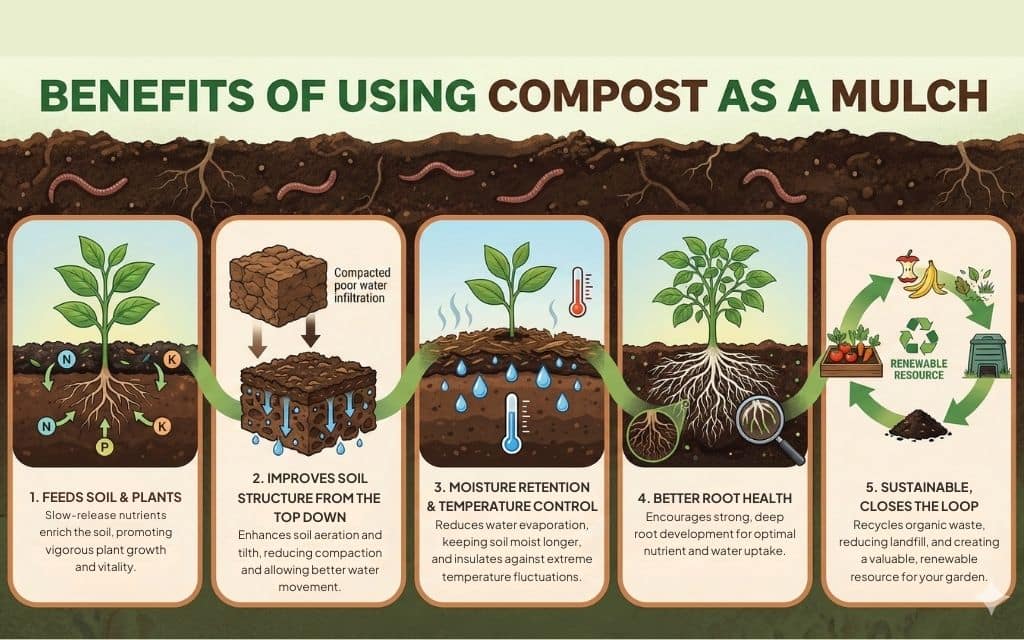
Feeds soil and plants
Inert mulches like wood chips or rock provide no nutrition. They protect the surface but starve the soil beneath. Compost mulch delivers both functions.
As rain and water percolate through the layer, dissolved nutrients move downward to plant roots. Nitrogen, phosphorus, potassium, and trace minerals become available gradually – a slow-release fertilizer that feeds plants for months.
Soil microbes feast on organic matter in the compost layer. Bacteria, fungi, and other decomposers multiply rapidly, creating a thriving biological community. These organisms break down organic compounds, making nutrients available to plants.
They also produce substances that improve soil structure and suppress plant diseases. A living soil grows healthier plants.
Improves soil structure from the top down
Compost as mulch improves structure naturally. Earthworms pull surface compost into deeper layers as they burrow. Freeze-thaw cycles mix particles downward.
Rain carries fine organic matter into cracks and pores. Over time, the upper 2–4 inches of soil become rich, crumbly, and well-aggregated.
This improved topsoil drains better after storms, holds more moisture during dry spells, and provides better anchorage for plant roots.
Moisture retention & temperature control
A 1 – 2 inch layer of compost mulch blocks direct sun and wind, keeping soil moist longer between waterings. This protection matters most during hot summer afternoons when evaporation peaks.
Compost also moderates soil temperature. In summer, the layer insulates soil from scorching heat. In winter, it buffers against extreme cold and temperature swings. Stable soil temperatures protect plant roots and keep beneficial organisms active longer through the growing season.
The mulch layer suppresses weeds by blocking light to the soil surface. Fewer weeds mean less competition for water and nutrients. Less hand-weeding means more time enjoying your garden.
Better root health
Healthy soil structure, consistent moisture, steady nutrition, and active biology combine to produce stronger plants.
Roots grow deeper into well-structured soil, accessing water and nutrients from a larger volume. Deep roots anchor plants against wind and drought. Better root health translates to more vigorous growth, improved flowering, and higher yields in vegetable gardens.
Sustainable, closes the loop
Making your own compost turns kitchen scraps and yard waste into a valuable resource.
Using that compost as mulch completes a closed loop: organic materials become soil improvement and surface protection, then break down to feed the next generation of plants.
This cycle reduces waste sent to landfills and eliminates the need to purchase bagged mulch or amendments.
Drawbacks & limitations – When compost mulch isn’t enough
Not as long-lasting as bark or wood chips
Finished compost breaks down quickly. That rapid decomposition feeds soil biology and releases nutrients, but it also means the mulch layer disappears faster than bark or wood chips.
Bark mulch can last 2 – 3 years before needing replenishment. Compost mulch typically requires topping up annually, sometimes twice per season in vegetable beds.
If you generate limited compost from your own bins, you may need to supplement with purchased material or combine compost with longer-lasting mulches.
Weed seeds if compost isn’t finished
Properly made compost reaches internal temperatures of 130 – 160°F during active decomposition. This heat kills weed seeds, disease organisms, and harmful bacteria.
Compost that never heated sufficiently – either because the pile was too small, too dry, or poorly managed – may still contain viable weed seeds. And the mulch layer creates perfect germination conditions: moisture, darkness, and contact with soil. Weed seedlings emerge in dense carpets, creating more work than if you’d used inert mulch.
Always verify your compost is fully finished before using it as mulch. Look for dark color, crumbly texture, earthy smell, and cooling temperatures. If you spot recognizable kitchen scraps or fresh grass clippings, the material needs more time.
Can crust or splash if layer is too thin
A very thin compost layer – less than ½ inch – provides minimal weed suppression and can dry into a hard crust.
This crust repels water rather than absorbing it. Rain and irrigation droplets hitting thin compost can also splash soil particles onto plant leaves, spreading soil-borne diseases.
Erosion on steep slopes
Loose, crumbly compost washes away more easily than heavier mulches on sloped ground.
Heavy rain or rapid snowmelt can erode compost from steep beds, leaving soil exposed and carrying organic matter into storm drains.
On slopes steeper than 10 – 15%, consider alternatives. Use shredded bark, wood chips, or a combination approach: apply compost as a base layer, then top with heavier mulch. On gentler slopes, secure compost by watering it in thoroughly after application and avoiding installation just before predicted storms.
When to use compost as a mulch vs traditional mulch
Best uses for compost mulch
- Vegetable gardens: Apply 2 – 3 inches in spring after soil warms; provides consistent nutrition and moisture for high-yield crops; top up mid-season as layer decomposes
- Raised beds: Heavier applications work well in contained structures; prevents runoff while building soil year after year
- Perennial borders: Especially effective in struggling or newly established beds; gradual soil improvement builds stronger root systems and drought tolerance
- Around trees and shrubs: Use as top-dressing mulch extending to drip line; feeds shallow feeder roots; particularly beneficial for nutrient-hungry or recently planted specimens
- Annual flower beds: Work remaining mulch into soil at season’s end; ongoing cycle builds rich, fertile beds over time
Where traditional mulch may be better
- Pathways and high-traffic areas: Wood chips or shredded bark withstand foot traffic; compost compacts and disappears quickly under regular use
- Steep slopes (over 15% grade): Bark nuggets, wood chips, or stone resist erosion; if using compost, apply thin layer under heavier mulch for stability
- Decorative front beds: Colored mulches, bark textures, or ornamental rock provide better curb appeal; use compost during establishment, then switch to decorative options
- Around acid-loving plants: Acidic wood chips or pine needles suit evergreens, blueberries, and rhododendrons better than neutral-pH compost
- Pest-prone areas: Inert mulches create less habitat for problem organisms around woody plants susceptible to rot or insect damage
How to use compost as a mulch
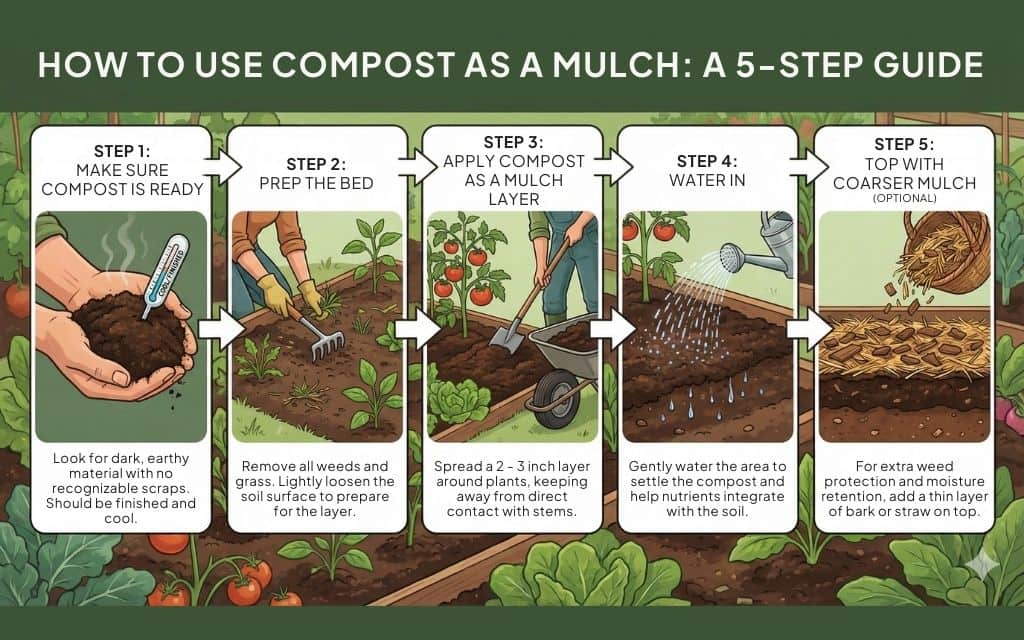
Step 1: Make sure compost is ready
Finished compost appears dark brown to black, with a crumbly texture that holds together when squeezed but breaks apart easily. It smells earthy, like a forest floor – never sour, ammonia-like, or putrid.
You shouldn’t recognize individual kitchen scraps or grass clippings. The pile’s internal temperature should have cooled to near air temperature, indicating active decomposition has finished.
Check for weed seeds by spreading a small amount in a pot, watering it, and watching for two weeks. Heavy weed germination indicates the compost didn’t heat sufficiently. That batch should cure longer or be reserved for mixing into soil rather than surface mulching.
If white mold appears on the surface of your compost pile, let it finish breaking down before use. Surface mold indicates active decomposition. Wait until the material stabilizes.
Step 2: Prep the bed
Remove large weeds by hand or with a hoe. Pull roots entirely rather than cutting at soil level. Clear debris like rocks, sticks, and dead plant material.
For heavily compacted clay areas, loosen the top inch of soil lightly with a garden fork or cultivator. This rough-up helps compost make better contact with underlying soil. Don’t dig deeply – you’ll bring buried weed seeds to the surface and disturb beneficial soil structure.
Level the bed roughly before applying mulch. Fill low spots and remove high points to prevent water pooling and ensure even mulch coverage.
Step 3: Apply compost as a mulch layer
Dump wheelbarrow loads of finished compost in piles around the bed. Use a garden rake to spread material evenly.
For general garden beds, aim for 1 – 2 inches depth. In vegetable gardens with good drainage, you can increase to 2 – 3 inches for better weed suppression and longer-lasting coverage.
Keep compost 2 – 3 inches away from plant stems, tree trunks, and shrub bases. Direct contact holds moisture against bark, creating conditions for rot and attracting insects. Leave a small bare circle around each plant.
For perennial beds, work carefully around emerging plants in spring. Push mulch between clumps rather than covering growth points. As plants expand, the compost layer will settle into gaps naturally.
Step 4: Water in
After spreading compost mulch, water the entire bed thoroughly.
This watering settles the material, eliminates air pockets, makes better soil contact, and starts microbial activity. Without moisture, compost behaves like dust and can blow away in the wind.
Use a gentle spray rather than a hard stream to avoid washing compost around. Soak the layer until water begins penetrating the underlying soil. You’ll see the color darken as material absorbs moisture.
Step 5: Top with coarser mulch (optional)
For longer-lasting coverage and better weed suppression, add 1–2 inches of coarser organic mulch over the compost layer. Shredded bark, wood chips, straw, or shredded leaves work well.
This double-layer strategy combines compost’s soil-building properties with the durability of traditional mulches.
The coarser top layer protects compost from drying out and blowing away in Denver’s wind. It also provides a more finished appearance and lasts longer between applications. As the coarse material breaks down, it mixes with compost below, continuing to improve soil.
Common mistakes when using compost as mulch
Using unfinished compost
Recognizable food scraps, grass clippings, or leaves indicate material hasn’t decomposed enough; ties up nitrogen and introduces weed seeds.
Solution: Wait until compost appears dark, crumbly, and earthy-smelling with no visible raw materials.
Piling compost against stems and trunks
Thick layers of moist material against bark invite fungal diseases, rot, and insect problems; volcano-shaped mounds around trees cause more harm than good.
Solution: Keep a 2–3 inch bare zone around all plant stems, shrub bases, and tree trunks; apply out to drip line but never touching woody tissue.
Skipping weed removal before mulching
Even 2-inch layers won’t stop established perennial weeds with deep root systems; bindweed, quackgrass, and thistle push through easily.
Solution: Remove existing weeds thoroughly and pull roots entirely; consider cardboard barriers under compost in heavily weeded areas.
Applying before heavy rain or snowmelt
Loose, dry compost washes away easily on slopes before settling and bonding with soil.
Solution: Time applications for stable weather periods; water immediately after spreading; secure with heavier top mulch on slopes.
Spreading too thinly
A ½-inch layer provides minimal benefits – insufficient weed suppression, poor moisture retention, and potential crusting.
Solution: Use a ruler to check depth; apply at least 1 inch in ornamental beds, 2 inches in most gardens, up to 3 inches in vegetable beds with good drainage.
Conclusion
You don’t have to choose between improving soil and protecting it. Compost as mulch delivers both benefits in one application. The same material that transforms clay soil also conserves moisture, suppresses weeds, and moderates temperature extremes—perfect for Denver’s challenging climate.
Each season’s compost layer enriches the soil beneath it. Clay becomes more crumbly. Water retention improves. Plant roots grow deeper and stronger. Your garden becomes more resilient to drought, heat stress, and the hazards that challenge Front Range gardening.
Next time you empty your compost bin, skip the plastic bag of bark. Spread a 1–2 inch layer of finished compost on one bed. Watch how the soil and plants respond. Let your Denver garden show you the power of compost mulch.
_______________
For nearly two decades, Mile High Lifescape has helped Denver Metro homeowners build resilient landscapes that thrive in Colorado’s demanding climate. Need guidance on soil improvement or mulching installation in Denver?
Contact us at (303) 877-9091 or hello@milehighlifescape.com.
Frequently asked questions (FAQs)
Can compost be used as mulch, or should it only be mixed into soil?
Yes, compost works effectively as surface mulch. When spread 1 – 2 inches deep, finished compost suppresses weeds, conserves moisture, and feeds plants gradually. In Denver’s clay soils, this top-down approach improves structure naturally without heavy digging.
What is the difference between compost and mulch?
Compost improves soil structure, adds nutrients, and supports beneficial microbes – it works from within. Traditional mulch protects the soil surface by blocking weeds and reducing evaporation. Using compost as mulch combines both functions in one layer.
Is compost the same as mulch?
No, but compost can function as mulch when applied correctly. All compost can serve as mulch, but not all mulches provide the soil-building benefits of compost. In Denver gardens, this dual function makes composted mulch particularly valuable.
Should I mulch with compost alone or compost plus wood chips/leaves?
For vegetable gardens prioritizing soil improvement, compost alone works well, apply 2–3 inches. For ornamental beds needing longer-lasting coverage, use both: spread 1 – 2 inches of compost, then add 1 – 2 inches of wood chips or leaves on top. In Denver’s windy conditions, the coarser top layer prevents compost from blowing away.
Does compost mulch attract pests or diseases?
Properly finished compost that reached 130 – 160°F during decomposition kills weed seeds and disease organisms. Keep compost 2 – 3 inches away from plant stems to prevent rot. Well-made compost actually supports beneficial organisms that suppress plant diseases naturally.
How often should I reapply compost mulch in Denver’s climate?
Plan to top up compost mulch annually in spring after soil warms. In vegetable gardens, you may need to add more mid-season. Denver’s dry air and intense sun accelerate breakdown, making yearly applications necessary for consistent coverage.