
Knowing the types of bermuda grass helps you choose turf that fits your climate, sun, and budget. Written for homeowners deciding between bermuda seed and sod, this guide compares 15 varieties by shade, drought, and cold tolerance. You will avoid costly winterkill and learn whether bermuda suits a Denver yard.
Types of bermuda grass at a glance
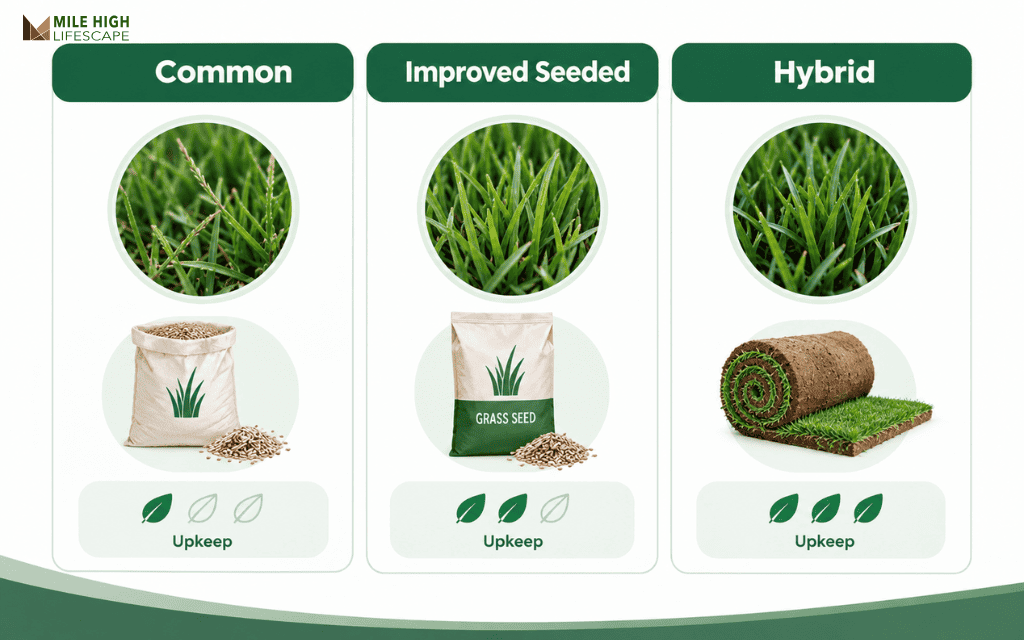
Bermuda grass comes in 3 main types: common bermuda grown from seed, improved turf-type seed, and sterile hybrids sold only as sod, plugs, or sprigs. The table below sums up how each type behaves in a home lawn.
| Type | How it is planted | Texture and color | Upkeep | Best fit |
| Common bermuda | Seed, sod | Coarse, light green | Low | Large, low-budget, sunny areas |
| Improved seeded | Seed (some as sod) | Medium-fine, darker green | Moderate | Home lawns, parks, sports fields |
| Hybrid bermuda | Sod, plugs, sprigs only | Fine, dense, dark green | High | Premium lawns, golf, athletic fields |
Quick picks by need: TifTuf for drought, TifGrand or Celebration for partial shade, Latitude 36, NorthBridge, Tahoma 31, or Yukon for cold winters, and common bermuda for tight budgets. In most Colorado lawns, bermuda grass behaves like a weed. We explain why below.
What is bermuda grass?
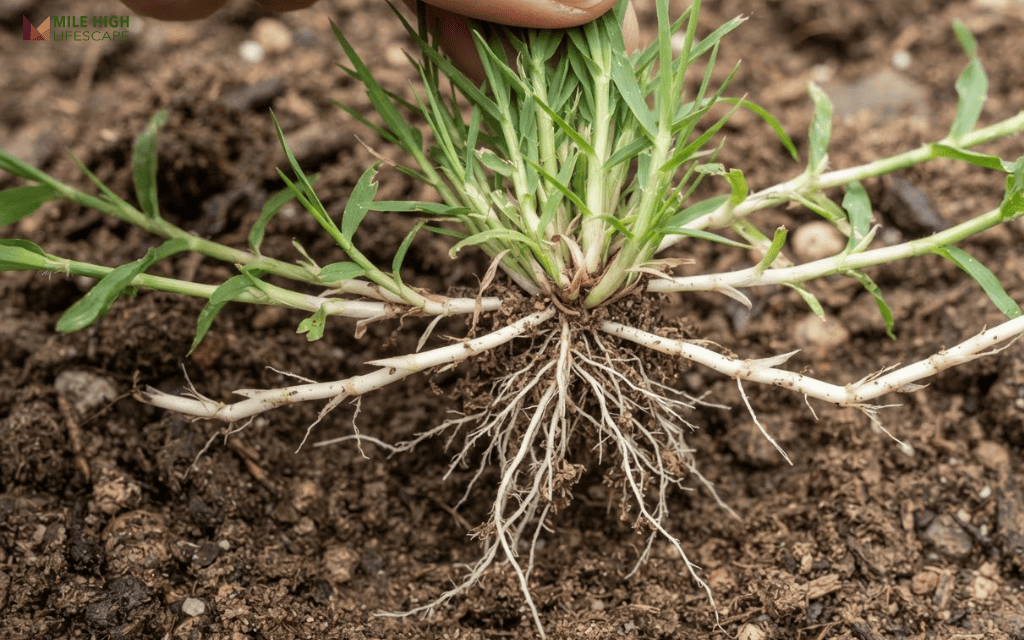
Bermuda grass (Cynodon dactylon) is a warm-season perennial turfgrass that spreads by above-ground stolons and below-ground rhizomes. It grows fast in heat and full sun, then turns straw-brown after the first hard frost.
The species is native to Africa. Records place its arrival in the United States at Savannah, Georgia, in 1751. Today it covers lawns, golf courses, and sports fields across the southern two-thirds of the country.
You can identify bermuda by 5 field traits, according to the University of Georgia:
- Ligule: a fringe of short hairs where the blade meets the stem.
- Blades: short, about 1/8 inch (3 mm) wide, rough along the edges.
- Seedhead: 3 to 5 slender spikes joined at the top of the stem.
- Stolons: long runners that root at each node.
- Rhizomes: white underground stems that survive digging and drought.
The 3 main types of bermuda grass
Bermuda varieties differ in genetics, planting method, and finish quality. Each type below suits a different budget and maintenance level.
Common bermuda grass
Common bermuda is the original, unimproved Cynodon dactylon. It costs the least because you can plant it from seed at 1 to 2 lb of hulled seed per 1,000 sq ft (about 0.5 to 0.9 kg per 93 m²).
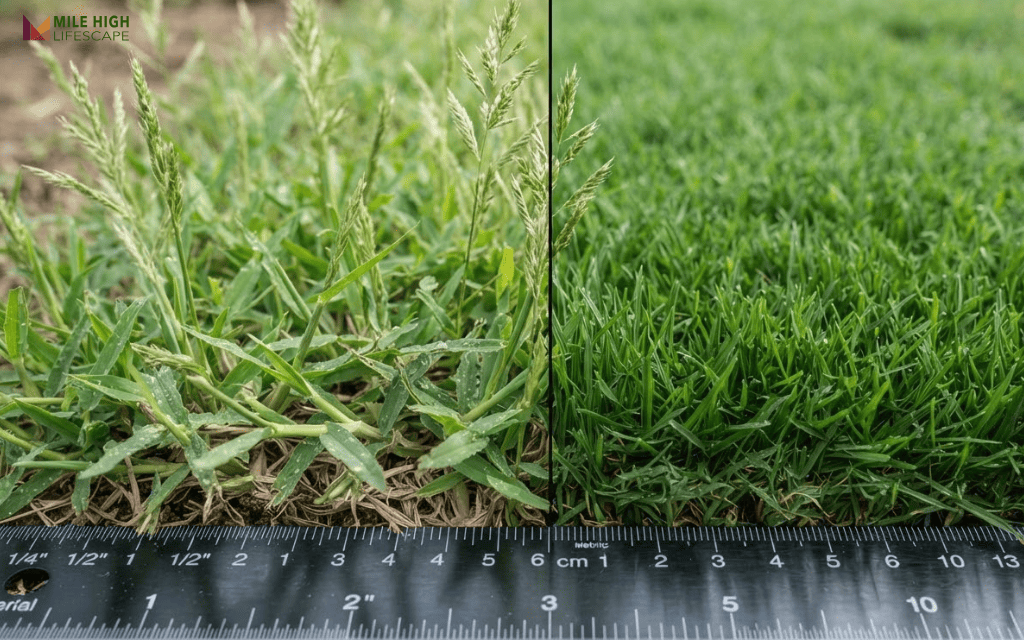
The trade-off shows in the finish. Common bermuda has coarse blades, a lighter green color, and many seedheads. Its deep rhizomes also make it the most invasive type in flower beds and neighboring lawns.
Improved seeded (turf-type) bermuda
Improved seeded varieties are still Cynodon dactylon, but breeders select them for finer texture, darker color, deeper roots, and higher density. Examples include Yukon, Riviera, Princess 77, Sahara, and Sultan.
Seed companies often sell them as blends of 2 or 3 varieties. These seeded types give a middle ground between low cost and a clean, uniform look.
Hybrid bermuda grass
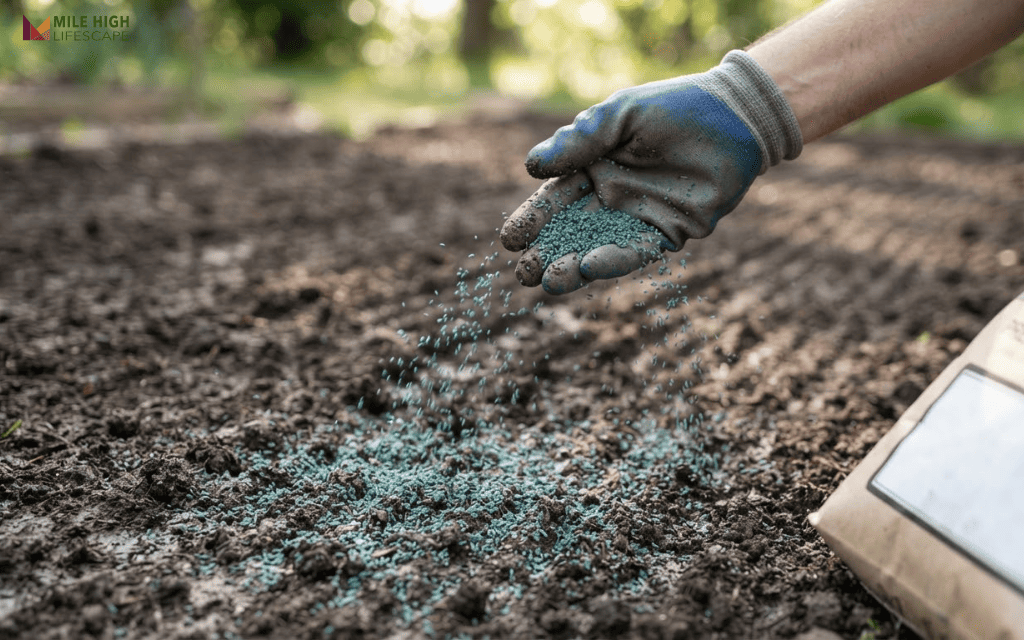
Hybrid bermuda usually crosses common bermuda with African bermuda (Cynodon transvaalensis). The cross pairs the toughness of the first parent with the fine blades of the second. Tifway 419, TifTuf, and Latitude 36 are 3 well-known examples.
Most premium hybrids are sterile, so you can plant them only as sod, plugs, or sprigs. They produce the densest, finest turf, but they need frequent mowing, steady fertilization, and close attention to thatch.
Common-type hybrids vs. true triploid hybrids
University of Georgia breeders Wayne Hanna and Brian Schwartz split “hybrid” bermuda into 2 groups. Triploid interspecific hybrids carry 27 chromosomes, produce no pollen or seed, and grow shallow rhizomes. Tifway, TifGrand, TifTuf, and Latitude 36 belong here.
Common-type hybrids, such as Celebration and Tiflawn, came from natural crosses within Cynodon dactylon. They carry 36 chromosomes, can still set some seed, and grow deeper rhizomes. This explains why a search for “Latitude 36 seed” comes up empty: true hybrids never set viable seed.
Other bermuda types: ultradwarf and forage varieties
Two more bermuda groups appear in search results but rarely belong in a home lawn. Ultradwarf hybrids, such as TifEagle, cover golf putting greens and tolerate mowing heights near 1/8 inch (3 mm).
Forage varieties, such as Coastal, Tifton 85, and Midland 99, feed cattle and produce hay. Texas A&M and Oklahoma State rate them on yield and digestibility, not on lawn quality.
15 popular bermuda grass varieties compared
The 15 varieties below cover the bermuda options homeowners most often see at sod farms and seed suppliers. Cold tolerance reflects university trial notes, not marketing labels. “Limited data” means no public northern trial results were found.
| Variety | Type | Planted as | Developer | Cold tolerance | Shade | Best for |
| Tifway 419 | Hybrid | Sod | Univ. of Georgia | Low | Low | Sports fields, sunny lawns |
| TifTuf | Hybrid | Sod | Univ. of Georgia | Moderate | Fair–good | Drought-prone lawns |
| TifGrand | Hybrid | Sod | Univ. of Georgia | Limited data | Good | Partly shaded lawns |
| Celebration | Common-type hybrid | Sod | Natural selection | Limited data | Fair–good | Busy family lawns |
| Latitude 36 | Hybrid | Sod | Oklahoma State | High | Low–fair | Transition-zone lawns |
| NorthBridge | Hybrid | Sod | Oklahoma State | High | Low–fair | Early spring green-up |
| Tahoma 31 | Hybrid | Sod | Oklahoma State | High | Low–fair | Northern bermuda range |
| Patriot | Hybrid | Sod, sprigs | Oklahoma State | High | Low | Golf tees, sports turf |
| Bimini | Hybrid | Sod, plugs | Commercial breeder | Limited data | Fair | Soft, dense lawns |
| Arizona Common | Common | Seed | Public domain | Low | Low | Low-cost cover |
| Yukon | Improved seeded | Seed | Oklahoma State | High | Low | Cold-winter seeded lawns |
| Riviera | Improved seeded | Seed | Oklahoma State | High | Low | Cold-winter seeded lawns |
| Princess 77 | Improved seeded | Seed | Commercial breeder | Limited data | Low | Fine-textured seeded lawns |
| Sahara | Improved seeded | Seed | Commercial breeder | Limited data | Low | Drought-tolerant seeded lawns |
| Rio | Improved seeded | Seed | Johnston Seed | High | Low | Transition-zone seeding |
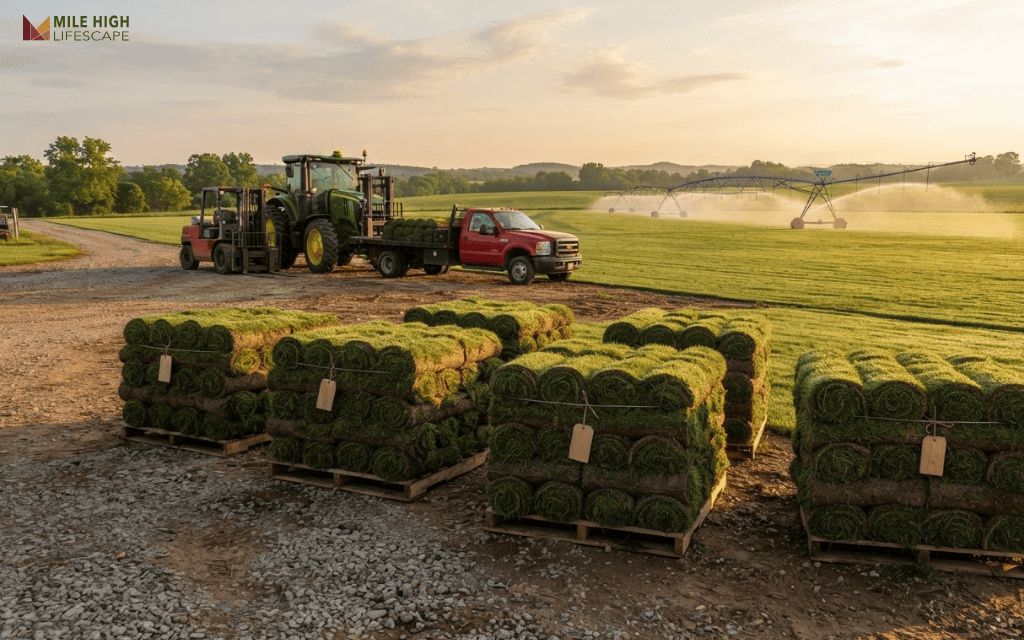
Hybrid sod varieties
Hybrid sod varieties give the finest finish. The 9 options below differ mostly in cold, shade, and water performance.
Plugs offer a cheaper route to the same hybrids. UF/IFAS reports that plugs spaced 12 inches (30 cm) apart cover in 3 to 6 months, while plugs set 24 inches (61 cm) apart take 6 to 9 months.
- Tifway 419: UGA released it in the 1960s, and it still covers many golf courses and athletic fields. It recovers fast from wear but has poor cold hardiness.
- TifTuf: UGA bred it for drought. Its developers report about 38% less water use than other bermudas, and UF/IFAS notes it holds color longer into fall.
- TifGrand: UGA released it in 2009 as a shade-tolerant hybrid. It handles up to 50% shade and needs fewer hours of direct sun than Tifway.
- Celebration: A blue-green bermuda with good traffic tolerance. UF/IFAS lists it as lower maintenance than other fine types, mowed at 1 to 2 inches (2.5 to 5 cm).
- Latitude 36: Oklahoma State released it in 2011 for cold climates. It resists spring dead spots but grows less aggressively than other hybrids.
- NorthBridge: Oklahoma State released it with Latitude 36 in 2011. It greens up earlier in spring than most bermudas.
- Tahoma 31: Oklahoma State released it in 2017. In K-State trials at Wichita, it ranked among the greenest varieties in several spring ratings.
- Patriot: Oklahoma State released it in 2002. It holds color and quality in cold regions and suits golf tees.
- Bimini: A deep green bermuda with growth between Celebration and fine hybrids. UF/IFAS expects mowing needs similar to Celebration.
Seeded bermuda varieties
Seeded varieties cost less and suit large areas. Six options stand out for lawn use.
- Arizona Common: The older industry standard seed. It establishes fast but lacks cold hardiness and fine texture.
- Yukon: Oklahoma State released it in 2000 as a cold-hardy seeded turf type. It showed almost no winter injury in a harsh 2018 Kansas winter.
- Riviera: Oklahoma State released it in 2001. CSU Extension reports that Yukon and Riviera persisted in Fort Collins research plots from 2005.
- Princess 77: A fine-textured seeded type that UF/IFAS reports has performed well throughout Florida.
- Sahara: A drought- and heat-tolerant seeded type bred to look greener than common bermuda.
- Rio: A cold-tolerant seeded variety from Johnston Seed Company in Oklahoma, released with a second cold-tolerant variety, Monaco.
Common vs. hybrid bermuda grass: key differences
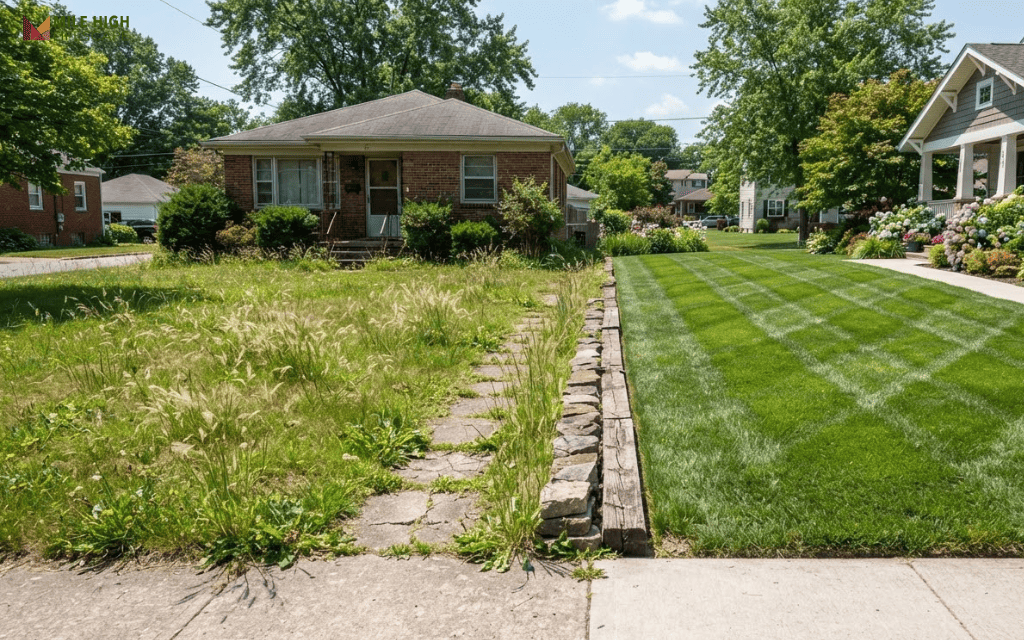
Common and hybrid bermuda grass differ in 7 core traits: seed, texture, density, seedheads, rhizome depth, cost, and upkeep. The table shows each difference.
| Trait | Common bermuda | Hybrid bermuda |
| Seed | Produces viable seed | Sterile, no viable seed |
| Texture | Coarse | Fine |
| Density | Open to moderate | Very dense |
| Seedheads | Many | Few |
| Rhizome depth | Deep, invasive | Shallow in triploid types |
| Mowing height | 1–2 in (2.5–5 cm) | 0.5–1.25 in (1.3–3.2 cm) |
| Upfront cost | Low (seed) | High (sod, plugs) |
Choose common bermuda for low-cost cover on large, sunny areas. Choose a hybrid for a manicured lawn you plan to mow often, ideally with a reel mower.
Popular bermuda matchups
Three head-to-head comparisons come up most often among homeowners choosing bermuda sod or seed.
Celebration vs. Tifway 419
Celebration suits busy home lawns better, while Tifway 419 suits high-maintenance sports turf. Celebration has a blue-green color, tolerates slightly more shade, and accepts a rotary mower at 1 to 2 inches (2.5 to 5 cm).
Tifway 419 gives a fine, dark green surface but needs more nitrogen, frequent mowing, and often a reel mower below 1 inch (2.5 cm). It also showed 100% winter injury in a severe 2017–2018 Kansas winter.
Common bermuda vs. TifTuf
Common bermuda wins on upfront cost, and TifTuf wins on finish and water use. Common bermuda grows from cheap seed but stays coarse and spreads into beds.
TifTuf costs more as sod, yet it holds color under drought and stays green longer into fall. Its developers report about 38% less water use than other bermudas.
Latitude 36 vs. NorthBridge
Latitude 36 and NorthBridge perform close to each other because Oklahoma State released both in 2011 for cold regions. Latitude 36 resists spring dead spots, and NorthBridge greens up a little earlier in spring.
In the 2017–2018 Kansas winter, Latitude 36 showed 80% injury and NorthBridge 75%. Neither grass is winter-proof in extreme cold.
Which bermuda grass types are most cold-hardy?
The most cold-hardy bermuda varieties come from Oklahoma State University: Yukon, Riviera, Patriot, Latitude 36, NorthBridge, and Tahoma 31. Rio and Monaco from Johnston Seed also rank as cold-hardy seeded types.
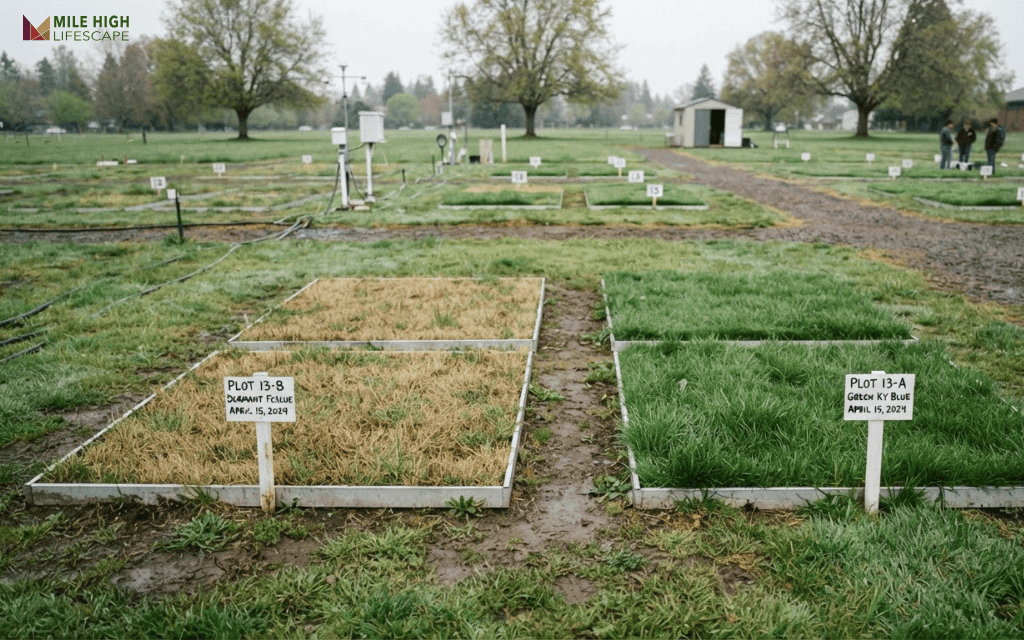
K-State calls Kansas the northernmost region in the central United States where bermuda grows as a perennial lawn. Even there, winterkill limits variety choice. The 2017–2018 winter in Manhattan, Kansas, damaged hybrids at 4 levels:
- Tifway: 100% winter injury.
- Latitude 36: 80% winter injury.
- NorthBridge: 75% winter injury.
- Patriot: 70% winter injury.
Seeded Yukon showed almost no injury that same year. The lesson is clear: “cold-hardy” lowers the risk of winterkill, but it never removes it.
Can bermuda grass grow in Denver and Colorado?
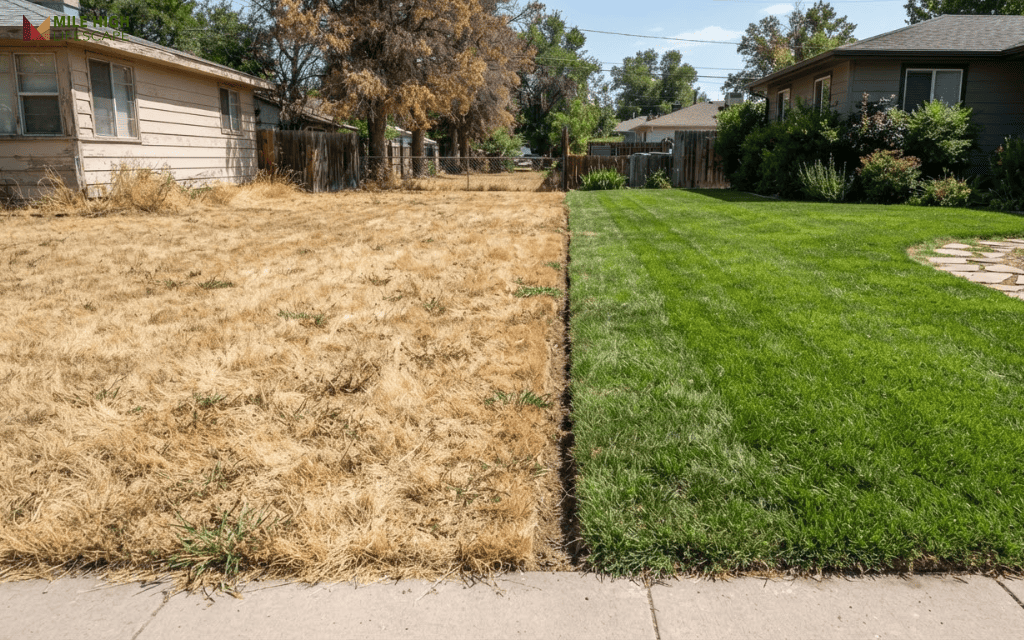
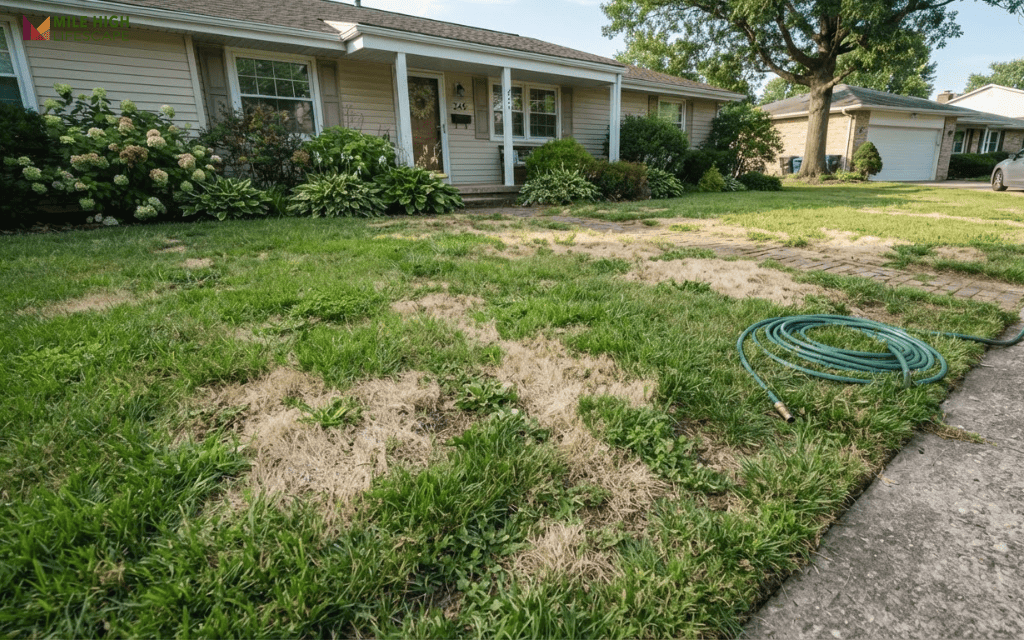
Bermuda grass can survive in Denver, but CSU Extension treats it as a weed in most Colorado lawns. It persists along the Front Range, yet it rarely makes a better home lawn than cool-season grasses at Denver’s elevation of 5,280 feet (1,609 m).
What CSU Extension says
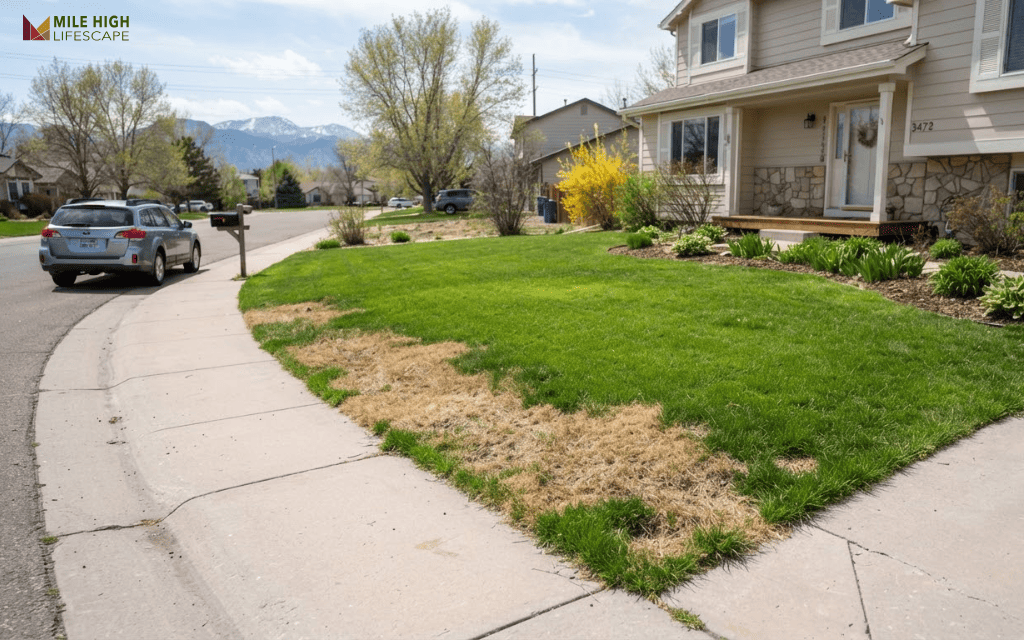
CSU Extension reports that bermuda is becoming a common weed in Colorado lawns and garden beds, especially in hot summers. Naturalized bermuda grows across the state, even in its northern counties.
CSU also notes that a few homeowners use these grasses as lawns with success. Yukon and Riviera persisted in Fort Collins research plots from 2005, which makes them the 2 varieties with Colorado trial history.
The trade-offs for a Denver yard
Bermuda creates 3 trade-offs in a Denver yard:
- Dormancy: Bermuda turns straw-brown after the first frost and greens up in late April or early May. K-State notes this brown period can last 5 months or more.
- Invasion: Rhizomes and stolons spread into Kentucky bluegrass, flower beds, and sidewalk edges. Hand pulling rarely removes them.
- Sun demand: Bermuda needs full sun and thins under trees and on north-facing slopes.
Water restrictions and warm-season lawns
Water rules now shape grass choice in Denver Metro. As of October 2026, Denver Water operates under a Stage 1 drought, limits lawn watering to 2 days per week, and sets October 1 as a hard cutoff for lawn irrigation.
Warm-season grasses use less water than Kentucky bluegrass in summer. For water savings, CSU points Colorado homeowners first to native buffalograss and blue grama, not bermuda.

How to choose the right bermuda type for your yard
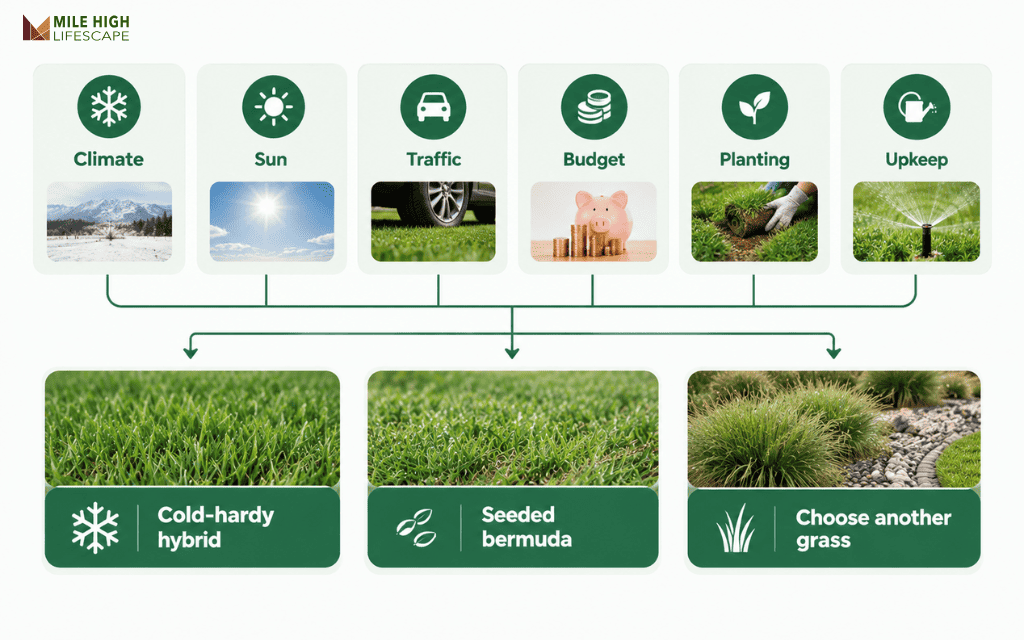
To choose the right bermuda type, match the grass to 6 site factors before you compare brands:
- Climate: Pick Oklahoma State varieties, such as Yukon, Latitude 36, or Tahoma 31, if winters drop below 0°F (-18°C).
- Sun: Plan for full sun. Pick TifGrand or Celebration, if the yard gets a few hours of shade.
- Traffic: Choose Celebration, Tifway 419, or NorthBridge for kids, dogs, and backyard games.
- Budget: Start with seeded Yukon or Riviera to cover large areas for less money.
- Planting method: Use sod for an instant lawn, and use seed only for common or improved seeded types.
- Upkeep: Expect weekly mowing, regular nitrogen, and yearly thatch control for hybrids.
Timing matters as much as variety. CSU Extension advises seeding warm-season grasses, including bermuda, in spring or early summer, once soil warms and frost risk passes.
If your yard fails 2 or more of these checks, a different grass species will likely perform better.
Found bermuda grass in your bluegrass lawn? Here’s what to do
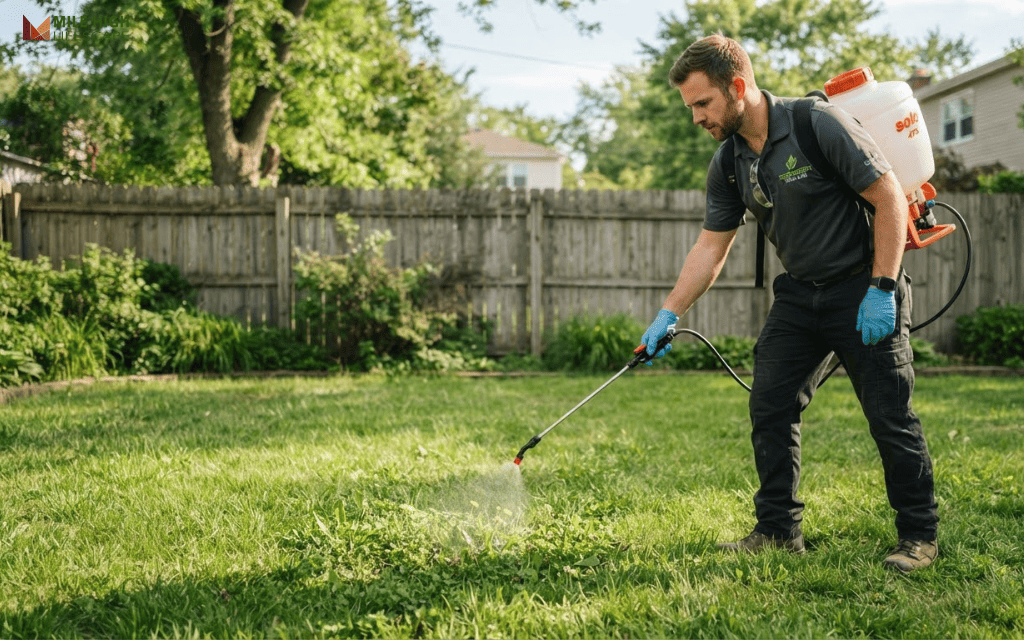
To control bermuda in a cool-season lawn, treat it only while it is green and actively growing. CSU Extension notes that any herbicide applied to dormant, brown bermuda fails.
Follow 4 steps that CSU and K-State recommend:
- Confirm the grass: Look for straw-colored patches in spring, stolons, and 3 to 5 spike seedheads. Crabgrass looks similar but dies each fall.
- Treat selectively: Use mesotrione (Tenacity) in bluegrass, ryegrass, or fescue lawns. Plan several applications through summer, and always follow the label.
- Spot-kill large patches: Spray glyphosate 2 to 3 feet (0.6 to 0.9 m) past the visible patch, then repeat 2 to 3 times every 3 to 4 weeks. Full control can take 2 to 3 years.
- Strengthen the turf: Mow cool-season grass high, skip summer nitrogen, and fertilize in fall to help bluegrass outcompete bermuda.
Our lawn care services include fertilization and weed control on a seasonal schedule. Badly infested lawns may need turf renovation and new sod.
Better-fit lawn options for Denver homeowners
Four grasses fit most Denver yards better than bermuda, according to CSU Extension:
- Kentucky bluegrass: It forms dense sod, recovers from wear, and comes as sod across Colorado. It needs more water and nitrogen than other options.
- Turf-type tall fescue: It roots deep, tolerates shade, and resists wear. It suits yards with mixed sun and moderate traffic.
- Buffalograss: This native warm-season grass uses less water and needs little mowing. CSU limits it to elevations below 6,500 feet (1,981 m).
- Blue grama: Colorado’s state grass handles cold, heat, and drought. It tolerates little traffic and does best on sunny, low-use areas.
For yards that need less lawn overall, xeriscape landscaping replaces thirsty turf with water-wise plants, rock, and mulch.
Sod installation for Denver lawns with Mile High Lifescape
Our Sod Installation service gives Denver Metro homeowners a finished lawn in one visit. Sod works well when you replace a lawn overrun by bermuda or start fresh after renovation.
Each sod project follows 4 stages:
- Assess the site: We check sun exposure, soil type, slope, and how you use the yard before we recommend a grass.
- Prepare the soil: We remove old turf, rocks, and debris, then level the grade and add organic matter.
- Lay the sod: We stagger the rolls in a brick pattern with tight seams for fast rooting.
- Set up watering: We match irrigation to the new lawn and explain the first weeks of care.
With over 20 years of experience in Denver Metro, our team picks grass that suits local soil, elevation, and water rules.

When to call a lawn care professional
Call a lawn care professional when bermuda covers more than a few patches, returns after 2 seasons of treatment, or spreads into garden beds. All types of bermuda grass spread by stolons, so these signs usually call for renovation, not spot treatment.
Mile High Lifescape offers 4 related lawn services across Denver, Lakewood, Littleton, Centennial, and nearby cities:
- Fertilization and weed control to keep bluegrass dense enough to resist invaders.
- Aeration and overseeding to thicken thin turf after weed removal.
- Turf renovation to rebuild lawns lost to bermuda or winterkill.
- Sod installation to deliver a complete new lawn.
After weed removal, lawn aeration opens compacted clay soil so new grass roots deeper.
The types of bermuda grass differ in climate fit, cost, and upkeep: hybrids give the finest turf, seeded types save money, and Oklahoma State varieties handle cold best. Call (303) 877-9091 for help with weed control or sod. In most Denver yards, cool-season or native grasses outperform all types of bermuda grass.
FAQs about bermuda grass types
Are there different types of bermuda grass?
Yes, there are 3 main types: common, improved seeded, and hybrid. Within these types, breeders have released dozens of named cultivars, such as Tifway 419, Celebration, and Yukon.
What is the best bermuda grass for residential lawns?
Celebration and TifTuf suit most warm-climate home lawns, while Latitude 36 and Yukon suit colder regions. The right choice depends on winter lows, sun, and traffic.
Which bermuda grass is most cold-tolerant?
Oklahoma State varieties, such as Yukon, Riviera, Tahoma 31, Latitude 36, and NorthBridge, show the highest cold tolerance. Severe winters can still injure them.
Can you buy hybrid bermuda grass as seed?
No, true hybrid bermuda is sterile and sells only as sod, plugs, or sprigs. Seed labeled “hybrid” contains improved common bermuda.
Which bermuda grass handles shade best?
TifGrand handles shade best, tolerating up to 50% shade. Celebration and TifTuf also tolerate more shade than most bermudas.
Is bermuda grass a weed in Colorado?
Yes, CSU Extension classifies bermuda as a weed in most Colorado lawns. It invades Kentucky bluegrass and stays brown for months each year.
How long does bermuda grass stay brown in winter?
Bermuda stays brown from the first fall frost until late April or early May in Colorado. K-State notes the dormant period can last 5 months or more.