Here is how to get rid of goosegrass for good: remove the plants you can see, then block the seeds you cannot. We wrote this guide for Denver Metro homeowners with bluegrass or fescue lawns. It covers identification, label-safe herbicides, Front Range timing, and the soil fixes that stop goosegrass from coming back.
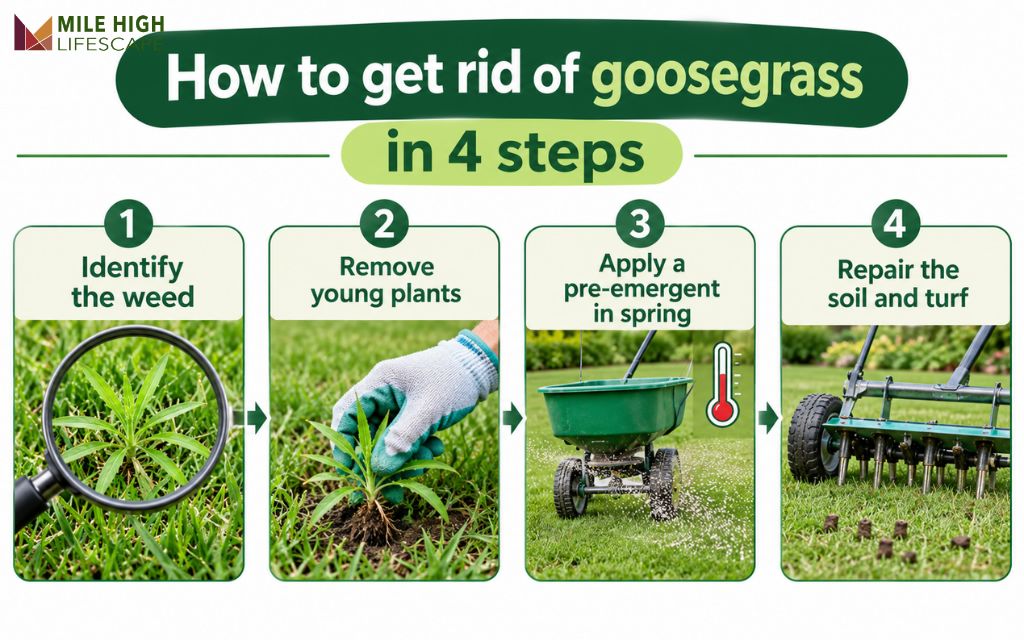
How to get rid of goosegrass in 4 steps
To get rid of goosegrass, kill young plants before they set seed, stop next year’s seedlings with a pre-emergent, and fix the packed soil that lets the weed move in. Goosegrass is an annual, so breaking its seed cycle ends the problem.
Follow these 4 steps in order:
- Identify the weed: Confirm you have goosegrass and not crabgrass, because the two sprout weeks apart and need different timing.
- Remove young plants: Pull small patches or spot-treat them with a grass herbicide labeled for your lawn type before plants form 2 side shoots.
- Apply a pre-emergent in spring: Put it down before soil at 2 inches (5 cm) reaches 62–65°F (17–18°C), and plan a second application.
- Repair the soil and turf: Core aerate, mow at 2.5–3 inches (6–8 cm), water deeply, and fill bare spots with seed or sod.
What is goosegrass?
Goosegrass (Eleusine indica) is a summer annual grass weed, also called silver crabgrass. It sprouts in late spring, grows through the summer heat, and dies at the first fall frost.
One plant can produce thousands of seeds that stay viable in soil for several years, so one missed season can refill the lawn.
How to identify goosegrass in your lawn
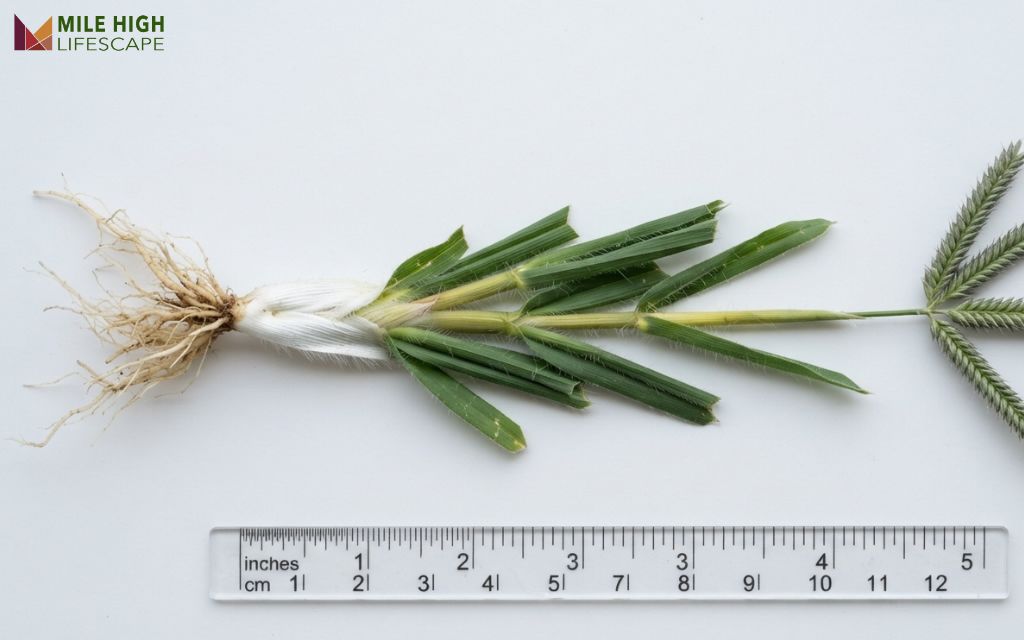
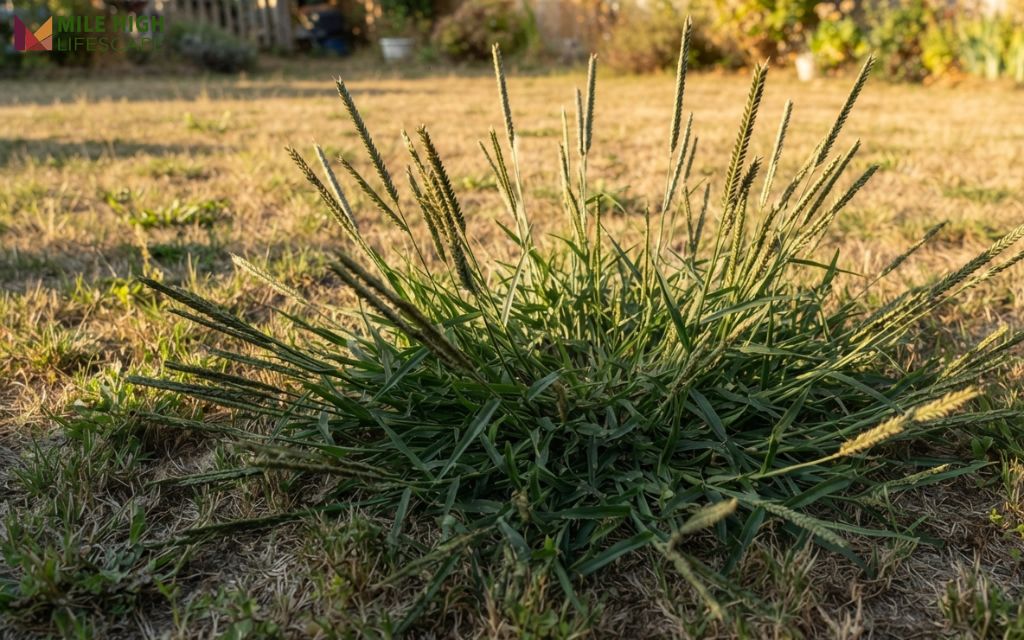
You can identify goosegrass by its flat, wagon-wheel shape and silver-white center. Check these 5 traits:
- Growth habit: Stems spread out from one point and lie flat, so the plant often slips under mower blades.
- Stem base: The center turns silver or white in summer, which gives the weed its nickname.
- Leaf blades: Folded blades measure 1/4–1/2 inch (6–13 mm) wide and 2–10 inches (5–25 cm) long, in a medium to dark green.
- Ligule: A short, jagged membrane about 1/16 inch (1–1.5 mm) tall sits where the blade meets the stem.
- Seedhead: Two to seven spikes fan out from the stem tip, each lined with two rows of seeds that look like a zipper.
Goosegrass vs. crabgrass: how to tell them apart
Four traits separate goosegrass from crabgrass:
| Trait | Goosegrass | Crabgrass |
| Plant center | Silver-white, flattened | Green, or purple in smooth crabgrass |
| New leaves | Folded along the midvein | Rolled in the bud |
| Spread | Stays in one clump, no rooting at stem joints | Roots at stem joints and creeps outward |
| Sprouting time | About 3–4 weeks after crabgrass | Early to mid-spring |
The timing gap matters most. A crabgrass preventer applied on the usual schedule can wear off before goosegrass starts to sprout.
Why goosegrass grows in your lawn
Goosegrass grows where turf is weak and soil is hard. It tolerates compaction, heat, and foot traffic better than Kentucky bluegrass or tall fescue, so it claims the spots your lawn gives up.
Watch for it in these 4 sites:
- Traffic paths: Dog runs, play areas, and footpaths press the soil tight.
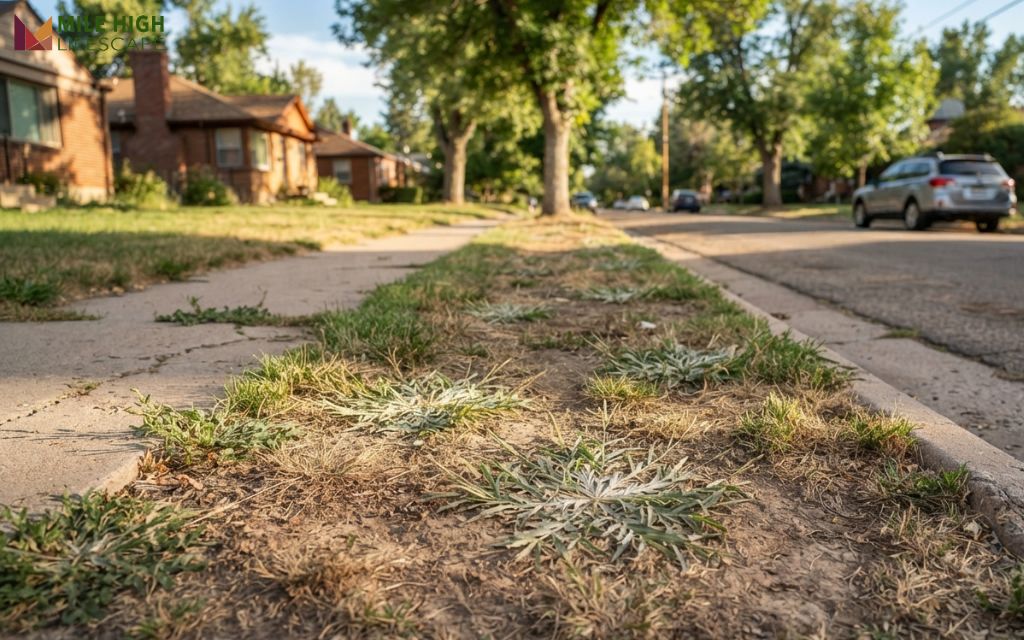
- Hardscape edges: Sidewalk, curb, and driveway strips heat up and thin out.
- Scalped turf: Lawns mowed under 2 inches (5 cm) let sunlight reach weed seeds.
- Overwatered spots: Light, daily irrigation keeps seeds moist and ready to sprout.
On the Denver Metro lawns our crews maintain, goosegrass tends to appear first along driveway edges and pet paths. We read it as a soil warning, not only a weed problem.
Is goosegrass a problem in Colorado lawns?
Yes, goosegrass can be a problem in Colorado lawns below about 6,000–6,500 feet (1,830–1,980 m). CSU Extension groups it with crabgrass, foxtail, and barnyardgrass as summer annual grasses that trouble lower-elevation lawns.
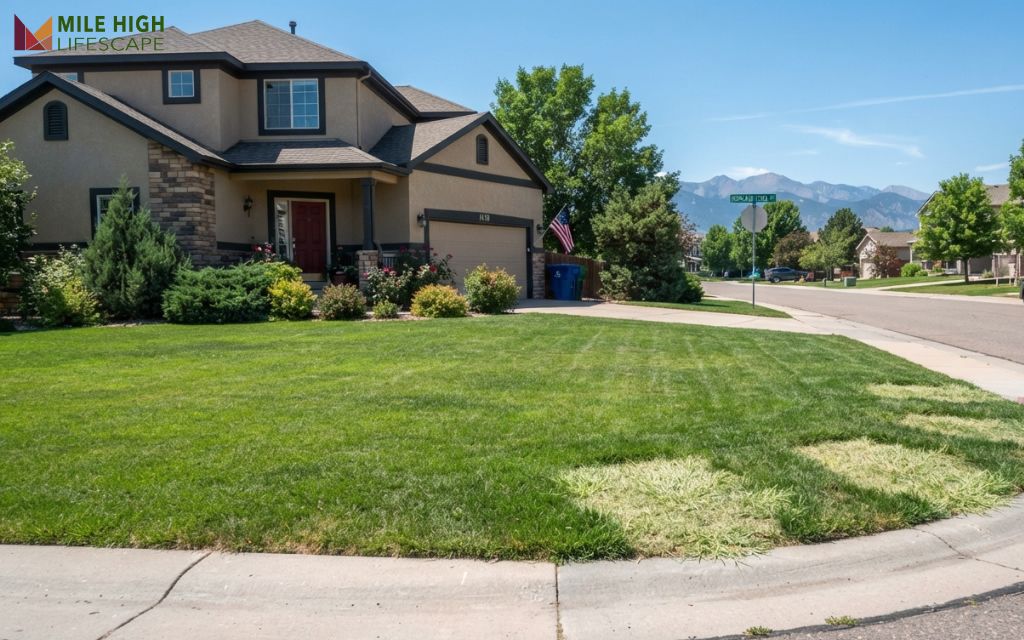
Denver sits at about 5,280 feet (1,609 m), so lawns from Lakewood to Thornton fall inside that range. Most of these lawns are cool-season turf, such as Kentucky bluegrass, tall fescue, and perennial ryegrass. That turf type decides which herbicides are safe.
CSU also notes that pre-emergents control goosegrass less reliably than crabgrass.
How to kill goosegrass that is already growing
To kill goosegrass that has already sprouted, match the method to the patch: pull a few plants, spot-treat scattered clumps, and keep non-selective products for cracks.
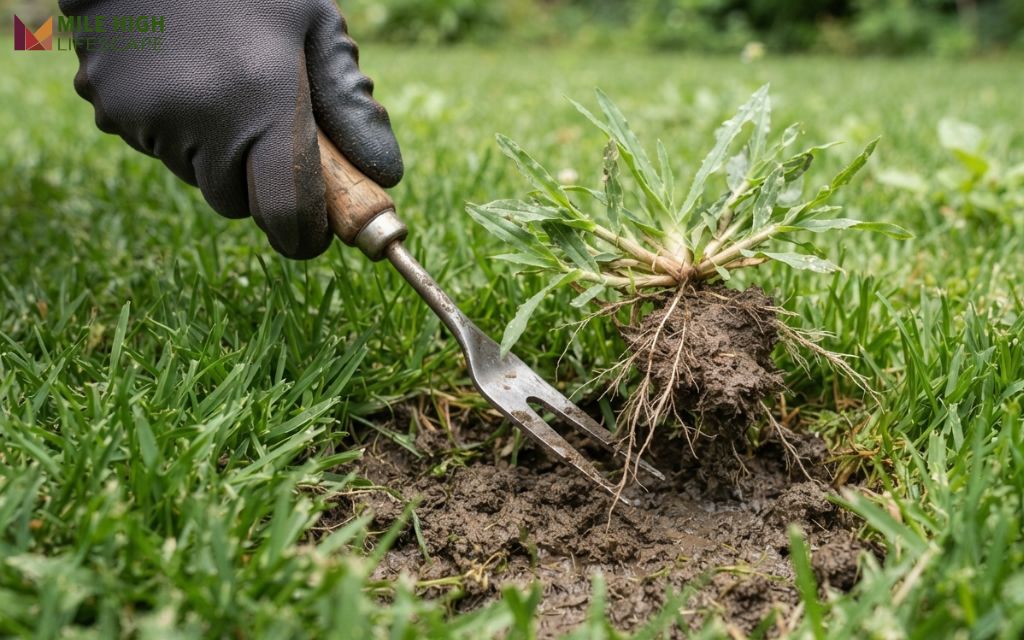
Pull or dig out small patches
Hand-pulling works best on young plants and small infestations. Pull after rain or irrigation, when moist soil releases roots more easily.
Use a weeding knife to lift the whole crown, then fill the hole with seed or a sod plug.
Choose a post-emergent herbicide labeled for your grass type
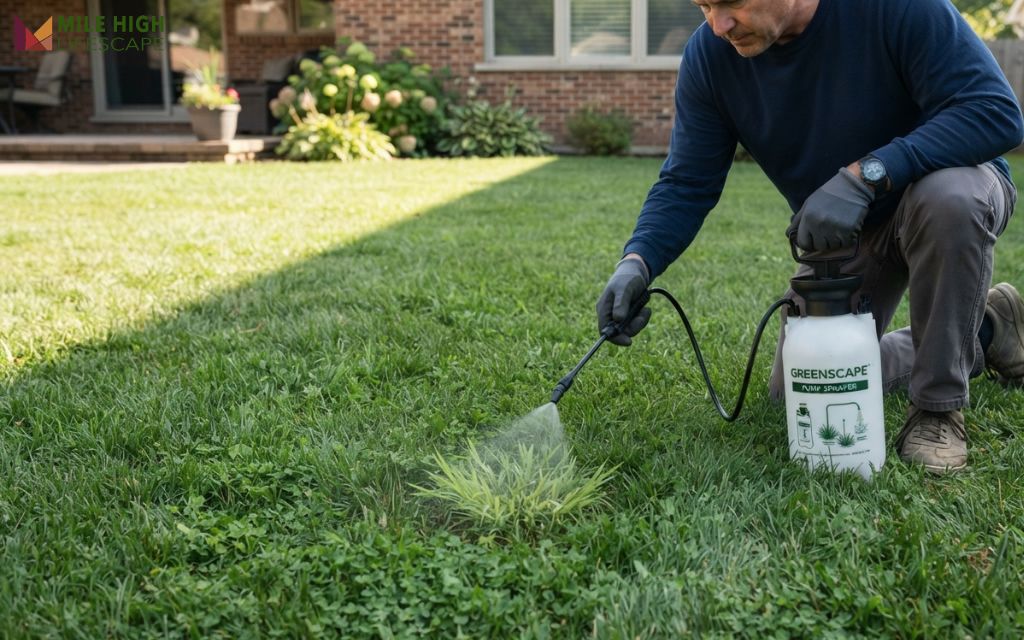
Choose a selective post-emergent herbicide that lists both goosegrass and your lawn grass on its label. Dandelion and clover products target broadleaf weeds, not grasses.
Timing decides the result. Control is easiest at the leaf stage and drops once the plant forms 2 tillers, or side shoots. Spray when soil is moist and temperatures are moderate.
What kills goosegrass in Kentucky bluegrass and tall fescue lawns
Three active ingredients control goosegrass in cool-season lawns: fenoxaprop-p-ethyl, mesotrione, and topramezone. Each has limits, so compare them before you buy:
| Active ingredient | Example product | Lawn fit and limits |
| Fenoxaprop-p-ethyl | Acclaim Extra | Safe on major cool-season grasses; not for bermudagrass or buffalograss. |
| Mesotrione | Tenacity | Labeled for bluegrass, ryegrass, and tall fescue; best on seedlings, often in 2 applications. |
| Topramezone | Pylex | Strong on goosegrass; safe on major cool-season grasses; needs the right adjuvant. |
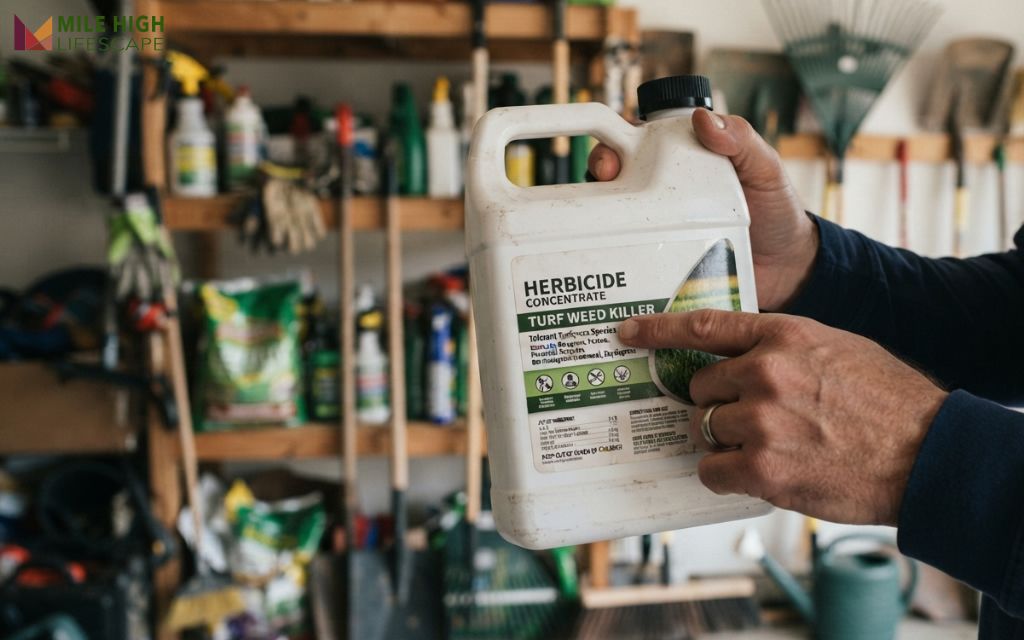
Read the current label before you spray. It lists the grasses, rates, and intervals a product allows, and it overrides any guide, including this one.
What kills goosegrass in bermuda and other warm-season lawns
Bermudagrass lawns have fewer goosegrass options than cool-season lawns. Foramsulfuron (Revolver) is labeled for goosegrass in warm-season turf, often in repeat applications. Keep these products off Colorado bluegrass.
Does Celsius WG kill goosegrass?
No, Celsius WG is not labeled for goosegrass. Its label lists grass weeds such as large crabgrass, dallisgrass, and foxtails, and goosegrass does not appear on it.
The label also prohibits use on Kentucky bluegrass and limits application to licensed commercial applicators. For most Denver lawns, Celsius WG is the wrong product.
Kill goosegrass in sidewalk cracks, driveways, and beds
Non-selective herbicides, such as glyphosate, kill goosegrass in pavement cracks and gravel. They also kill any lawn grass they touch, so keep them off turf and shield nearby plants.
In planting beds, a 3-inch (7.5 cm) layer of wood or bark mulch blocks light and limits new seedlings.
How to prevent goosegrass with a pre-emergent herbicide
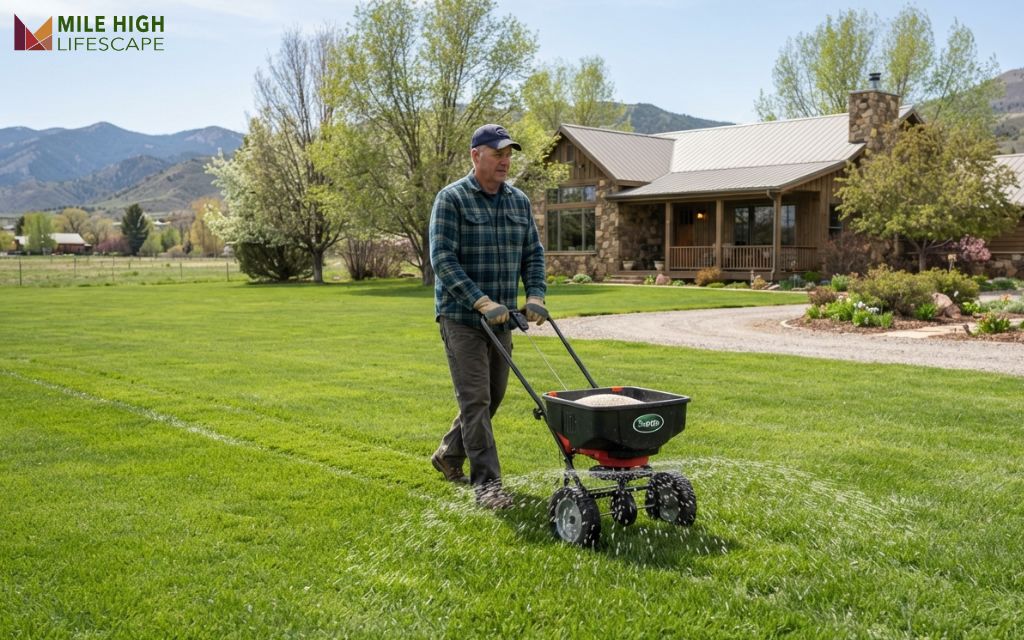
To prevent goosegrass, apply a pre-emergent herbicide before the seeds sprout, then water it in. A pre-emergent forms a barrier in the top layer of soil, but it will not control plants that have already emerged.
When to apply pre-emergent in the Denver area
Along the northern Front Range, crabgrass sprouts from mid-April to mid-May, and CSU advises applying pre-emergents 2–4 weeks earlier. Goosegrass follows about 3–4 weeks after crabgrass.
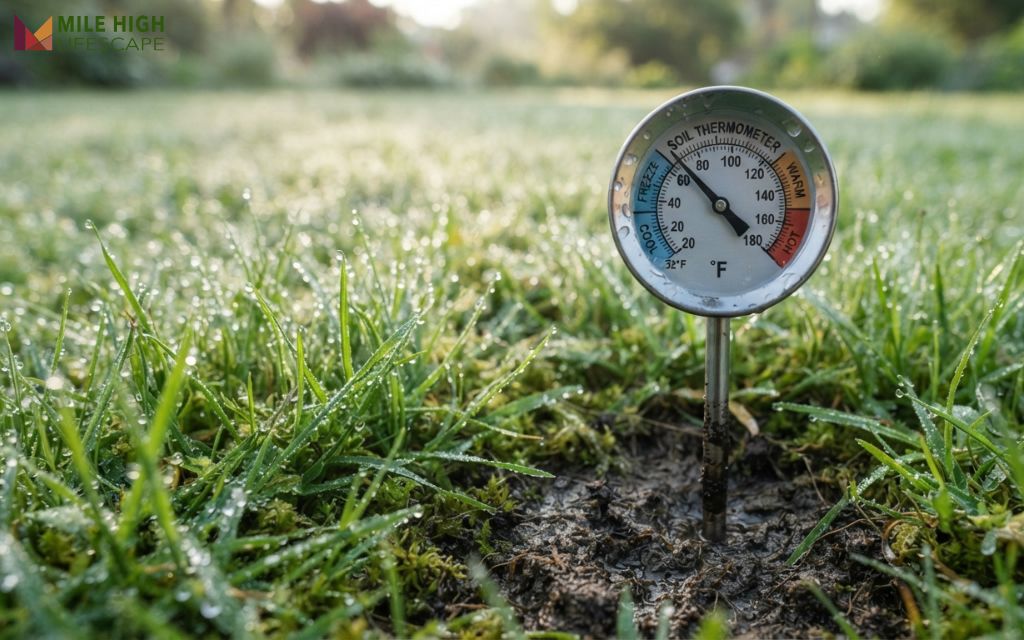
Penn State recommends having the barrier in place before the daily high soil temperature at 2 inches (5 cm) reaches 62–65°F (17–18°C). A soil thermometer gives a better cue than the calendar, because warm, moist springs speed germination and cool, dry springs delay it.
Why your crabgrass preventer may miss goosegrass
A single early application can fade before goosegrass finishes sprouting. Penn State notes that a second application 6–8 weeks after the first often helps where goosegrass seed is present.
Split rates must stay within the label’s yearly maximum. Water each application with about 1/2 inch (13 mm) of irrigation within 1–2 days.
Pre-emergent options rated for goosegrass
CSU Extension rates common pre-emergent ingredients by how well they control goosegrass. Use this table to compare products at the store:
| Active ingredient | Example brand | CSU goosegrass rating | Note |
| Pendimethalin | Pre-M, Pendulum | Excellent | Common homeowner choice; follow rate limits |
| Dithiopyr | Dimension | Good to excellent | Does not control goosegrass that has emerged |
| Prodiamine | Barricade | Good | Yearly rate limits differ by grass species |
| Oxadiazon | Ronstar | Excellent | Granular only on cool-season turf; restricted on home lawns in some states |
| Bensulide | Betasan | Poor to fair | Weak choice for goosegrass |
Cultural fixes that stop goosegrass long-term
Herbicides treat the symptom, while dense turf removes the opening. Focus on these 5 fixes:
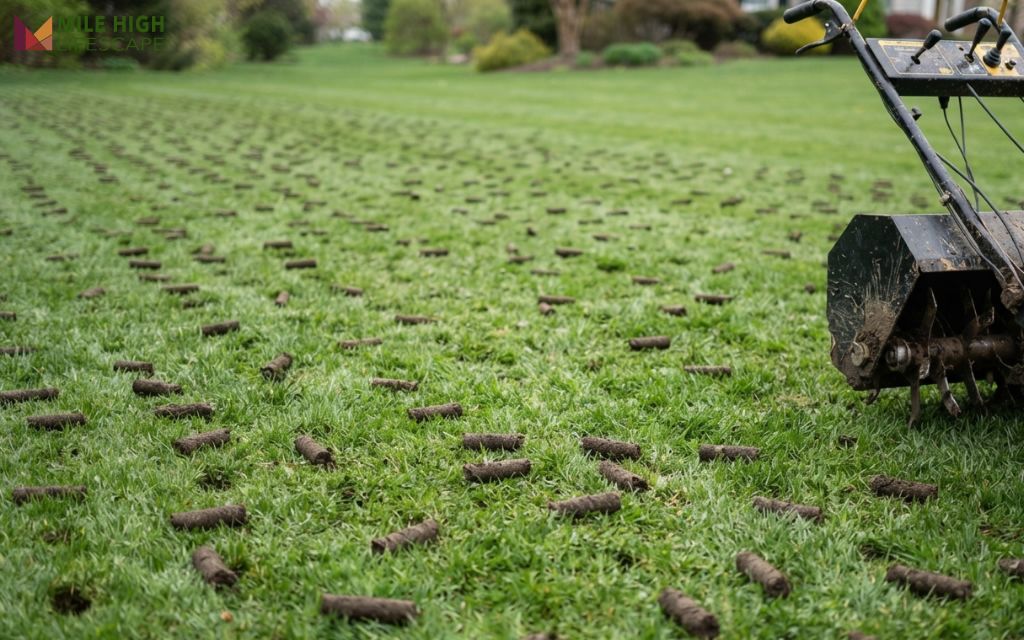
Relieve compaction with core aeration
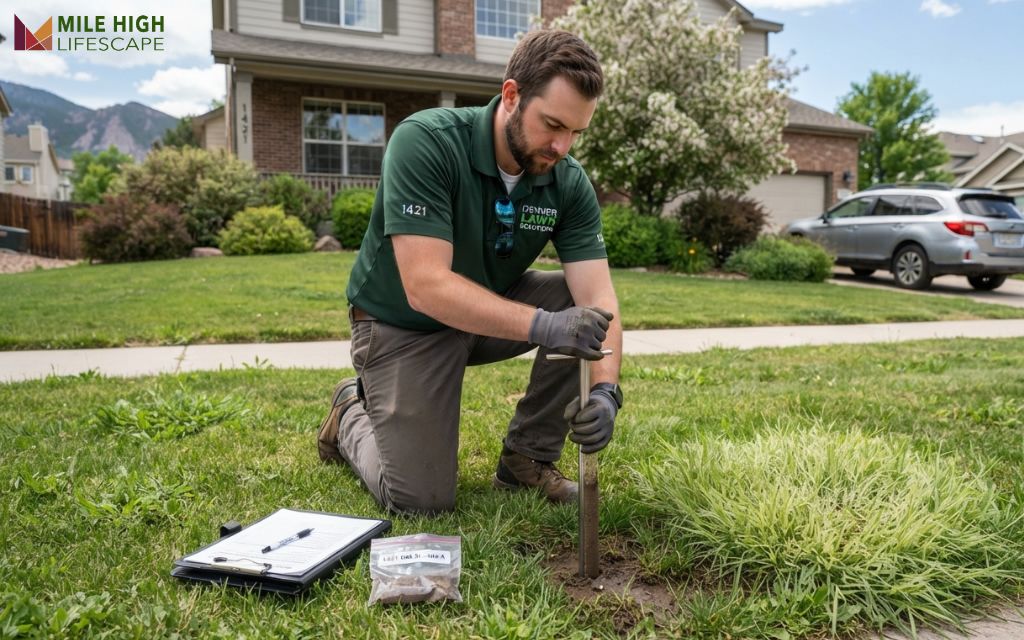
Core aeration pulls plugs of soil from the lawn and lets air, water, and roots move into packed ground. CSU recommends core aerating at least once a year to reduce compaction and thatch.
On goosegrass-prone spots, aerate before you apply pre-emergent, or follow your product label if you aerate afterward. Our lawn aeration service targets the compacted areas where goosegrass starts.
Mow higher: 2.5–3 inches for cool-season grass
Raise your mower to 2.5–3 inches (6–8 cm) for bluegrass, tall fescue, and ryegrass in summer. CSU notes that lawns mowed under 2 inches (5 cm) suffer more from aggressive annual grasses. Remove no more than one-third of the blade at each cut.
Water deeply and less often
Deep, infrequent watering builds roots and lets the soil surface dry between cycles. Water by need, and check your local watering rules each season.

Fill thin spots with seed or sod
Bare soil invites the next flush of goosegrass, so cover it fast. Overseed in late summer or early fall, when cool-season grass establishes best.
Most pre-emergents also stop grass seed, and Rutgers lists mesotrione as the main option that is safe at seeding. For larger dead areas, new sod covers the soil at once.
Redesign high-traffic strips where grass always fails
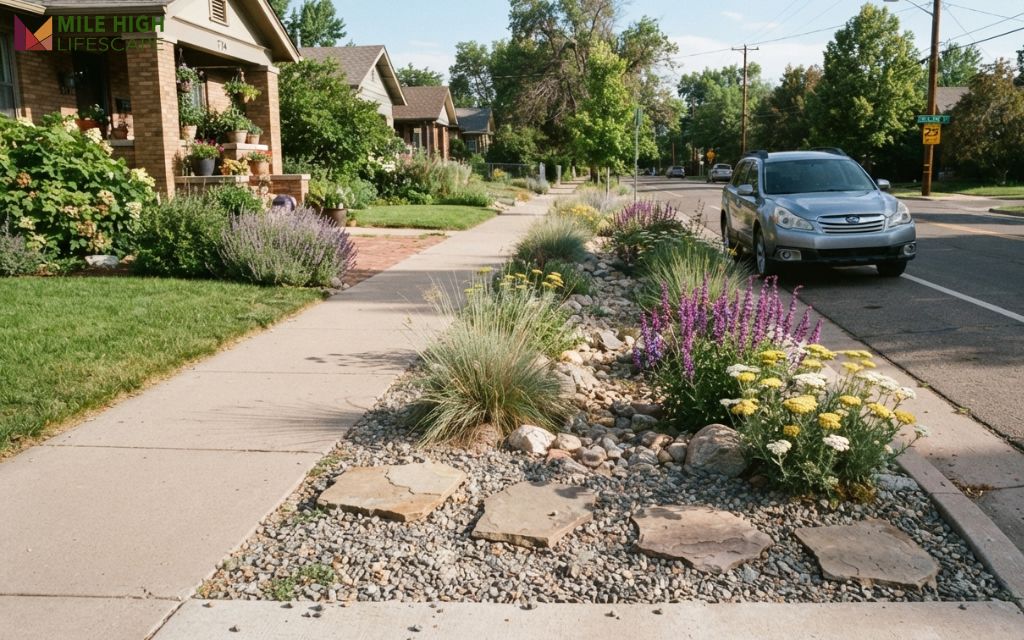
Some areas never hold turf, such as narrow strips between the sidewalk and curb. Replace them with stepping stones, mulch, or landscape rock, or plant them with xeriscape landscaping. A strip without bare soil gives goosegrass nowhere to grow.
Sod installation for lawns too damaged to recover
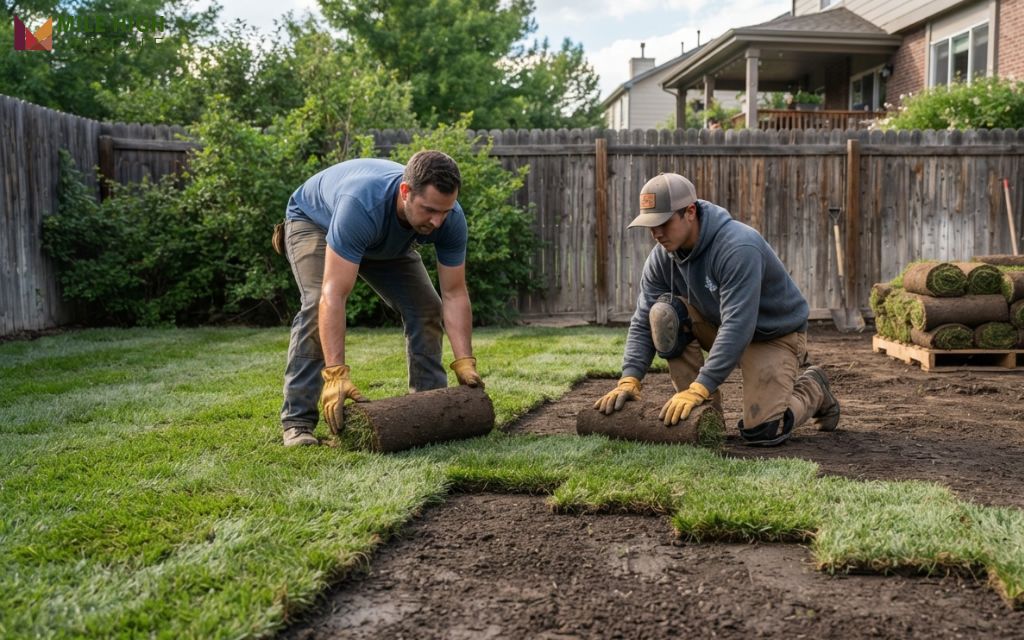
When goosegrass and compaction leave large bare areas, professional Sod Installation gives you a full lawn faster than seed. Sod covers the soil on day one, which leaves weed seeds less light and space.
New turf rolls can handle light foot traffic in about a week, while a seeded lawn may need a few months. Our sod projects follow 4 stages:
- Site assessment: We review your soil, sunlight, and yard layout, then plan the lawn around them.
- Soil preparation: We remove rocks and weeds, level the ground, and add organic matter or fertilizer.
- Sod laying: We lay rolls in a staggered pattern with no gaps, then water them in.
- Aftercare guidance: We explain how to keep the soil moist and when to start mowing.
With over 20 years of experience in the Denver Metro area, we prepare the soil first, so goosegrass has less to work with.
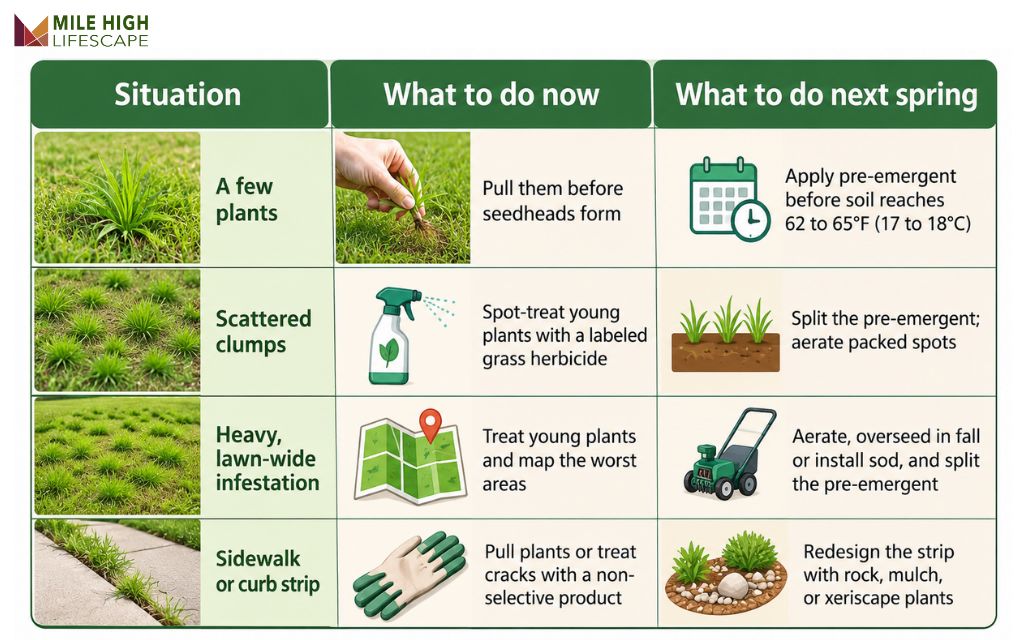
Goosegrass control plan by situation
Your plan depends on how much goosegrass you have and where it grows. Use this table to match your yard to a response:
| Situation | What to do now | What to do next spring |
| A few plants | Pull them before seedheads form | Apply pre-emergent before soil reaches 62–65°F (17–18°C) |
| Scattered clumps | Spot-treat young plants with a labeled grass herbicide | Split the pre-emergent; aerate packed spots |
| Heavy, lawn-wide infestation | Treat young plants and map the worst areas | Aerate, overseed in fall or install sod, and split the pre-emergent |
| Sidewalk or curb strip | Pull plants or treat cracks with a non-selective product | Redesign the strip with rock, mulch, or xeriscape plants |
6 common goosegrass control mistakes
Most failed programs trace back to timing, product choice, or soil. Avoid these 6 mistakes:
- Using a broadleaf weed killer: Dandelion and clover products give poor control of a grassy weed.
- Applying pre-emergent once: A single early application can fade before goosegrass finishes sprouting.
- Waiting for mature plants: Post-emergent control drops after the 2-tiller stage.
- Buying a warm-season product: Celsius WG and similar products are not labeled for Kentucky bluegrass lawns.
- Relying on quinclorac: Virginia Tech weed scientist Shawn Askew told Lawn & Landscape that quinclorac gives poor goosegrass control.
- Ignoring compaction: Packed soil keeps inviting new seedlings.
When to call a lawn care professional
Call a lawn care professional if you have tried every step on how to get rid of goosegrass and the weed still returns each summer. That pattern points to a soil problem, not a spray problem.
Professional help makes sense in 3 situations:
- Recurring infestations: The weed comes back despite correct pre-emergent timing.
- Restricted products: The best option for your lawn is labeled for licensed commercial applicators only.
- Large repairs: The lawn needs aeration, overseeding, turf renovation, or new sod.
In Colorado, any business that applies pesticides for hire must hold a commercial pesticide applicator business license. Ask any provider to show theirs before work begins.
Mile High Lifescape brings over 20 years of experience to lawns across the Denver Metro area. Our lawn care in Denver pairs fertilization and weed control with aeration, overseeding, and mowing, so goosegrass loses the conditions it needs.
FAQs about goosegrass
Will goosegrass die in winter?
Yes, goosegrass plants die after the first fall frost, but their seeds survive. Those seeds sprout the next spring, so plan your pre-emergent before the soil warms.
Can a crabgrass preventer stop goosegrass?
Yes, many crabgrass preventers also control goosegrass, but a single early application often runs out too soon. A split application covers the later germination window.
What kills goosegrass but not grass?
Selective herbicides with fenoxaprop-p-ethyl, mesotrione, or topramezone kill goosegrass in cool-season lawns when used as labeled. Confirm your grass species appears on the label first.
Can I overseed after applying pre-emergent?
Wait for the interval on the label, because most pre-emergents also stop grass seed. Mesotrione is the main exception and can go down at seeding.
How to get rid of goosegrass naturally: do vinegar or organic weed killers work?
Natural post-emergent products are generally non-selective, so they can burn the lawn around the weed. Rutgers also reports that corn gluten meal rarely gives acceptable control under heavy weed pressure. The most reliable natural approach is to pull young plants and fix compacted, thin turf.