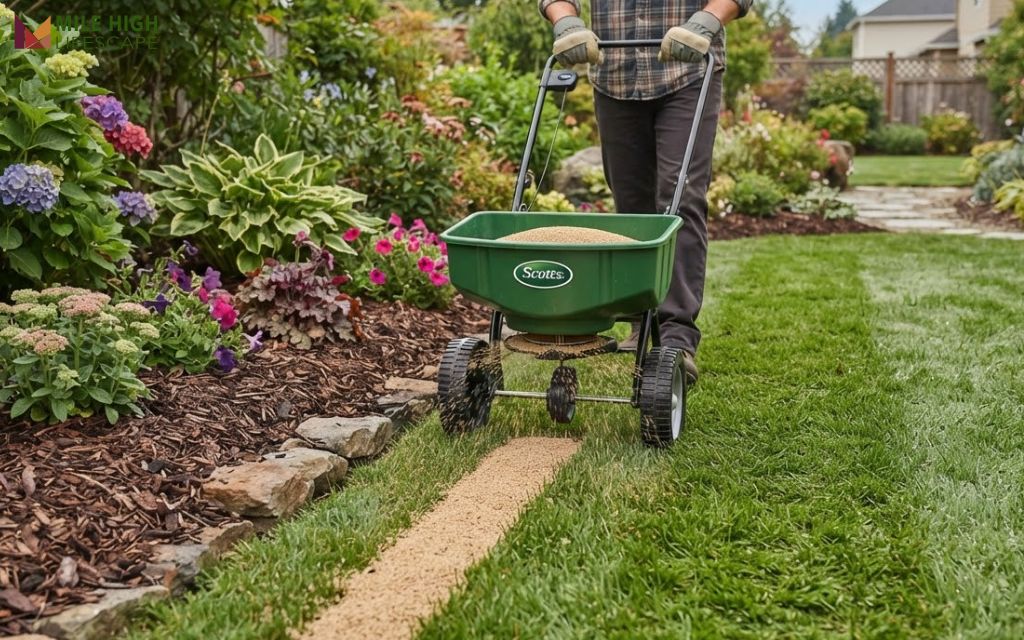
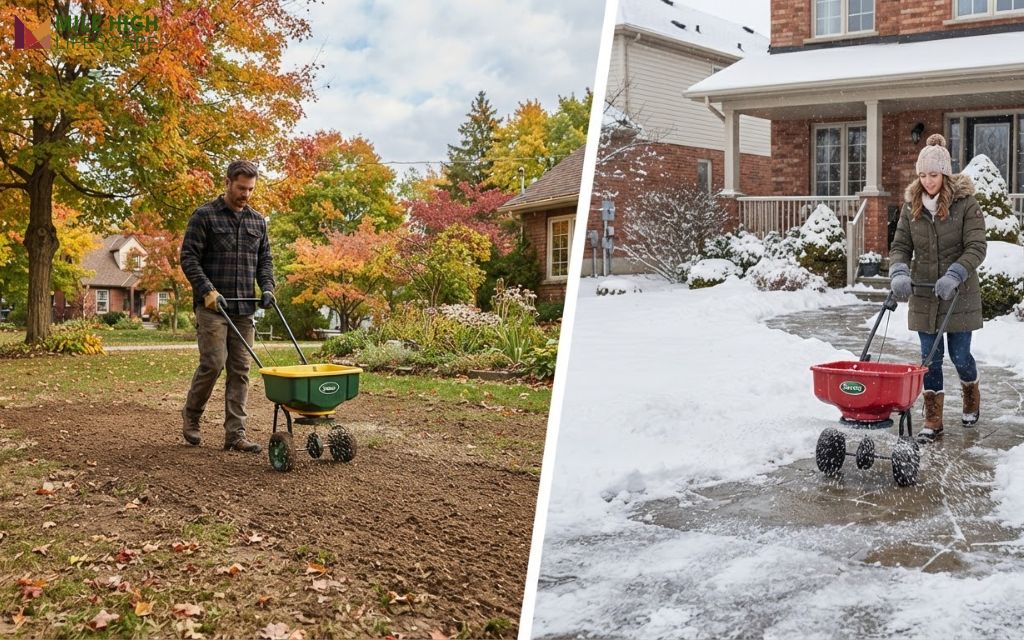
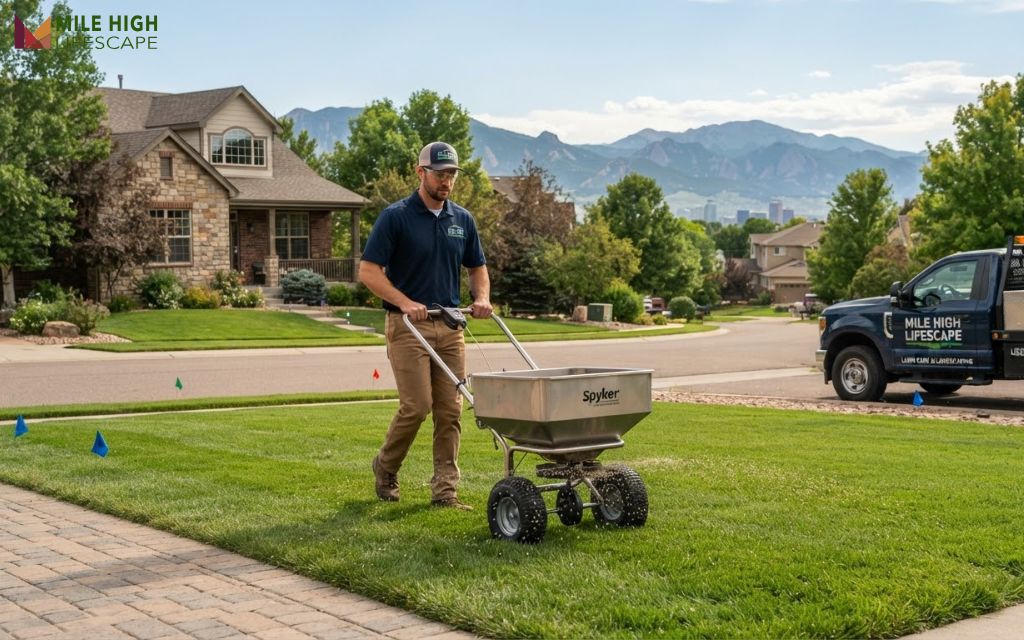
A broadcast spreader throws granular fertilizer, grass seed, or ice melt across a wide swath, so you cover an open lawn in fewer passes. This guide is for homeowners who feed or seed their own yards. We compare broadcast and drop spreaders, show you how to pick one, and walk you through calibration so every square foot gets the right dose.
What is a broadcast spreader?
A broadcast spreader is a lawn tool that uses a spinning impeller to throw dry granules away from the machine in a fan-shaped pattern. Turf scientists also call it a rotary, centrifugal, spinner, or cyclone spreader. Some people call it a “broadcaster.”
How a broadcast spreader works
A broadcast spreader works through 5 parts: a hopper, a rate dial, a gate, a flow lever, and an impeller. The rate dial sizes the holes in the hopper floor, and the flow lever opens or closes them. As you push, a geared wheel spins the impeller plate, which flings granules outward.
Most modern models add an edge guard or deflector. This shield blocks the throw on one side, so the product stays off driveways, sidewalks, and planting beds.
Types of broadcast spreaders
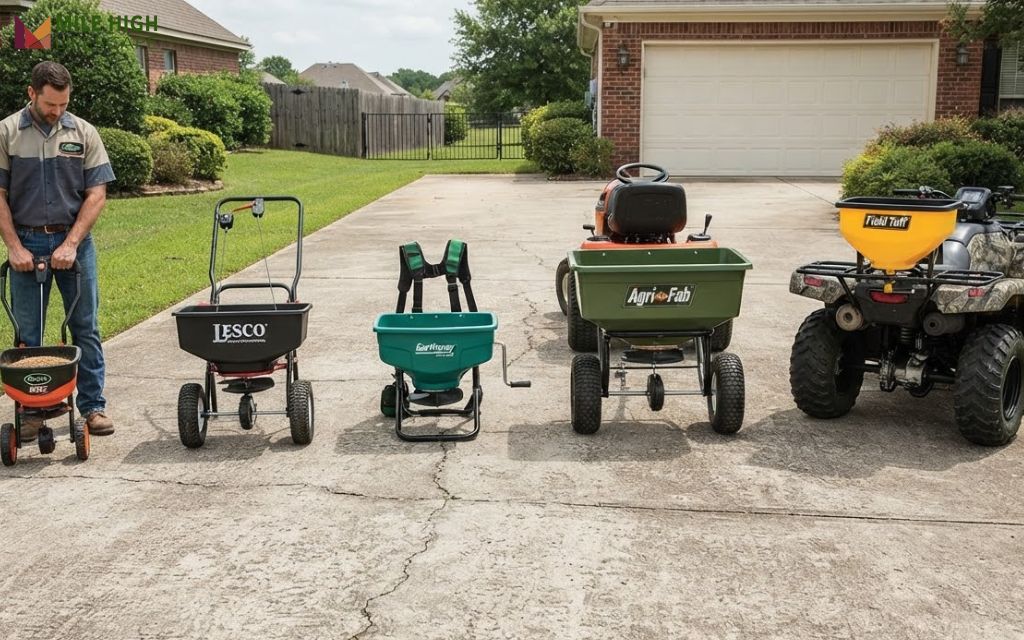
Broadcast spreaders come in 5 formats, sized by lawn area and the vehicle that moves them:
- Handheld spreaders hold a few pounds of product and suit patch repairs, steps, and very small yards.
- Walk-behind (push) spreaders hold roughly 40 to 80 pounds (18 to 36 kg) and cover most suburban lawns.
- Chest-mount or shoulder spreaders hang from a strap and help on slopes or rough ground where wheels struggle.
- Tow-behind spreaders hitch to a lawn tractor and often hold 85 pounds (39 kg) or more for large properties.
- ATV, UTV, and truck-mounted spreaders run on 12-volt motors and serve acreage, parks, and commercial grounds.
What is a drop spreader?
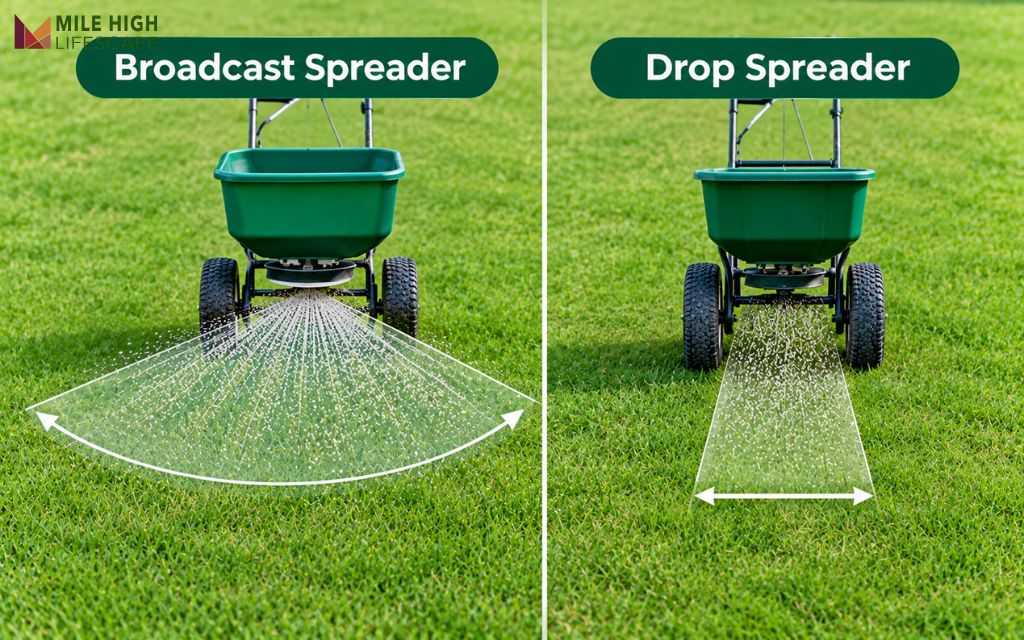
A drop spreader is a push spreader that releases granules straight down through a row of holes, so the product lands only in the strip between its wheels. Most drop spreaders measure 1.5 to 3 feet (46 to 91 cm) wide, according to Penn State Extension.
How a drop spreader works
A drop spreader works with a rectangular hopper, a rotating agitator, and an adjustable gate. The agitator keeps granules moving toward the holes. Because granules fall straight down, the swath width equals the width of the hopper opening.
Where drop spreaders shine
Drop spreaders shine in 3 situations: narrow strips, lawns ringed by planting beds, and edges along concrete. They also handle lightweight or very fine granules well, which a broadcast spreader can scatter in the wind. Penn State Extension notes that drop spreaders are inefficient on large areas, because you walk many more passes to cover the same ground.
Drop spreader vs. broadcast spreader: side-by-side comparison
The main difference between a drop spreader and a broadcast spreader is how far the granules travel. A drop spreader places the product only under the hopper. A broadcast spreader throws it several feet to each side.
| Factor | Broadcast (rotary) spreader | Drop spreader |
| Swath width | Wide; distribution tapers toward the edges | 1.5 to 3 ft (46 to 91 cm); even across the swath |
| Edge control | Needs an edge guard near hardscape | Precise placement next to beds and walks |
| Forgiveness | Overlapping edges hide small steering errors | Missed gaps show up as stripes |
| Speed | Fewer passes on open lawns | More passes; slower on large areas |
| Materials | Struggles with very light or mixed-size granules | Agitator can crack coated slow-release fertilizer |
| Wind | More drift on breezy days | Less drift |
| Calibration | Needs swath width and pattern checks | Simple; width equals the hopper |
| Price | Wide range, from about $35 for handhelds to several hundred dollars for tow-behinds (as of November 2026) | Fewer residential models; compare current prices by brand |
Broadcast spreader pros and cons
A broadcast spreader brings 3 advantages: speed, coverage, and forgiveness. The University of Kentucky reports that rotary spreaders are less likely to leave dark and light green stripes, because the thin edges of each pass blend into the next one. The trade-offs are drift onto hard surfaces, a harder calibration, and uneven results with lightweight products.
Drop spreader pros and cons
A drop spreader brings 3 advantages: edge precision, even distribution inside the swath, and low drift. Its weaknesses are slower coverage and a high stripe risk when passes miss each other. UF/IFAS Extension adds one more limit: the agitator can damage the coating on some slow-release fertilizers, so use soluble or organic products in a drop spreader.
Which spreader should you use?
Choose the spreader by 3 factors: lawn size, lawn shape, and the product you plan to apply. Open, rectangular lawns favor a broadcast spreader. Lawns cut up by beds, walkways, and narrow side yards favor a drop spreader. Many homeowners keep both.
| Your yard | Best spreader | Why |
| Under 500 sq ft (46 m²) | Handheld spreader | CSU Extension limits hand-crank units to very small lawns |
| Typical lot, open lawn | Walk-behind broadcast spreader | Fast coverage with fewer refills |
| Many beds, strips, or tight turns | Drop spreader, or broadcast with edge guard | Keeps product on the turf |
| Large lot or acreage | Tow-behind broadcast spreader | Large hopper and wide swath |
| Slopes or rough ground | Chest-mount broadcast spreader | No wheels to bounce |
CSU Extension horticulturist Alison O’Connor calls the hand-crank spreader useful only on lawns under about 500 square feet (46 m²). On a 3,000-square-foot (279 m²) lawn, she notes, you would refill the hopper about 30 times to apply 1 pound of nitrogen per 1,000 square feet. Scotts sizes its battery and hand-crank models for lawns up to 1,500 square feet (139 m²), so check the product label before you buy.
Best spreader for lawn fertilizer
A walk-behind broadcast spreader is the standard tool for lawn fertilizer on a typical residential lot. Switch to a drop spreader along beds, or turn on the edge guard for your perimeter pass. If you use a coated slow-release fertilizer, keep it in the broadcast spreader, because a drop spreader’s agitator can damage the coating.
Best spreader for grass seed
Both spreader types handle grass seed. A broadcast spreader seeds large areas faster. A drop spreader for grass seed works better for narrow strips and small bare patches, where you want seed on the soil and not in the mulch. Set the seed rate from the seed label, which lists a different dial setting than fertilizer.
Can you use a spreader for ice melt?
Yes, most push and handheld spreaders also spread salt and ice melt, when the manufacturer lists it as a compatible material. Start with a small gate opening, because ice melt pellets are dense. Rinse the spreader after each use, since salt corrodes metal parts.
How to use a broadcast spreader step by step
To use a broadcast spreader, measure the lawn, calibrate the rate, set your pass spacing, and walk an even pattern at a steady pace. The 7 steps below follow the methods published by Penn State, UF/IFAS, and University of Kentucky extension turf specialists.
1. Measure your lawn and read the label
Measure the length and width of each lawn area, multiply them, and subtract beds, patios, and the driveway. The total square footage tells you how much product to buy. A common lawn rate is 1 pound of nitrogen per 1,000 square feet (about 4.9 g/m²) per application. Divide the target rate by the nitrogen percentage on the bag. A 20-0-10 fertilizer needs 5 pounds (2.3 kg) of product per 1,000 square feet.
2. Calibrate before you trust the dial
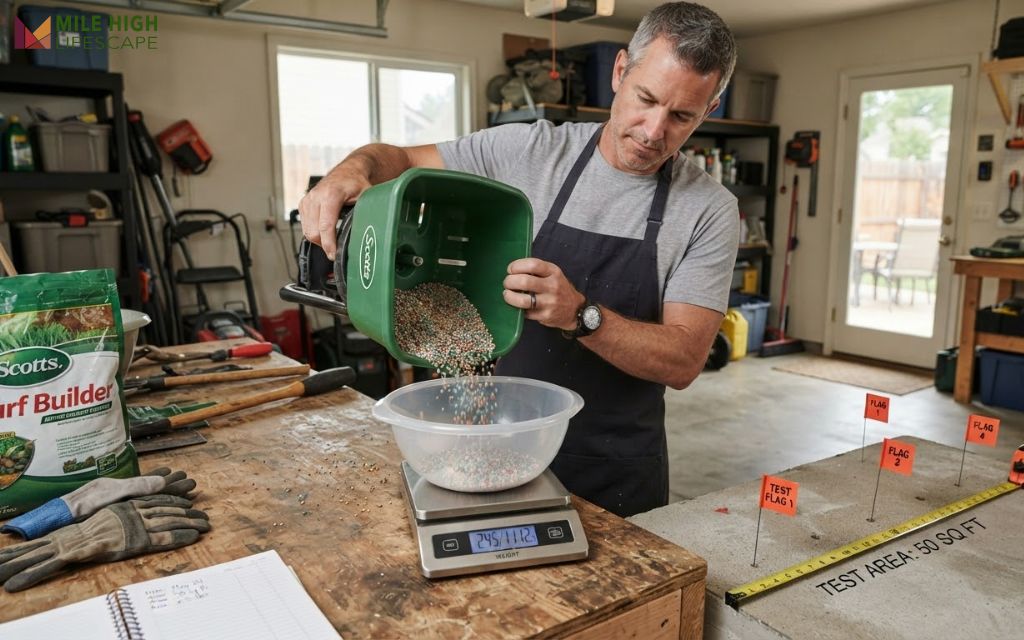
Calibrate your spreader, because the bag setting is only a starting point. Penn State Extension explains that walking speed and small differences between spreaders change the output. Follow these 5 steps:
- Mark a test strip 50 to 100 feet (15 to 30 m) long on turf or pavement.
- Weigh 5 to 10 pounds (2.3 to 4.5 kg) of product and pour it into the hopper.
- Walk the strip at your normal pace, opening the gate at the start line and closing it at the finish.
- Weigh the product left in the hopper to find how much you applied.
Adjust the dial up or down and repeat until the output matches your target.
For example, a half-rate pass of 20-0-10 needs 2.5 pounds (1.1 kg) per 1,000 square feet. On a 10-by-50-foot (3-by-15 m) test strip, that equals 1.25 pounds (0.57 kg) of product. Recalibrate whenever you switch products, because granule size and density change the flow.
3. Find your effective swath width, not the throw width
Your effective swath width is the spacing between passes, and it is narrower than the full throw. A rotary spreader drops most granules near the center and fewer at the edges. The University of Kentucky uses a rule of thumb: the effective width is about 75% of the total throw. A 12-foot (3.7 m) throw gives a 9-foot (2.7 m) effective width.
For a precise number, Penn State and UF/IFAS set shallow catch pans 1 foot (30 cm) apart across your path. The effective swath ends where a pan collects half as much as the center pan. Walk each new pass at that distance from the last one.
4. Fill on a hard surface, then do a perimeter pass
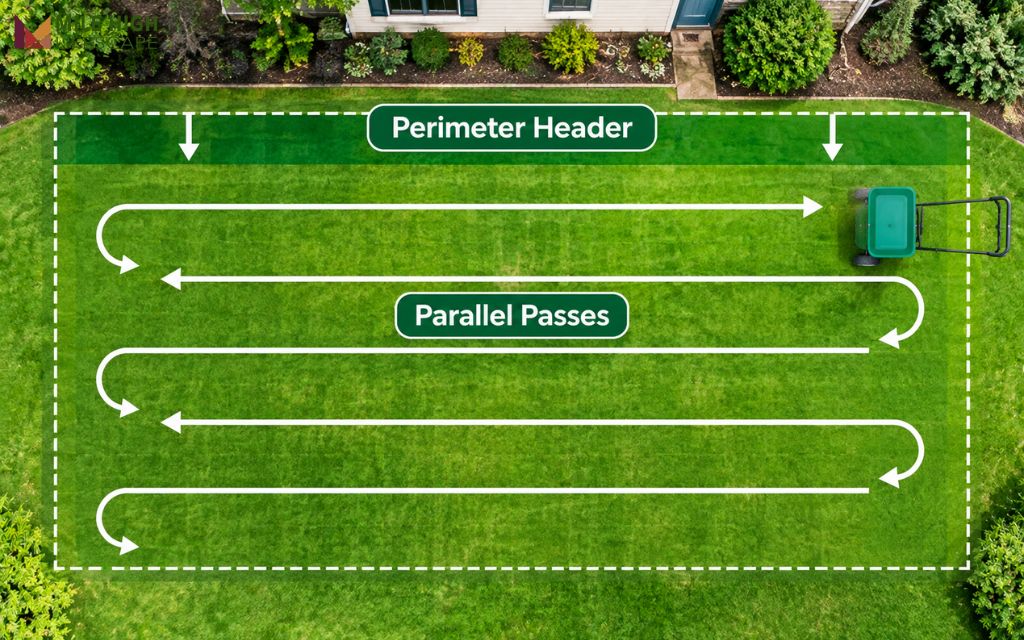
Fill the hopper on the driveway, so a spill does not burn the grass. Then walk one pass around the outside edge of the lawn, called a header strip, with the edge guard on.
5. Walk parallel passes at a steady pace
Walk back and forth along the longest side of the lawn, spacing passes at your effective swath width. Keep the same pace you used during calibration. Family Handyman and Scotts both describe a typical pace near 3 mph (4.8 km/h). Start walking before you open the gate, and close it before you stop or turn. Keep the impeller level, because tilting the handle throws the product too high or too low.
6. Use the half-rate crisscross pattern
Set the spreader to half the target rate and cover the lawn twice, with the second pass at a right angle to the first. Penn State Extension recommends this grid pattern because each direction masks the skips and overlaps of the other.
7. Sweep stray granules back onto the lawn
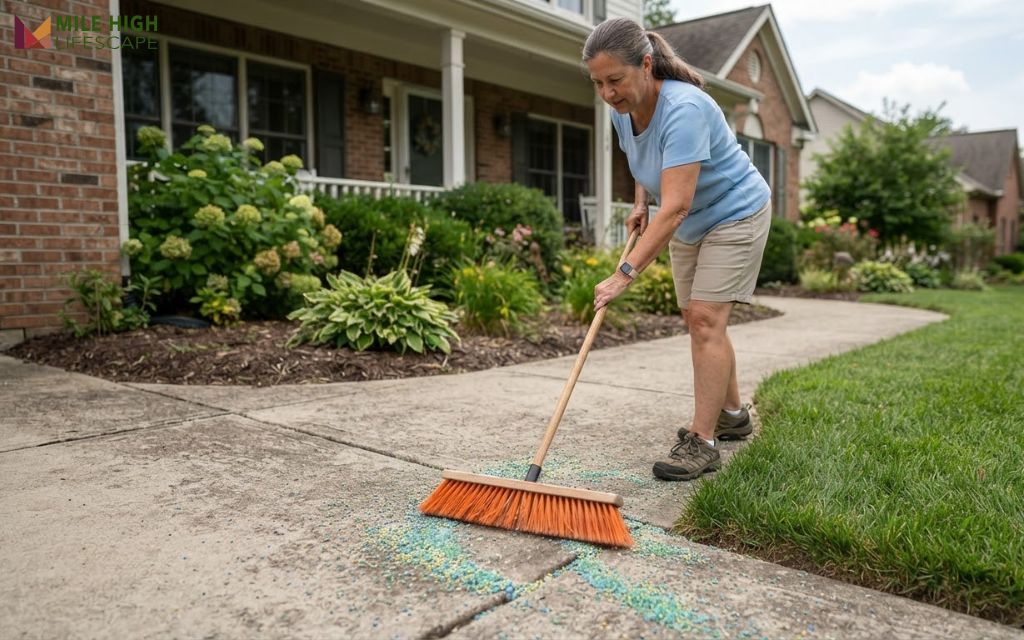
Sweep or blow granules off sidewalks, driveways, and the street back onto the turf. Fertilizer on pavement washes into storm drains. Then water the lawn or time the application before rain, as CSU Extension advises.
How to use a drop spreader without stripes
To use a drop spreader without stripes, line up each pass so the wheel track overlaps the previous pass. Penn State Extension compares the pattern to hanging strips of wallpaper: each strip meets the last one with no gap. Burn lines after uneven passes are a common complaint among DIY users.
Use 4 habits to prevent drop-spreader stripes:
- Overlap the wheel tracks on every pass.
- Split the rate in half and make 2 passes at right angles.
- Close the gate before each turn and reopen it after you straighten out.
- Walk a header strip at both ends to give yourself turning room.
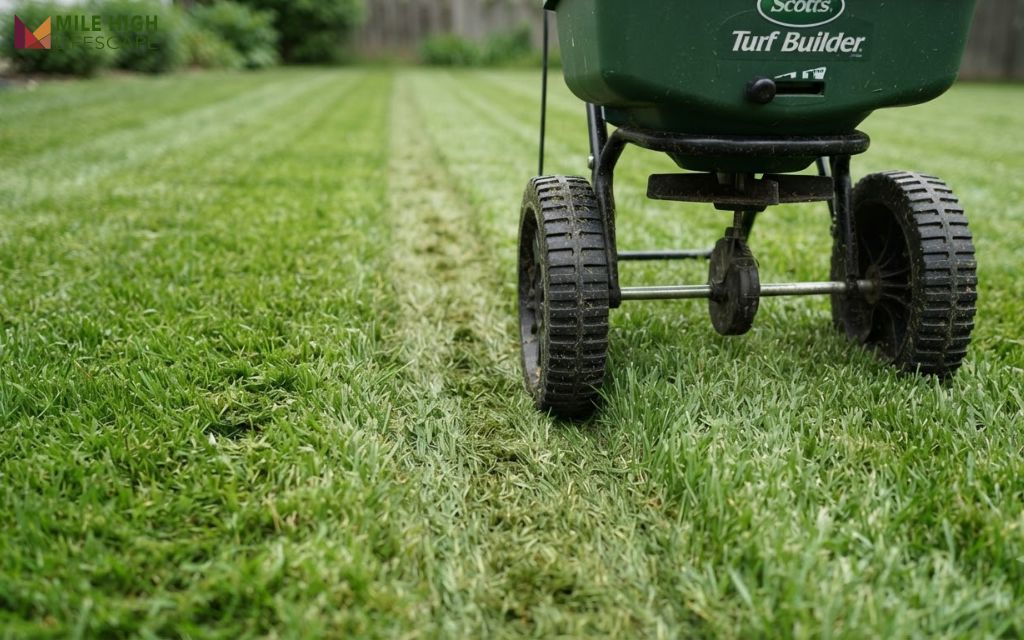
Common spreader mistakes and how to fix stripes or burn
Most lawn stripes and burn spots come from 6 application mistakes, not from the fertilizer itself.
- Opening the gate while standing still dumps a pile that burns the grass.
- Pulling the spreader backward with the gate open releases extra product.
- Skipping calibration after switching products throws off the rate.
- Spreading light granules on a windy day blows product off target.
- Spacing passes at the full throw width leaves light strips between passes.
- Using a hand-crank spreader on a large lawn leads to under-feeding.
To even out light strips, apply a half-rate pass at a right angle to the original direction. For a burned spot, water deeply to flush excess nitrogen, then reseed if the grass does not recover.
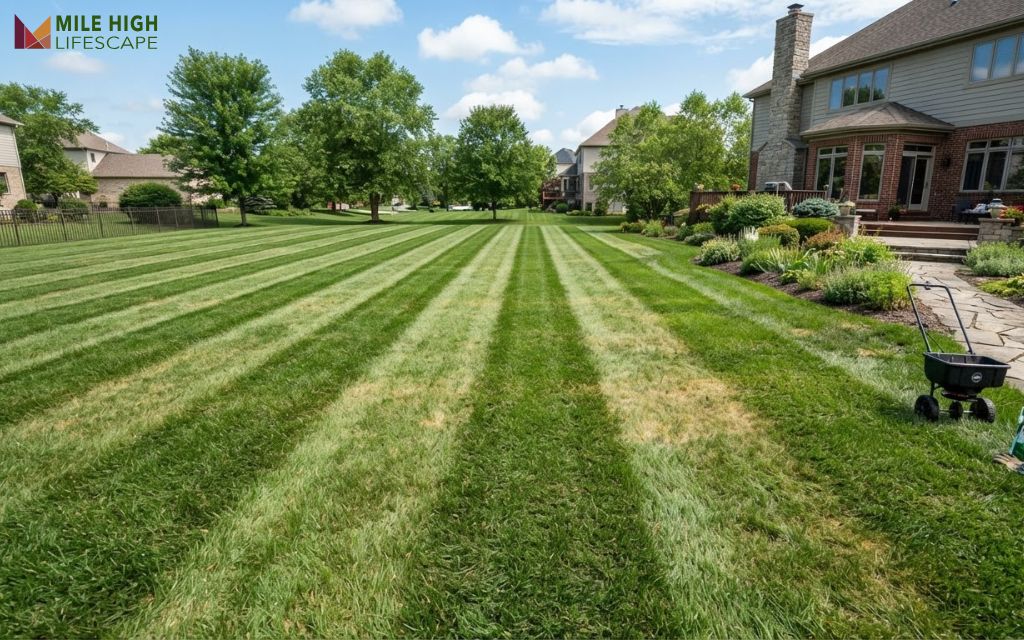
Using a spreader in Colorado: timing and local tips
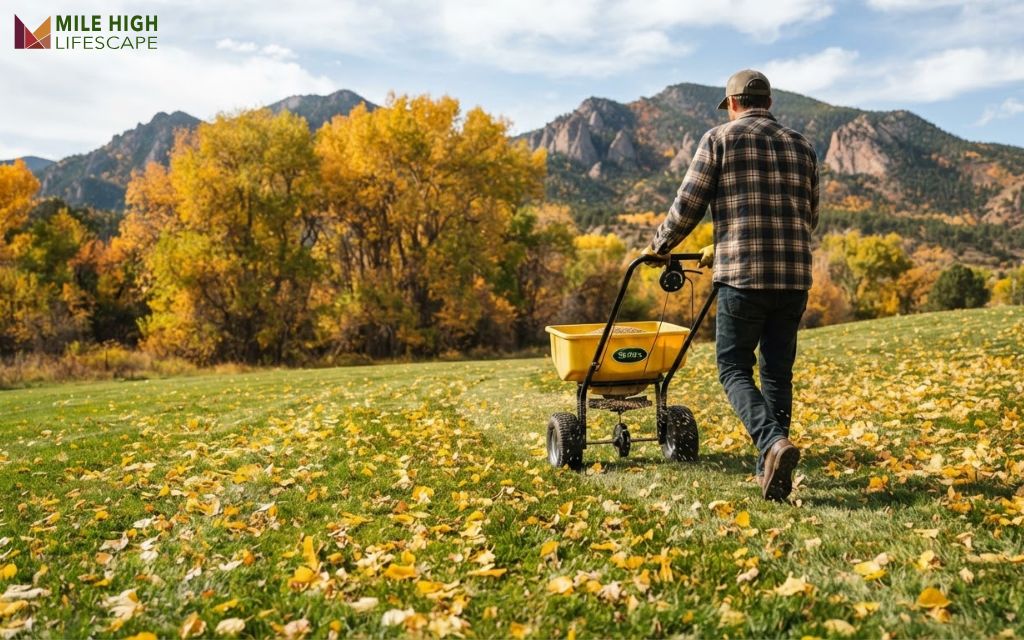
In Colorado, fall is the most valuable time to run your spreader. CSU Extension states that fall is the best time of year to fertilize Colorado’s Kentucky bluegrass lawns, because it builds a dense, green lawn the next spring. Fall is also the season to overseed after core aeration, when soil stays warm and air temperatures cool down.
Use 4 local practices for Denver Metro lawns:
- Water fertilizer in after you spread it, or apply it just before rain or snow.
- Spread on calm days, because wind drifts light granules onto walks and beds.
- Apply fall fertilizer before your sprinkler system shuts down, so water moves the nutrients into the root zone.
- Keep granules off sidewalks and gutters, since storm drains carry runoff to local waterways.
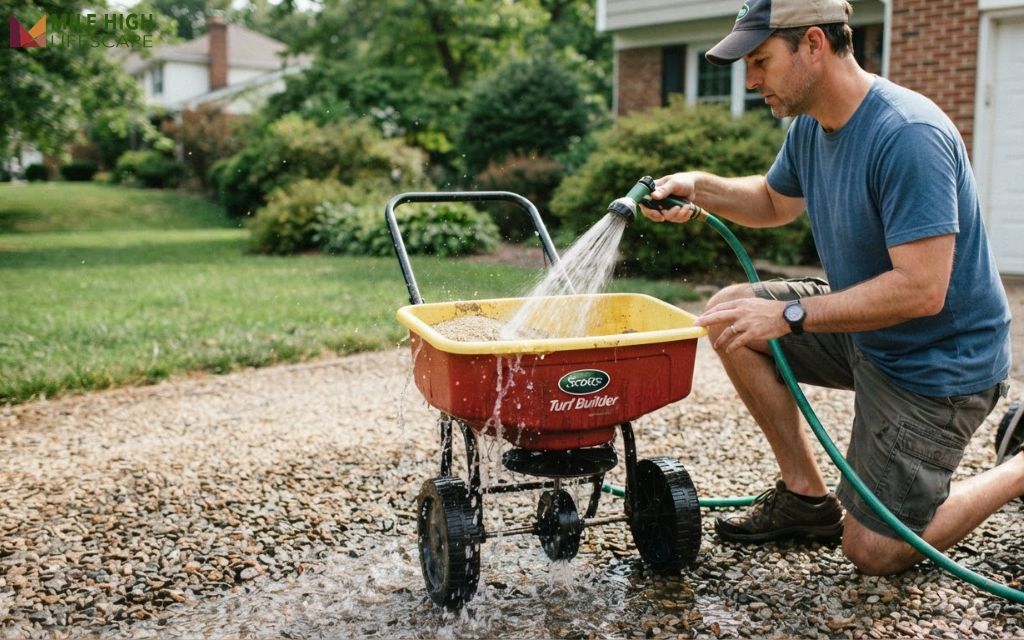
Spreader cleaning, storage, and maintenance
Clean the spreader after every use, because fertilizer and salt corrode gears, axles, and gate plates. Return leftover product to its bag, rinse the hopper and impeller, and let every part dry. Penn State Extension also recommends lubricating gears and moving parts before storage. Store the spreader indoors, and check the tires, gate cable, and calibration before the next season.
When to let a lawn care pro handle fertilizing and seeding
A professional crew makes sense when the lawn is large, the yard has many beds, or past applications left stripes and burn spots. Calibration, timing, and product choice take practice.
Mile High Lifescape brings over 20 years of experience to lawns across the Denver Metro area, including Denver, Lakewood, Littleton, and Centennial. Our fertilization and weed control program matches product and timing to your grass type and season. For thin turf, our crews pair core aeration with overseeding, so seed lands in open soil. Explore our Lawn Care services, or see how Lawn Aeration prepares soil for seed.
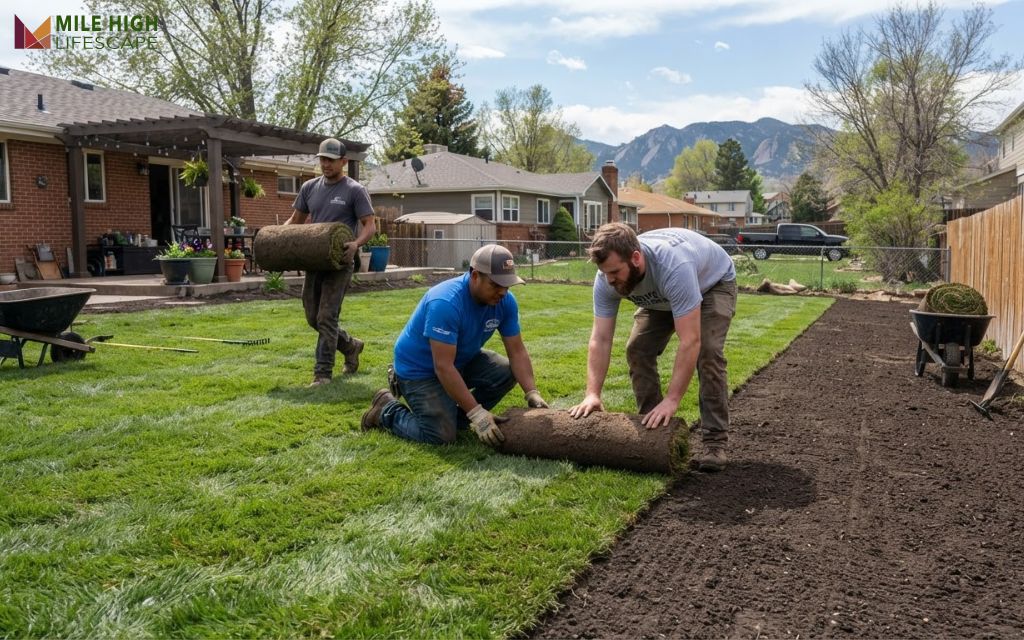
Sod installation: when a spreader can’t fix a thin lawn
Sod installation replaces a failing lawn with mature turf in a single day, while seed from a spreader takes weeks to fill in. Kentucky bluegrass seed needs at least 3 weeks to germinate, according to Cornell Cooperative Extension. Large bare areas, heavy weed cover, or damaged soil often call for a fresh start instead of repeated overseeding.
A sod project starts with soil preparation, then crews lay fresh rolls and water them in. Once new sod roots in, your broadcast spreader returns to its usual job: feeding the lawn each season. Learn more about our Sod Installation service for Denver Metro homes.
FAQs about broadcast spreader
What is a broadcast spreader used for?
A broadcast spreader applies granular fertilizer, grass seed, weed control, and ice melt over a wide area.
Is a drop spreader or broadcast spreader better for grass seed?
A broadcast spreader is better for seeding large, open lawns, and a drop spreader is better for small patches and narrow strips.
Is a broadcast spreader the same as a rotary spreader?
Yes, a broadcast spreader and a rotary spreader are the same machine. Turf experts also call it a centrifugal, spinner, or cyclone spreader.
How far apart should broadcast spreader passes be?
Space broadcast spreader passes at your effective swath width, about 75% of the full throw. A 12-foot (3.7 m) throw means passes about 9 feet (2.7 m) apart.
Why does my lawn have stripes after fertilizing?
Stripes form when the spreader passes, misses each other or overlaps too much. Calibrate the spreader, space passes at the effective width, and use a half-rate crisscross pattern.
Can I use the same spreader for fertilizer, seed, and ice melt?
Yes, one spreader can handle all 3 products, when the manufacturer lists them as compatible. Rinse it after spreading salt.
What size spreader do I need for my lawn?
A walk-behind broadcast spreader fits most residential lawns, a handheld fits lawns under about 500 square feet (46 m²), and a tow-behind fits large lots.