Centipede grass identification comes down to six clues you can check in about five minutes: color, blade shape, runners, collar, ligule and seed head. This guide is for homeowners who want to know what is growing in their yard before they feed, spray or replace it. We pair each clue with photo tips and side-by-side comparisons, so you can name your grass with confidence.
Centipede grass identification at a glance
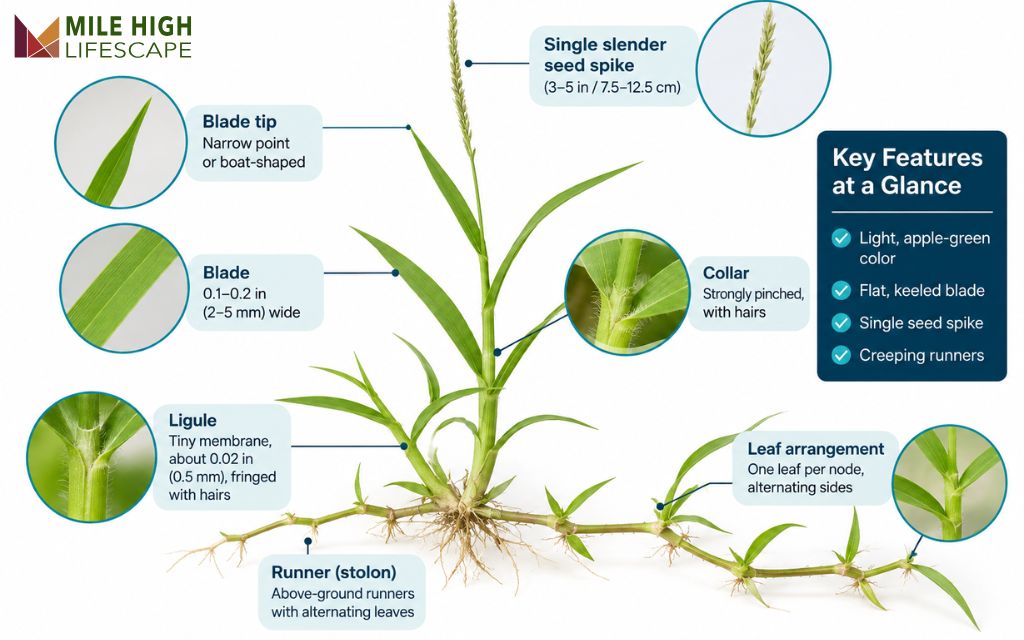
Centipede grass is a light, apple-green warm-season turf that creeps on above-ground runners with alternating leaves. Its flat, keeled blades run about 0.1–0.2 inch (2–5 mm) wide, and it sends up a single slender seed spike.
Use this checklist on your own lawn. Each row lists one trait, what centipede shows and the fastest way to check it.
| Trait | What centipede shows | How to check |
| Color | Light apple-green to yellow-green | Compare with nearby lawns from standing height |
| Blade | Short, flat, keeled; 0.1–0.2 in (2–5 mm) wide | Pull one blade and measure it |
| Blade tip | Narrow point or boat-shaped | Look at the end of the blade |
| Spread | Above-ground runners (stolons) only; no rhizomes | Lift the edge of a patch |
| Leaf arrangement | One leaf per node, alternating sides | Follow a runner node by node |
| Collar | Strongly pinched, with hairs | Bend the blade back at its base |
| Ligule | Tiny membrane, about 0.02 in (0.5 mm), fringed with hairs | Peel the blade away from the stem |
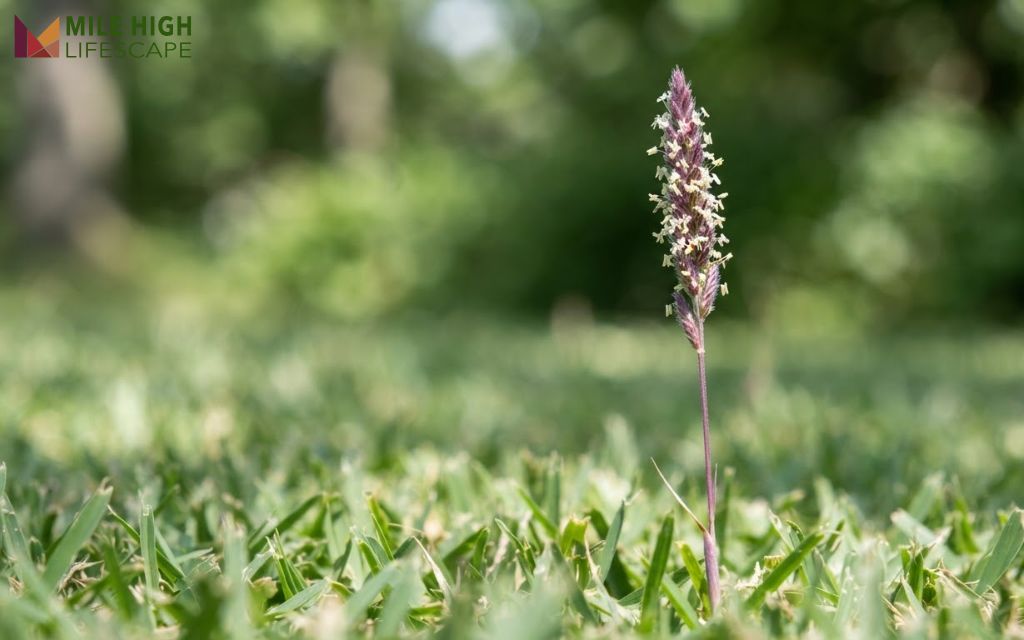
| Seed head | One slender spike, about 3–5 in (7.5–12.5 cm) | Check unmown edges in late spring and summer |
What is centipede grass?
Centipede grass (Eremochloa ophiuroides) is a slow-growing, warm-season lawn grass from China. According to Alabama Cooperative Extension, it reached the United States in 1916. Southern homeowners call it “lazy man’s grass” because it needs little mowing and fertilizer.
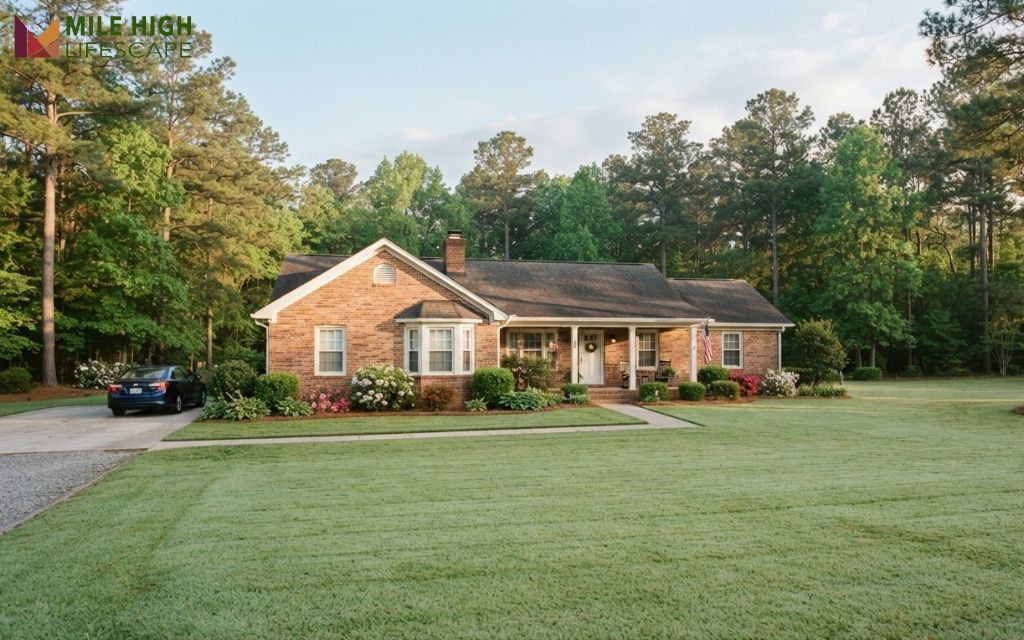
UGA places its best range from North Carolina south to North Florida, then west along the Gulf into Arkansas and Texas. It favors acidic, low-fertility soil and full sun. That narrow range is your first identification clue.
How to identify centipede grass in 6 steps
With over 20 years of experience caring for lawns, we have learned that a reliable grass ID moves from the big picture to the small details. Grab your phone camera and a ruler, then work through these checks in order.
1. Check your climate and soil
Start with location. Centipede is a Southeastern grass that needs acidic soil, roughly pH 5 to 6. If you live outside that belt, or a soil test reads above pH 7, centipede is unlikely.
When we reviewed the UF/IFAS centipedegrass fact sheet, we found that leaves yellow from iron chlorosis once pH climbs above 6.5. A lawn in alkaline soil rarely stays centipede for long.
2. Look at the color from standing height
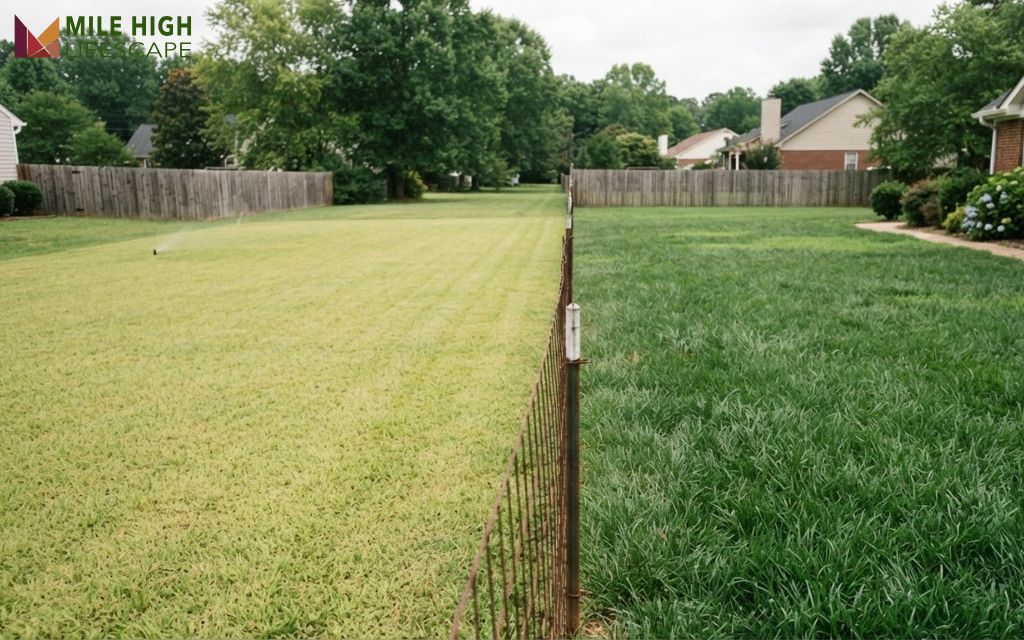
Step back and compare your turf with the neighbors’. Healthy centipede is naturally lighter than most lawn grasses, often described as apple-green. A deep, dark green stand is usually another species.
Treat color as a hint, not proof. Fertilizer, iron levels and season all shift the shade.
3. Pull a blade: width, keel and tip
Pull one blade and lay it on white paper. Centipede blades measure about 0.1–0.2 inch (2–5 mm) wide and stay short. They fold along a sharp crease, called a keel, like the hull of a small boat.
Clemson Extension notes the tip narrows to a point, while St. Augustinegrass ends blunt and rounded. UF/IFAS adds that the edges carry fine hairs near the base.
4. Follow the runners (centipede stolons)
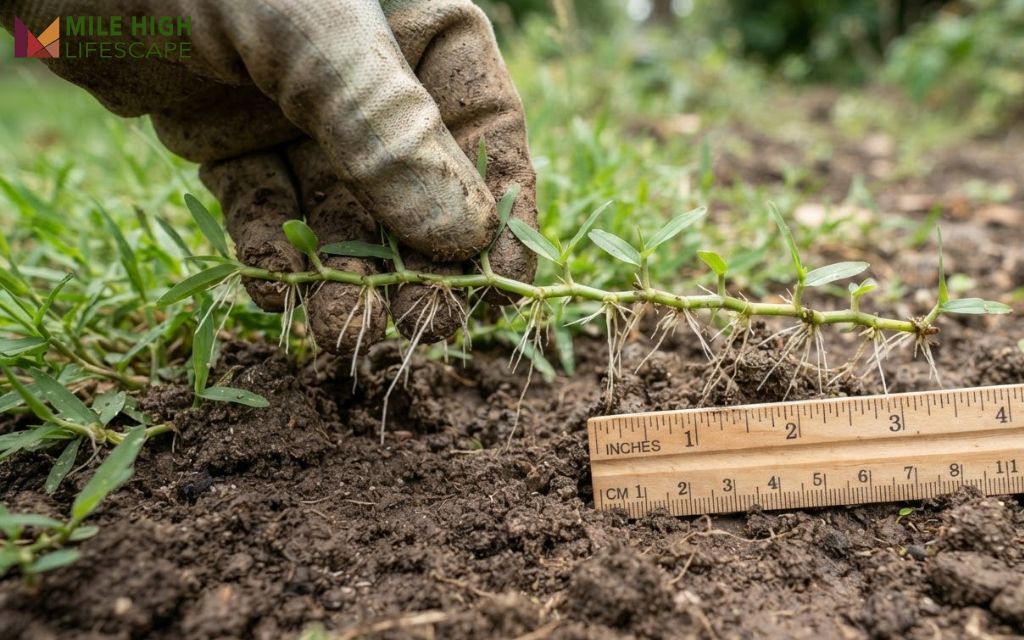
Lift the edge of a patch near a sidewalk or bed. Centipede spreads only by above-ground runners called stolons, which root at each node. It has no underground rhizomes.
Trace one runner. You will see a single leaf at each node, alternating left and right. Alabama Extension points to the short spaces between nodes, which give the runner its segmented, centipede-like look.
5. Peel back the leaf: collar, ligule and auricles
Bend a blade back where it meets the stem. Three tiny parts confirm the species:
- Collar: the band at the blade base. It is strongly pinched and hairy. Virginia Tech’s weed ID profile ranks it among the most constricted collars of any grass.
- Ligule: the thin flap inside the collar. In centipedes it is a very short membrane, about 0.02 inch (0.5 mm), topped with fine hairs.
- Auricles: claw-like flaps some grasses grow at the collar. Centipede has none.
New leaves also emerge folded, not rolled, inside the sheath.
Field tip: Switch your phone to macro mode and hold a white index card behind the stem. The collar and ligule show up far better against a plain background.
6. Find a seed head
Centipede flowers in late spring and summer. Search fence lines and unmown edges, because regular mowing removes most seed heads.
Each stem carries one slender spike, about 3–5 inches (7.5–12.5 cm) long. Virginia Tech describes it as purplish, and LSU AgCenter notes small white flowers along the spike. Bermudagrass, by contrast, shows 3–5 spikes joined at one point.
What centipede grass looks like through the seasons
Centipede changes its look across the year. Knowing each stage keeps you from misreading a dormant or stressed lawn.
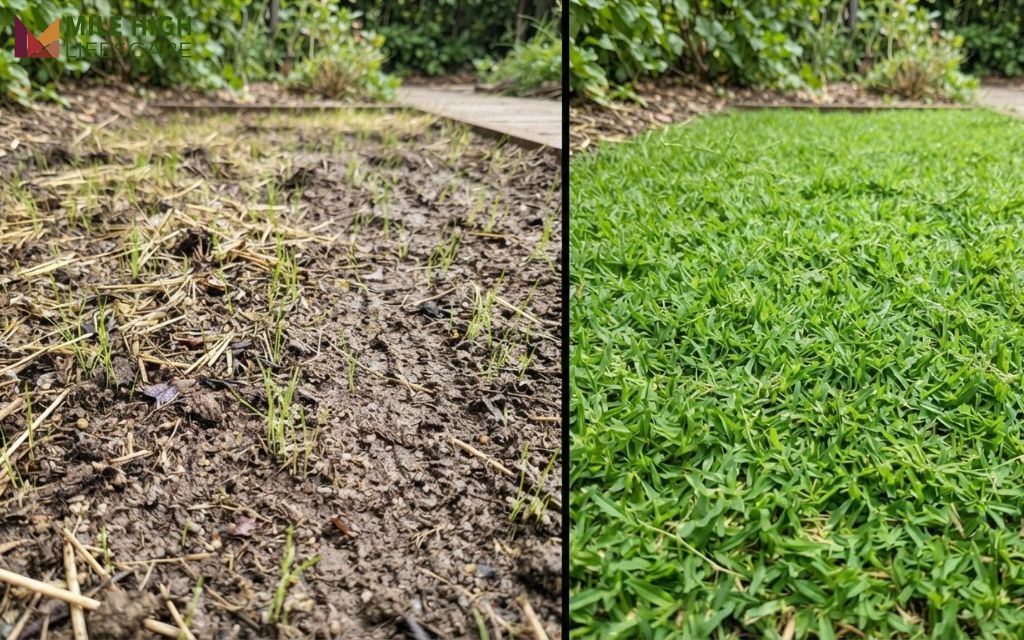
When it sprouts
Centipede seed starts slowly. Alabama Extension and UF/IFAS expect seedlings about 2 to 3 weeks after planting, and Clemson Extension allows about 28 days.
Sprouts appear as thin, light green threads. They lack runners and seed heads, so a sprout alone cannot confirm the species. UF/IFAS adds another 6 to 8 weeks for establishment, so check again once runners form.
Mature, actively growing lawn
An established stand forms a low, even, apple-green mat. Most extension services recommend mowing it at 1–2 inches (2.5–5 cm), which keeps runners and nodes easy to see along edges.
Dormant in winter
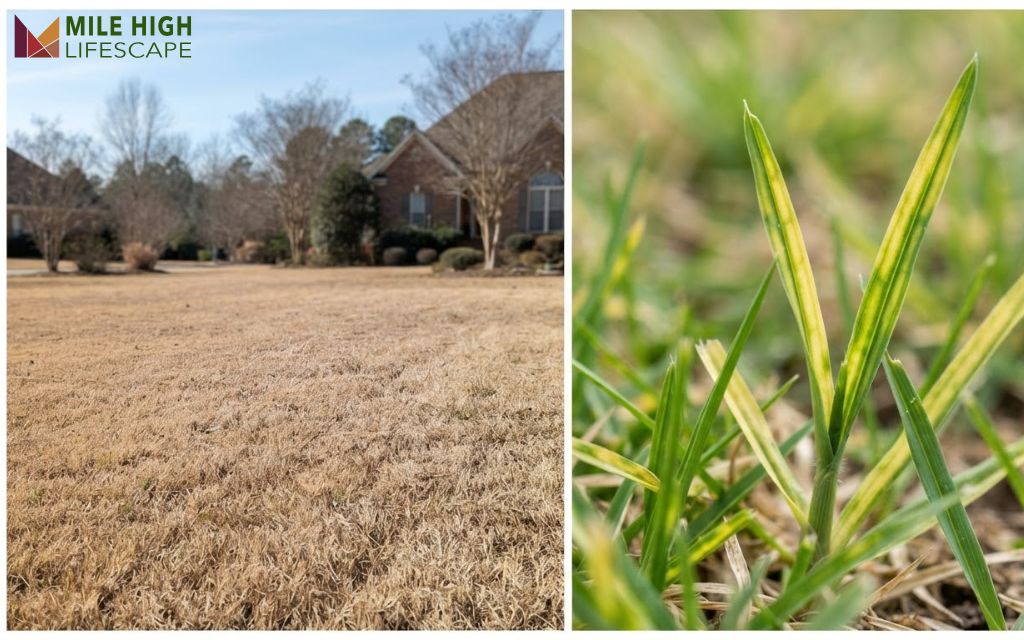
After frost, centipede turns tan to brown and stops growing. Clemson Extension notes green-up arrives in April to mid-May across South Carolina. UF/IFAS also observes that the grass browns during drought dormancy, then recovers with rain.
Yellow or purple-tinged turf
Yellow blades in early spring often signal iron chlorosis, which UF/IFAS says peaks when nights stay cool. LSU AgCenter links purple to red leaves with stress from traffic and compacted soil. Neither color means you have a different grass.
Centipede grass pictures: what to photograph for an accurate ID
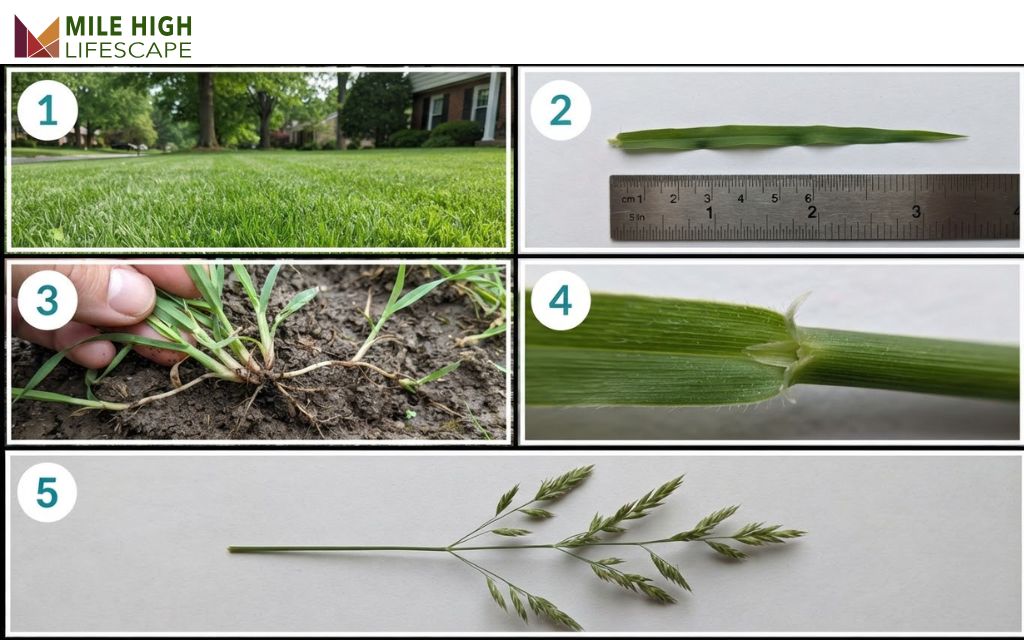
One wide shot rarely settles a grass ID. Whether you send pictures to an extension office or a lawn care pro, capture these five views:
- A wide shot of the lawn from standing height, in daylight.
- One blade on white paper beside a ruler marked in inches and centimeters.
- A lifted runner showing its nodes and leaf pattern.
- A macro of the collar and ligule with the blade bent back.
- Any seed head, photographed from the side.
Photo apps offer a quick first guess. Confirm the result with the physical traits above, or ask your county extension office before applying any product.
Types of centipede grass
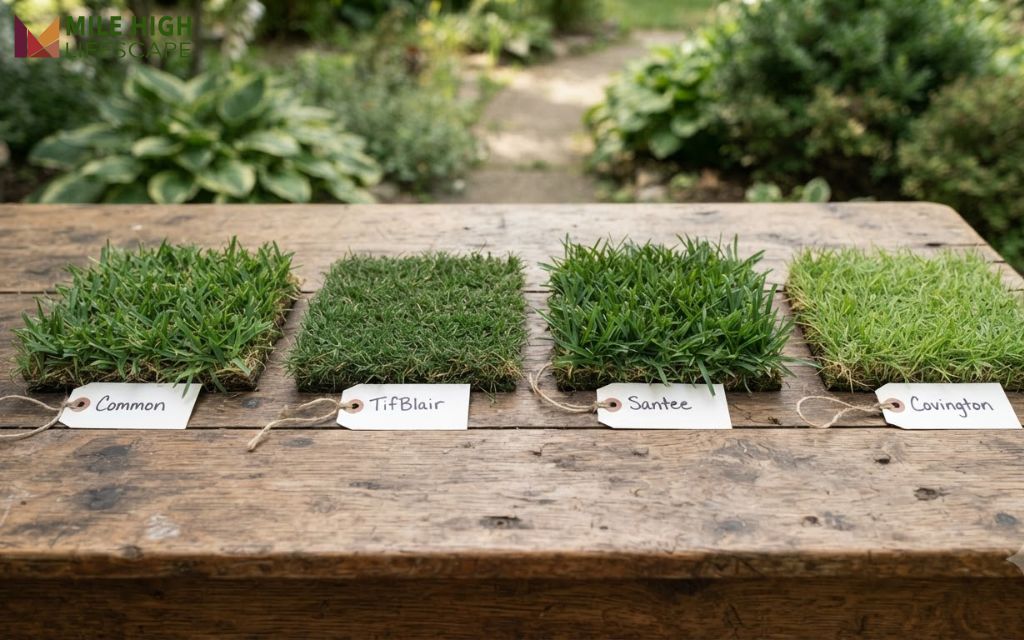
Breeders have released a few centipede cultivars because the grass has a small growing region. UF/IFAS lists these main types:
- Common: the unimproved population, sold as seed or sod.
- TifBlair: released by the University of Georgia in 1997, with better cold tolerance and slightly faster growth.
- Santee: a proprietary selection with limited production.
- Covington: a proprietary selection with emerald-green leaves that holds fall color longer.
These types look nearly identical in a yard. The label on the sod pallet or seed bag remains the only dependable way to tell them apart.
Centipede grass vs. look-alike grasses
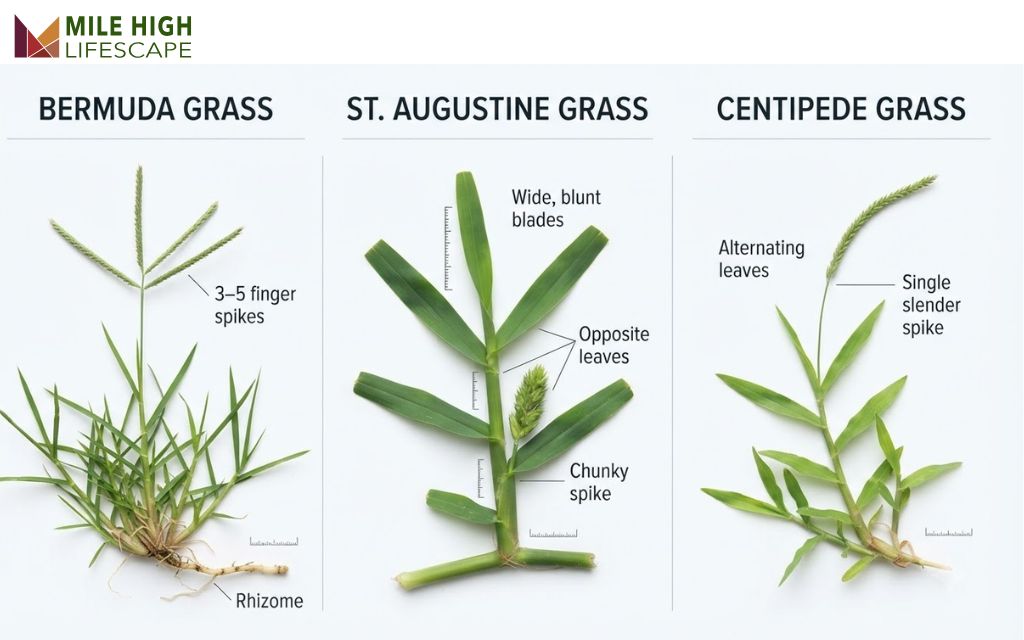
Several creeping grasses resemble centipedes at a glance. This table compares the traits that separate the three most common look-alikes:
| Trait | Centipede | Bermuda | St. Augustine |
| Spreads by | Stolons only | Stolons and rhizomes | Stolons |
| Blade width | 0.1–0.2 in (2–5 mm) | About 1/8 in (3 mm) | Much wider than most grasses |
| Blade tip | Narrow point | Sharp point | Blunt, rounded |
| Leaves on runner | Alternate | Not a key clue | Opposite |
| Ligule | Short membrane with hairs | Fringe of hairs | Not a key clue |
| Seed head | One slender spike | 3–5 finger-like spikes | Chunky spike, seeds embedded |
Centipede vs. Bermuda grass
Bermuda grass spreads both above and below ground, so pulling a clump often brings up rhizomes. UGA describes a ligule made only of hairs and a seed head with 3–5 spikes. Centipede has neither feature.
Centipede vs. St. Augustine grass
Clemson Extension separates these two by leaf tip, runner and seed head. St. Augustine blades are wider and flatter, with opposite leaves on thick runners. Its spike looks chunky, with seeds pressed into the sides.
Centipede vs. carpetgrass
Carpetgrass shares centipede’s low, creeping habit. LSU AgCenter recommends checking the seed head: carpetgrass carries several spikes per stem, while centipede carries one.
Centipede vs. crabgrass
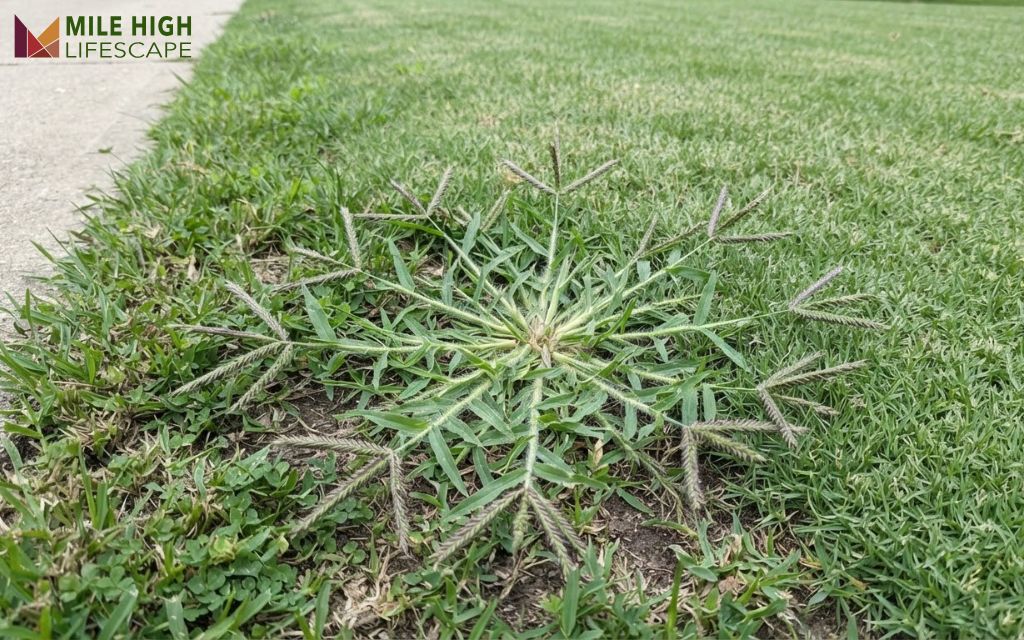
Crabgrass is a summer annual, not a lawn grass. It sprouts from seed each spring, dies at the first hard frost and forms flat clumps rather than a continuous mat. Its seed heads split into several finger-like branches.
Does centipede grass grow in Colorado?
Rarely. Centipede needs acidic soil and mild winters, while CSU Extension reports most Colorado soils are alkaline, with pH 7.0 to 8.3. Centipede also does not appear on Denver Water’s list of common Colorado turf types.
Why centipede struggles on the Front Range
In alkaline soil, iron stays locked away from grass roots, which triggers the yellowing described above. CSU Extension adds that lowering pH is impractical in soils rich in free lime, which covers much of the Front Range.
Cold adds a second barrier. Alabama Extension rates centipede’s cold tolerance as poor, with winter kill common during severe winters.
Grasses mistaken for centipede in Denver lawns
If you spot a creeping grass in a Denver Metro yard, check these candidates first:
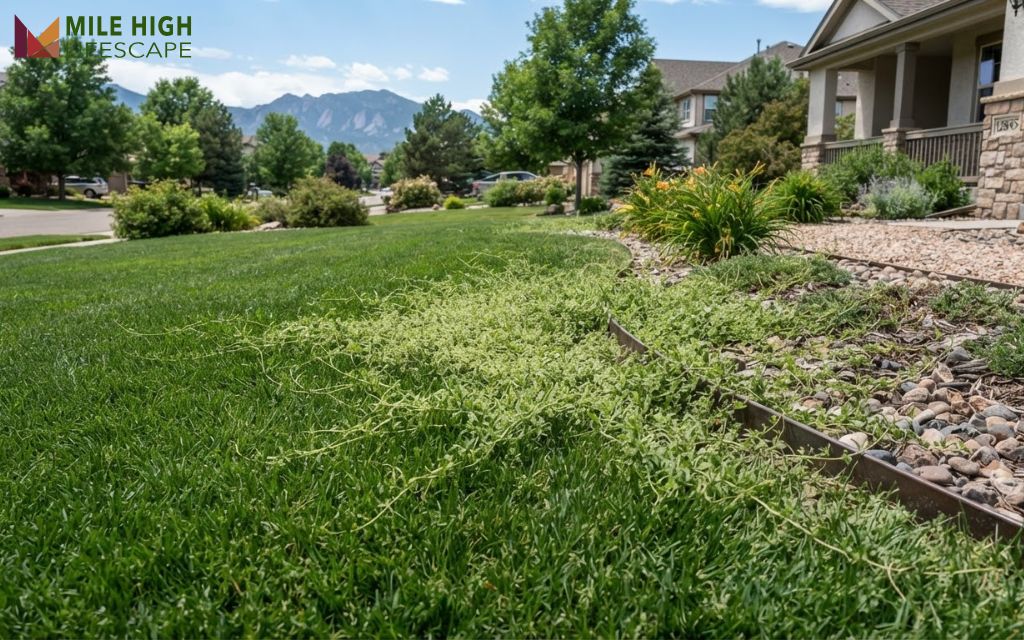
- Bermudagrass: PlantTalk Colorado reports it is becoming a common weed in Colorado lawns and garden beds, especially in warm summers.
- Buffalograss: a native warm-season grass with fine, blue-green blades that spreads by runners, per Denver Water.
- Weedy grasses called “crabgrass”: CSU notes many are quackgrass, tall fescue or bromegrass.
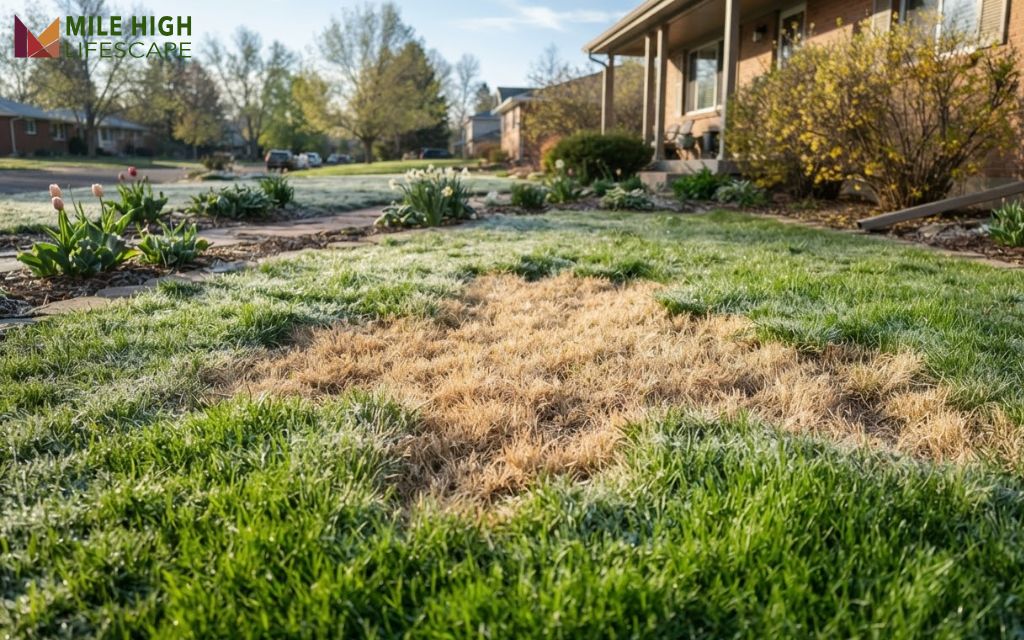
Why one patch stays brown in spring
A CSU Extension diagnostician explains that warm-season grass in a cool-season lawn greens up weeks later than bluegrass. You can leave the patch, dig it out or treat it after it greens up, then reseed with cool-season grass.
What to do after you identify your grass
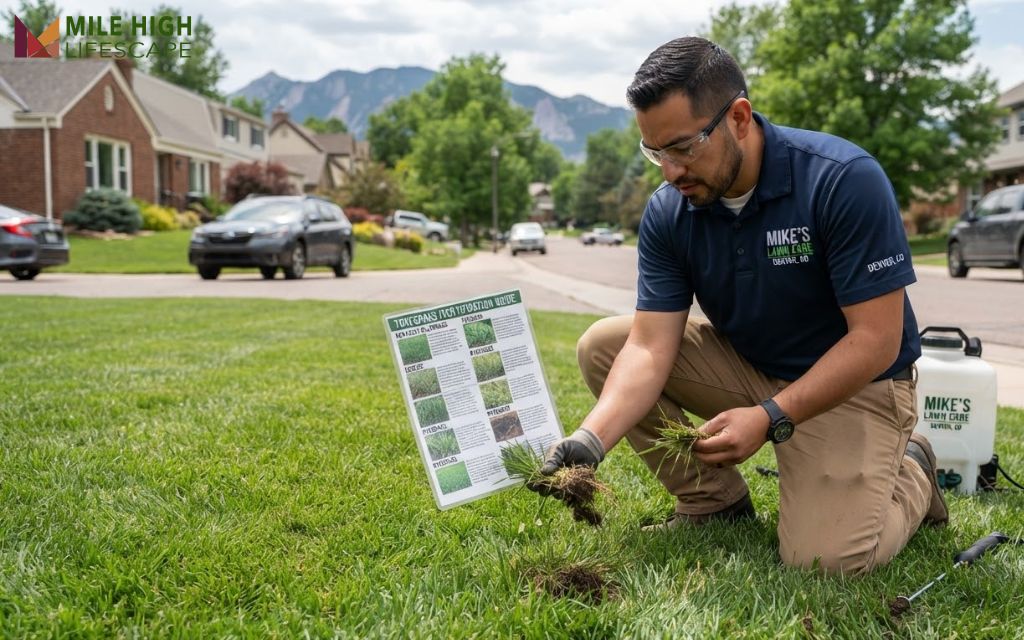
Your next step depends on what you found. Here is how we would approach each result:
- It is centipede (Southeast lawns): feed lightly, about 1–2 lb of nitrogen per 1,000 sq ft (roughly 0.5–1 kg per 100 m²) a year, per Clemson. Mow at 1–2 inches (2.5–5 cm) and skip lime unless a soil test calls for it.
- It is a weed grass in a cool-season lawn: confirm the species first, then spot-treat or remove it. Our lawn care team handles fertilization and weed control for Denver Metro yards.
- The lawn is thin after removal: aeration and overseeding helps bluegrass and fescue fill bare spots.
Sod installation for a fresh, uniform lawn
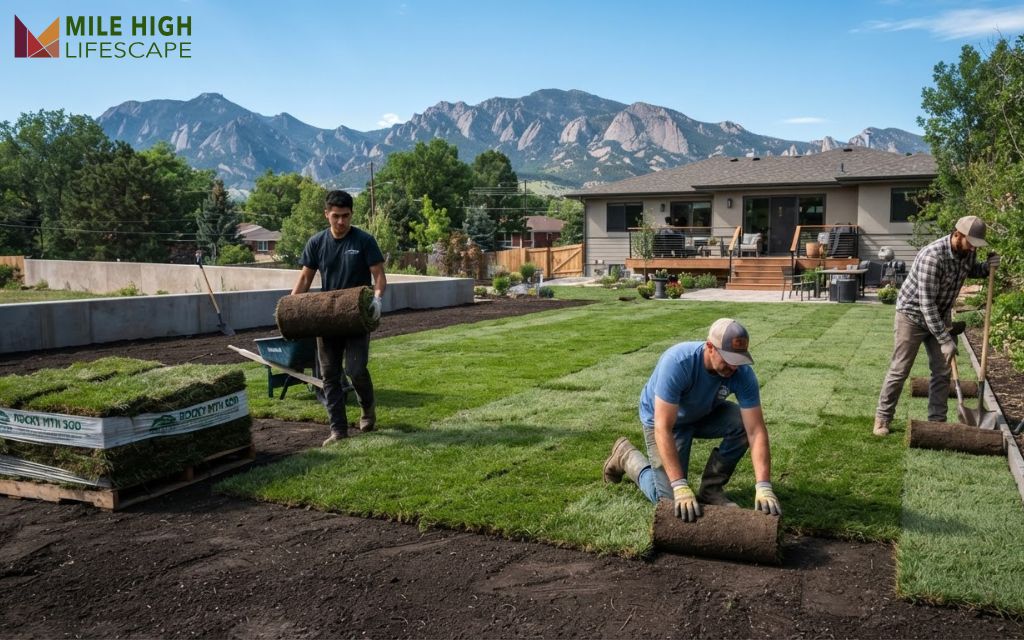
If your centipede grass identification points to bermudagrass or another creeping weed grass across large parts of the lawn, spot treatments rarely keep up. Replacing the area with fresh sod gives you a uniform, cool-season lawn suited to Front Range soil and winters.
Our Sod Installation service starts with a consultation to confirm what is growing and why. We then recommend the right fix, from turf renovation to full sod replacement. Every project follows applicable building codes and proven landscaping techniques.
Mile High Lifescape brings over 20 years of experience to homes in Denver, Lakewood, Littleton, Centennial, Broomfield, Thornton, Westminster and Highlands Ranch. Call (303) 877-9091 or email hello@milehighlifescape.com, Monday to Saturday, 8am to 5pm.
FAQs about Centipede grass identification
What does centipede grass look like?
Centipede grass is a low, apple-green turf with short, flat blades about 0.1–0.2 inch (2–5 mm) wide. It creeps on above-ground runners with alternating leaves and grows one slender seed spike.
How do you tell centipede grass from Bermuda grass?
Pull up a runner. Bermuda grass has underground rhizomes, a ligule made of hairs and 3–5 finger-like seed spikes. Centipede has no rhizomes, a short membranous ligule and one spike.
What does centipede grass look like when it sprouts?
Centipede sprouts look like thin, light green threads. They emerge about 2–4 weeks after seeding and show no runners yet, so wait until runners form to confirm the species.
What does a centipede seed head look like?
A centipede seed head is a single slender spike about 3–5 inches (7.5–12.5 cm) long. It rises above the blades in late spring and summer and may look purplish with small white flowers.
Does centipede grass spread by runners?
Yes. Centipede spreads only by above-ground runners called stolons, which root at each node. It has no underground rhizomes, so it spreads slowly and recovers slowly from damage.
Why is my centipede grass turning yellow?
High soil pH is the most common cause. Above about pH 6.5, iron becomes unavailable and blades turn yellow. Early spring yellowing can also fade once soil warms.
Can centipede grass grow in Denver?
Not well. Most Colorado soils are alkaline and winters are cold, which works against centipedes. A creeping grass in a Denver lawn is more likely bermudagrass or buffalograss.
Can an app identify centipede grass from a photo?
An app can offer a first guess, but photo-based centipede grass identification often misses small traits like the collar and ligule. Confirm the runners, collar, ligule and seed head yourself, or send clear photos to your county extension office.