Zoysia vs bermuda comes down to sun, foot traffic, and climate. Bermuda wants full sun and repairs itself fast, while zoysia handles partial shade and forms a dense, stiff carpet. This guide compares both warm-season grasses across 7 factors, shows how to identify each one, and explains why Denver homeowners need a different plan.
Zoysia vs bermuda at a glance
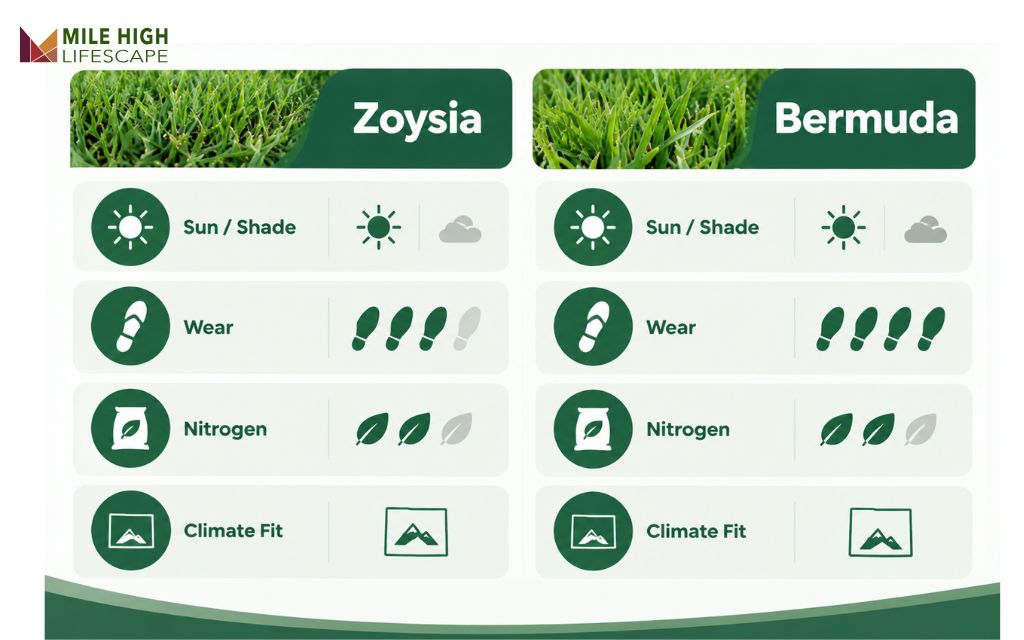
In the zoysia vs bermuda decision, bermuda grass suits full-sun, high-traffic lawns, while zoysia grass suits partial shade and lighter use. Both are warm-season grasses that turn tan when cool weather arrives.
The table below compares the 2 grasses across 10 attributes that shape everyday lawn performance.
| Attribute | Zoysia grass | Bermuda grass |
| Grass type | Warm-season | Warm-season |
| Sunlight | Full sun to partial shade | Full sun required |
| Feel underfoot | Stiff, dense, and springy | Fine-bladed and softer |
| Wear recovery | Slow | Fast |
| Spread rate | Slow rhizomes and stolons | Aggressive rhizomes and stolons |
| Annual nitrogen | 1–2 lb per 1,000 sq ft (0.5–1 kg per 100 m²) | 2–4 lb per 1,000 sq ft (1–2 kg per 100 m²) |
| Thatch risk | Higher | Lower |
| Establishment | Full cover can take up to 2 years | Fast cover from sod, sprigs, or seed |
| Invasiveness | Low to moderate | High; invades beds and borders |
| Colorado fit | Poor fit for most Front Range lawns | Spreads as a common lawn weed |
What is zoysia grass?
Zoysia grass (Zoysia spp.) is a warm-season turfgrass that forms a dense, stiff lawn and tolerates more shade than bermuda. Most home lawns use Zoysia japonica, Zoysia matrella, or hybrids of the 2 species.
University of Delaware Extension notes that zoysia works as a low-input lawn and golf course grass in its region. It thrives in long, hot summers, such as those in Kansas, Tennessee, and the Carolinas.
How zoysia grows
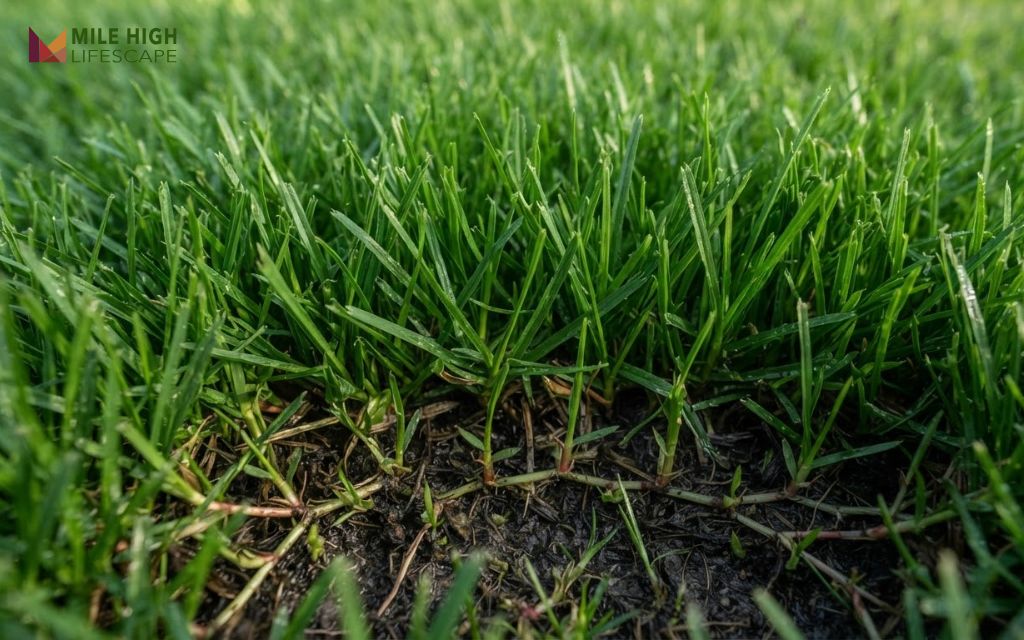
Zoysia spreads through rhizomes, which are underground stems, and stolons, which are above-ground runners. Its lateral growth runs slow, so a plugged lawn can take up to 2 years to fill in, according to Kansas State University.
That slow pace cuts 2 ways. You mow and edge less often, but damaged spots stay thin for weeks.
Pros and cons of zoysia grass
Zoysia trades fast recovery for density and lower inputs. These 4 strengths explain its appeal:
- Shade tolerance: Zoysia grows in full sun or partial shade, according to NC State Extension.
- Low fertilizer demand: Zoysia needs 1 to 2 lb of nitrogen per 1,000 sq ft (0.5 to 1 kg per 100 m²) per year, half of Bermuda’s range.
- Dense canopy: The tight turf crowds out many broadleaf and grassy weeds once it fills in.
- Easy containment: Slow runners stay out of flower beds more easily than bermuda runners.
These 4 drawbacks matter just as much for a homeowner:
- Slow establishment: Bare spots and new plugs take months to knit together.
- Thatch buildup: NC State Extension advises power raking once thatch passes 1/2 inch (1.3 cm), often every 2 to 3 years.
- Long dormancy: Zoysia turns tan in fall and greens up late in spring.
- Higher sod cost: Zoysia sod usually costs more than bermuda because farms need longer to grow a harvestable crop.
What is bermuda grass?
Bermuda grass (Cynodon dactylon and its hybrids) is a fine-textured, warm-season turfgrass built for full sun, heat, and heavy wear. Sports fields, golf fairways, and sunny Southern lawns rely on it because it repairs damage fast.
Common bermuda grows from seed. Hybrid types, such as Tifway and TifTuf, spread from sod or sprigs, according to NC State Extension. Its deep, wiry rhizomes also explain why bermuda survives as a weed long after homeowners try to remove it.
How bermuda spreads
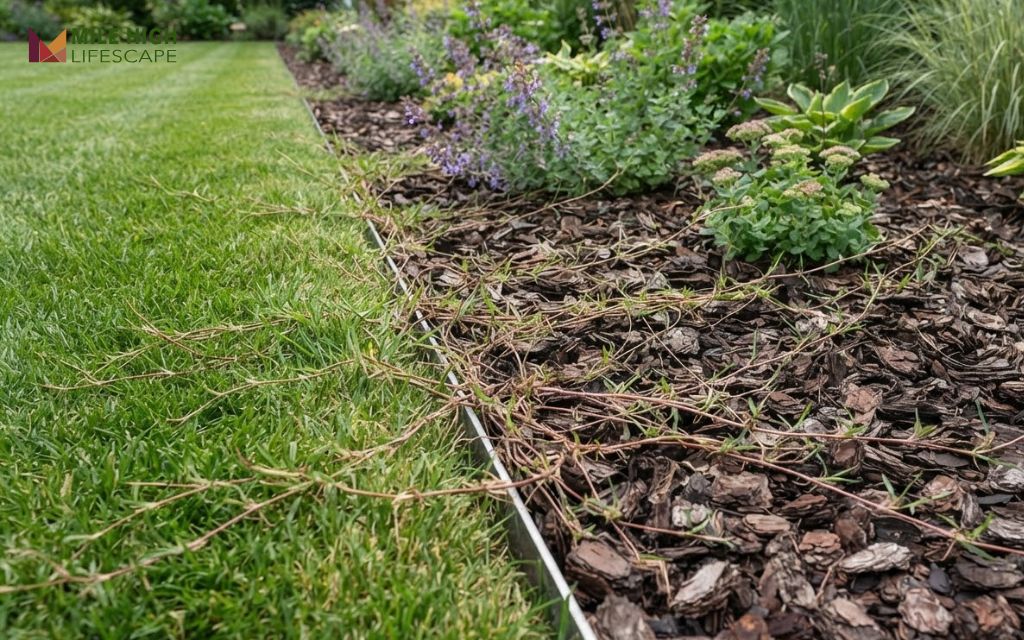
Bermuda spreads through both rhizomes and stolons, and that aggressive habit defines the grass. CSU Extension notes that pulling or digging bermuda almost always fails because broken pieces regrow.
The same runners creep into flower beds, vegetable gardens, and gravel paths. On the Houzz gardening forum, one homeowner described tearing out an entire front yard after bermuda invaded beds and a backyard fish pond.
Is bermuda grass soft?
Yes, bermuda grass feels soft underfoot because its blades are narrow and flexible. Zoysia blades feel stiffer and push back against your hand, a trait NC State Extension uses to separate the 2 grasses.
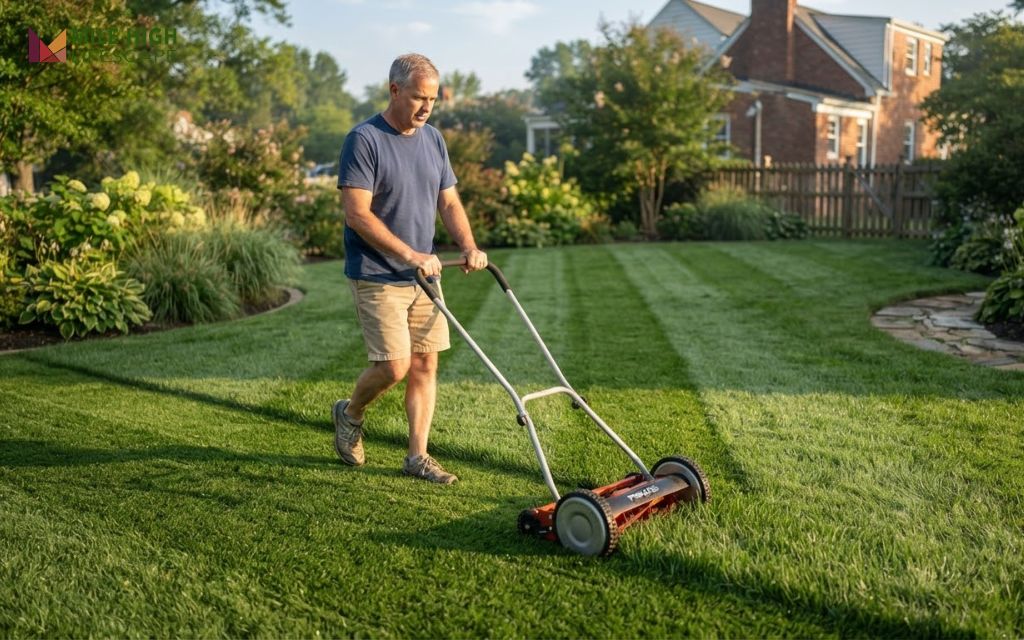
Mowing height shapes that feel. NC State lists 3/4 to 1 inch (1.9 to 2.5 cm) as Bermuda’s best height with a reel mower, which creates a tight, barefoot-friendly surface.
Difference between zoysia and bermuda grass: 7 factors that matter
The difference between zoysia and bermuda grass shows up in 7 areas: sunlight, wear, water, maintenance, spread, cold, and establishment. Each factor below names the stronger grass first and then explains why.
Sun and shade tolerance
Zoysia tolerates partial shade, and bermuda needs full sun. NC State Extension states that bermuda requires full sunlight, while zoysia grows in full sun or partial shade.
Under mature trees or along the north side of a house, bermuda thins out first. Fine-bladed zoysia cultivars hold density longer in those low-light spots.
Foot traffic, kids, and dogs
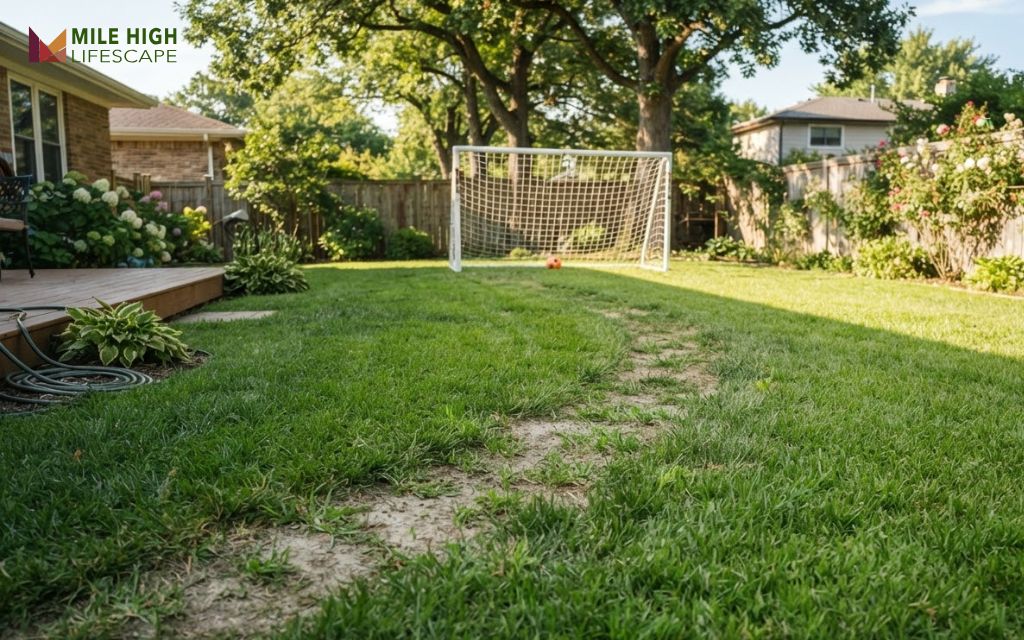
Bermuda recovers from wear faster than zoysia. Its runners fill divots, worn paths, and dog-run trails within the same growing season.
Zoysia handles moderate play, but worn areas stay thin longer. Yards with active dogs or daily backyard games favor bermuda.
Water use and drought tolerance
Both grasses tolerate drought, but they respond in different ways. Each one can go dormant during a dry spell and green up again after rain or irrigation.
Oklahoma State University Extension notes that zoysia needs more frequent watering than bermuda to prevent wilting. Zoysia’s lower fertilizer needs offset part of that cost, and soil type often matters as much as the species. In Colorado, CSU Extension notes that warm-season buffalograss grows most actively from late May through early September, and zoysia and bermuda follow a similar summer-only calendar there.
Mowing, fertilizing, and thatch
Bermuda needs more mowing and more nitrogen than zoysia. Kansas State University recommends 2 to 4 lb of nitrogen per 1,000 sq ft (1 to 2 kg per 100 m²) per year for bermuda and 1 to 2 lb (0.5 to 1 kg) for zoysia.
Excess nitrogen builds thatch in both grasses, and zoysia shows it first. NC State advises mowing zoysia before it passes 1 1/2 to 2 1/2 inches (3.8 to 6.4 cm).
Invasiveness and garden beds
Bermuda invades beds, borders, and neighboring lawns far more than zoysia. Its stolons cross edging, and its rhizomes travel underneath it.
Zoysia spreads too, but at a pace a sharp spade edge can manage. Homeowners with perennial beds or vegetable gardens should weigh this factor heavily.
Cold tolerance and winter dormancy
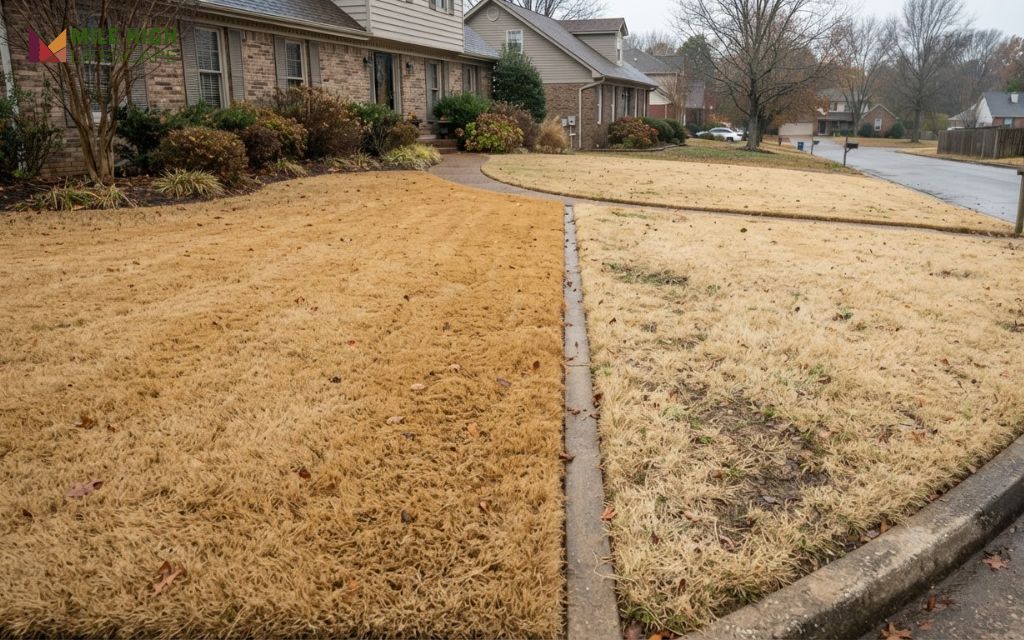
Zoysia tolerates cold better than bermuda, yet both go dormant and turn tan in winter. Bermuda carries a higher risk of winterkill in colder parts of the transition zone.
Dormancy length decides how many months your lawn stays green. In Colorado, CSU Extension notes that zoysia stays green only from mid-May through early October.
Establishment: sod, plugs, or seed
Bermuda establishes faster with every planting method. Common bermuda grows from seed, and hybrid bermuda covers ground quickly from sod or sprigs.
Zoysia comes mostly as sod or plugs. Sod gives the most uniform start for either grass, while plugs leave gaps for 1 to 2 seasons.
How to tell the difference between zoysia and bermuda grass
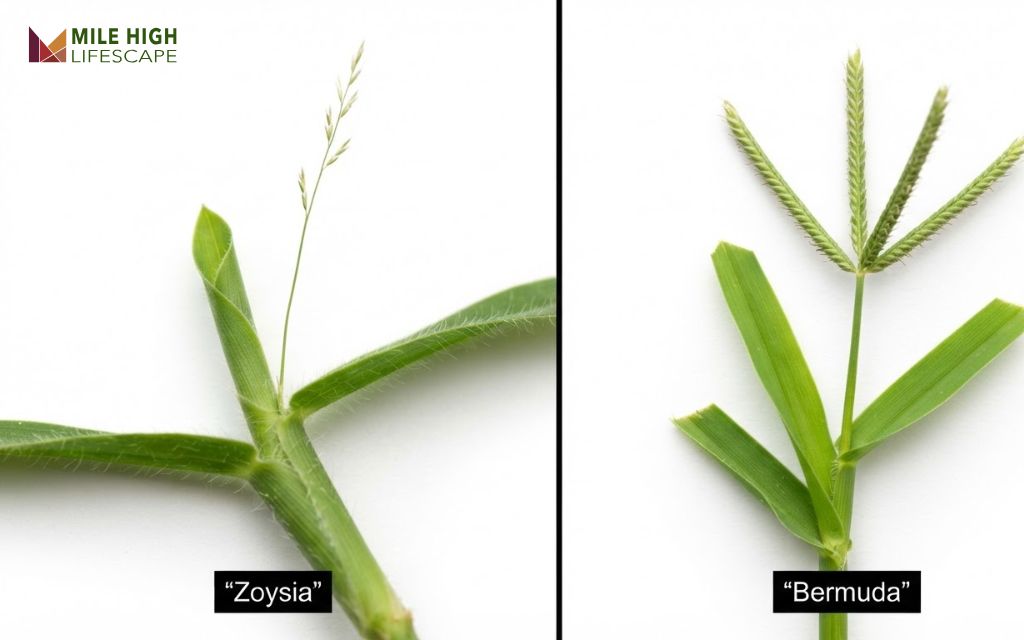
To tell zoysia from bermuda, check the leaf hairs, blade stiffness, new-leaf shape, and seed head. NC State Extension uses these traits to separate the 2 grasses in the field.
Pull a few shoots in midsummer, when both grasses grow actively, and compare them against this table:
| Trait | Zoysia grass | Bermuda grass |
| Leaf hairs | Upright hairs on the blade | No upright hairs on the blade |
| Feel | Stiff; resists your hand | Soft and flexible |
| New leaf (vernation) | Rolled like a tube | Folded in half |
| Seed head | Single short spike | Several finger-like spikes |
| Runners | Short and slow | Long, wiry, and visible on soil or paving |
| Common look-alike | Bermuda | Crabgrass |
CSU Extension points out that many homeowners confuse bermuda with crabgrass because the 2 grasses produce similar seed heads. Check for long runners: crabgrass is an annual and lacks them.
Should you plant zoysia or bermuda in Denver?
For most Denver lawns, neither zoysia nor bermuda is the right choice. Both are warm-season grasses built for long, hot summers, and the Front Range climate shortens their green season.
Why Colorado’s short season works against warm-season grass
Denver sits at 5,280 feet (1,609 m), where summer nights cool fast after hot days. CSU Extension states that Colorado summers are too short and nights too cool for zoysia to establish well.
CSU turf specialist Tony Koski notes that bluegrass lawns start greening in March, while warm-season grasses wait until May. Hotter Colorado areas, such as Pueblo and Grand Junction, give zoysia a better chance, according to an Extension expert.
A word of caution about zoysia plug ads
Mail-order ads often sell zoysia plugs as a carpet that fills any lawn. CSU Extension reports that plugs set into Colorado lawns stay as small, scattered patches, which gives the lawn a weedy look.
That patchwork shows most in April and October. The tan zoysia sits dormant while the surrounding bluegrass stays green.
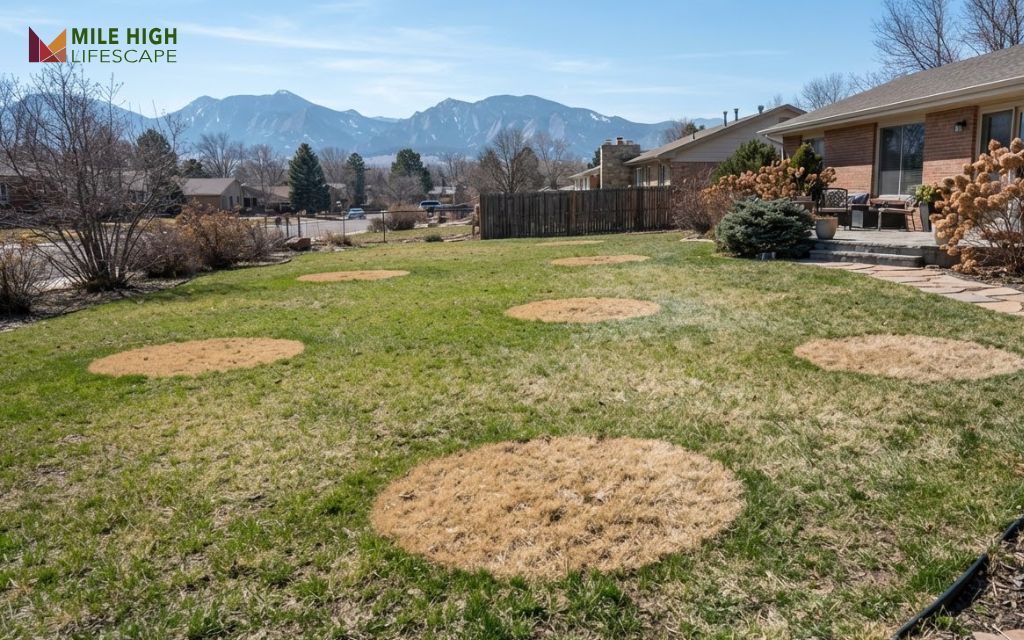
Found bermuda spreading in your bluegrass lawn?
Bermuda in a Denver lawn usually arrives as a weed, not as a choice. CSU Extension reports that Bermuda is becoming a common weed in Colorado lawns and garden beds, especially during hot summers.
Spot it in late April or early May, when bermuda starts greening up. In fall, its tan patches stand out against green bluegrass. CSU Extension outlines 4 control principles for Colorado homeowners:
- Treat during active growth: Herbicides fail when bermuda is brown and dormant in spring or fall.
- Repeat applications: Control takes several treatments spaced 2 to 4 weeks apart through summer.
- Extend the treated zone: Spot treatments should reach 2 to 3 feet (0.6 to 0.9 m) beyond visible runners.
- Plan for several seasons: Full removal can take 2 to 3 years before the area is ready to reseed or resod.
Always follow the product label. Our team handles fertilization and weed control and turf renovation through our lawn care services in Denver, including grass identification before any treatment.
Better-fit lawn options for the Denver metro
Cool-season grasses and native warm-season grasses outperform zoysia and bermuda in most Denver yards. CSU Extension names Kentucky bluegrass as the most widely used lawn grass in Colorado.
CSU Extension lists these 5 grass groups among the options that work well for Colorado lawns:
- Kentucky bluegrass: A dense sod-former that stays green from early spring to late fall. It needs about 1.5 inches (3.8 cm) of supplemental water per week when temperatures pass 85°F (29°C).
- Turf-type tall fescue: A deep-rooted grass for sunny and partly shaded lawns with steady family use.
- Fine fescues: A group of hard, chewings, creeping red, and sheep fescues for shade and low-input areas.
- Buffalograss: A native warm-season grass for full sun at elevations of 6,500 feet (1,981 m) or lower.
- Blue grama: A native bunchgrass for dry, sunny, low-traffic areas.
Water rules shape this choice too. During the 2026 irrigation season, Denver Water declared a Stage 1 drought, limited lawn watering to 2 assigned days per week, and banned watering between 10 a.m. and 6 p.m. (status as of October 2026).
Any new lawn needs steady water to root, including drought-tolerant buffalograss, according to CSU Extension. Many homeowners shrink thirsty turf and add xeriscape landscaping in hot, dry corners.
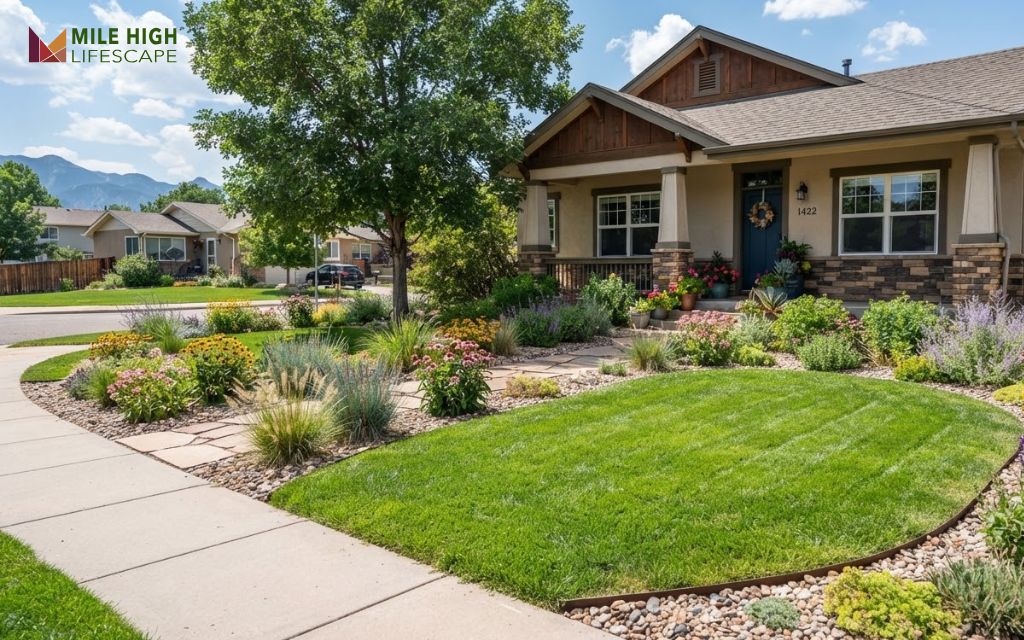
Zoysia or bermuda: which one fits your yard?
Choose bermuda for sun and heavy use, choose zoysia for shade and low inputs, and choose a cool-season or native grass in Denver. The checklists below match each grass to specific yard conditions.
Choose bermuda if…
Bermuda fits yards that meet these 4 conditions:
- Full sun: Your lawn gets direct sun most of the day.
- Heavy use: Kids, dogs, or sports wear the turf daily.
- Active upkeep: You accept frequent mowing and edging.
- Hot climate: Your summers run long and hot, as in Texas, Georgia, or Florida.
Choose zoysia if…
Zoysia fits yards that meet these 4 conditions:
- Partial shade: Trees or buildings shade part of the lawn.
- Lower inputs: You want a dense lawn with less fertilizer.
- Patience: You can wait up to 2 years for full cover from plugs.
- Transition-zone climate: You live in a warm transition-zone state, such as Kansas, Missouri, or Tennessee.
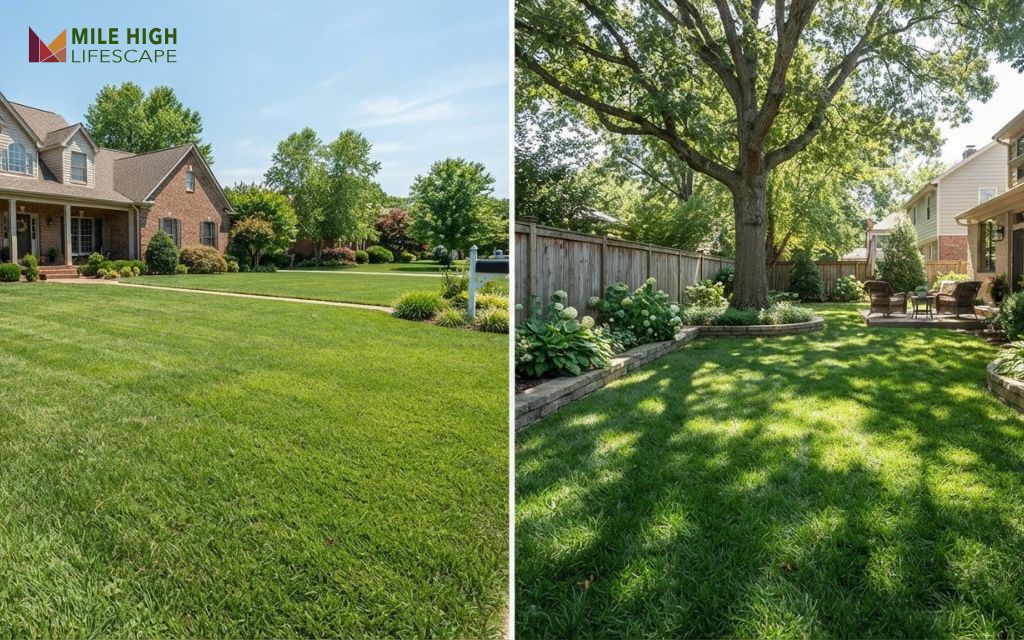
If you live on the Colorado Front Range
Front Range homeowners get stronger results from Kentucky bluegrass, tall fescue, fine fescue, or buffalograss matched to sun, soil, and water. Mile High Lifescape brings over 20 years of experience to that decision across the Denver Metro.
We review 3 site factors before recommending a grass: sun hours, soil type, and sprinkler coverage. Heavy clay soils across the metro change how a new lawn roots and drains, and uneven coverage may call for sprinkler installation before new turf goes down.
Sod installation for Denver lawns
After you weigh zoysia vs bermuda, sod is the fastest way to put a Front Range-ready grass on your lawn, with full cover in weeks instead of seasons. It also lets you replace a struggling or bermuda-infested lawn with a cool-season grass, such as Kentucky bluegrass or tall fescue, that suits Denver’s short summers.
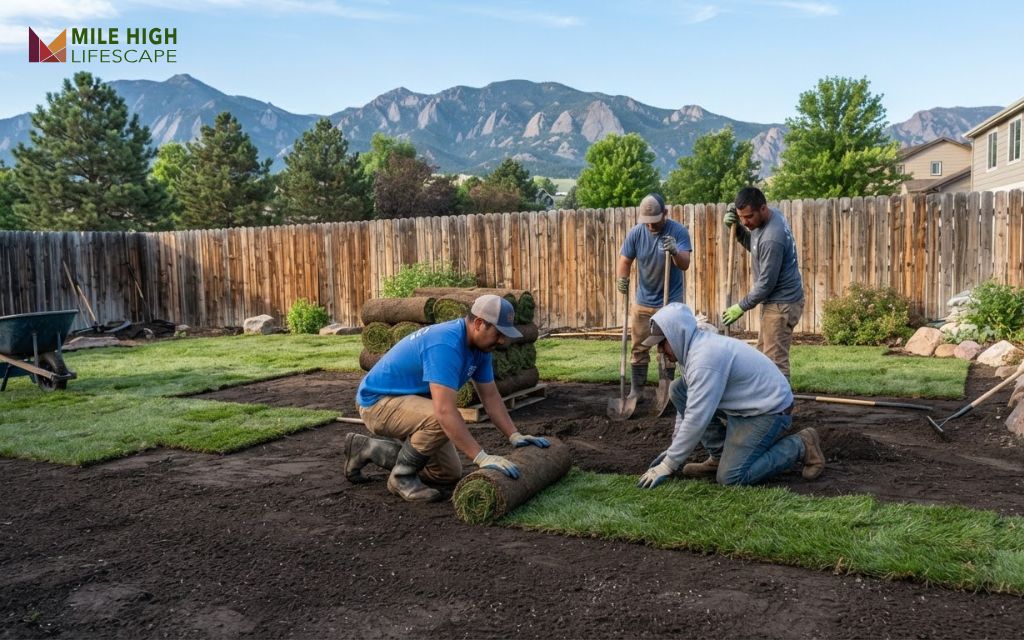
Our Sod Installation service follows 4 stages that set new turf up to root:
- Site assessment: We check sun exposure, drainage, and slope before choosing a sod type.
- Turf removal: We clear failing grass and weeds, and bermuda gets treated during active growth first so runners stay out of the new lawn.
- Soil preparation: We grade the site and loosen compacted Denver clay so roots can reach down.
- Sod laying and watering plan: Rolls go down with tight, staggered seams, and you get a watering schedule that fits new sod and local rules.
Spring and early fall give new cool-season sod the mild temperatures it needs to root before summer heat or winter freezes arrive. Call (303) 877-9091 or email hello@milehighlifescape.com to schedule a lawn assessment. We serve Denver, Lakewood, Littleton, Centennial, and nearby communities, Monday to Saturday, 8 a.m. to 5 p.m.
Frequently asked questions about zoysia vs bermuda
Is zoysia or bermuda better for shade?
Zoysia handles shade better than bermuda. Bermuda requires full sun, while zoysia grows in full sun or partial shade.
Which is softer, zoysia or bermuda?
Bermuda feels softer underfoot because its fine blades bend easily. Zoysia blades feel stiffer and resist pressure from your hand or foot.
Can you mix zoysia and bermuda in one lawn?
Mixing the 2 grasses produces a patchy, uneven lawn. Bermuda overtakes the sunny areas, and the different textures and green-up dates stay visible all season.
Which grass is better for dogs and kids?
Bermuda suits active households because it repairs worn areas faster. Zoysia stays thin longer after heavy use, so it fits quieter yards.
Does zoysia grass grow in Colorado?
Zoysia survives in parts of Colorado but performs poorly in most Front Range lawns. CSU Extension reports that short summers and cool nights limit its establishment, while hotter areas, such as Pueblo and Grand Junction, suit it better.
How do I get rid of bermuda grass in my Denver lawn?
Treat bermuda with repeated applications while it is green and growing. CSU Extension notes that full control can take 2 to 3 years, so many homeowners pair treatment with turf renovation or new sod.
Which grass stays green longer?
In Denver, Kentucky bluegrass stays green longer than both warm-season grasses. Bluegrass greens up in March, while zoysia and bermuda wait until late April to May and brown out after the first hard frost.