Storms move fast, and lightning can turn a healthy shade tree into a safety concern in a fraction of a second. Lightning striking a tree is one of the most common causes of sudden, severe tree damage, and the results vary widely, from barely visible scorch marks to a trunk split wide open. Understanding what happens during a strike, and how to read the aftermath, helps homeowners make sound decisions about a tree’s future.
Not every tree hit by lightning needs to come down, and not every tree that looks fine afterward is actually safe. This guide walks through how lightning damages a tree, the signs to look for, and the questions that determine whether a tree can recover or should be removed.
How lightning strikes a tree
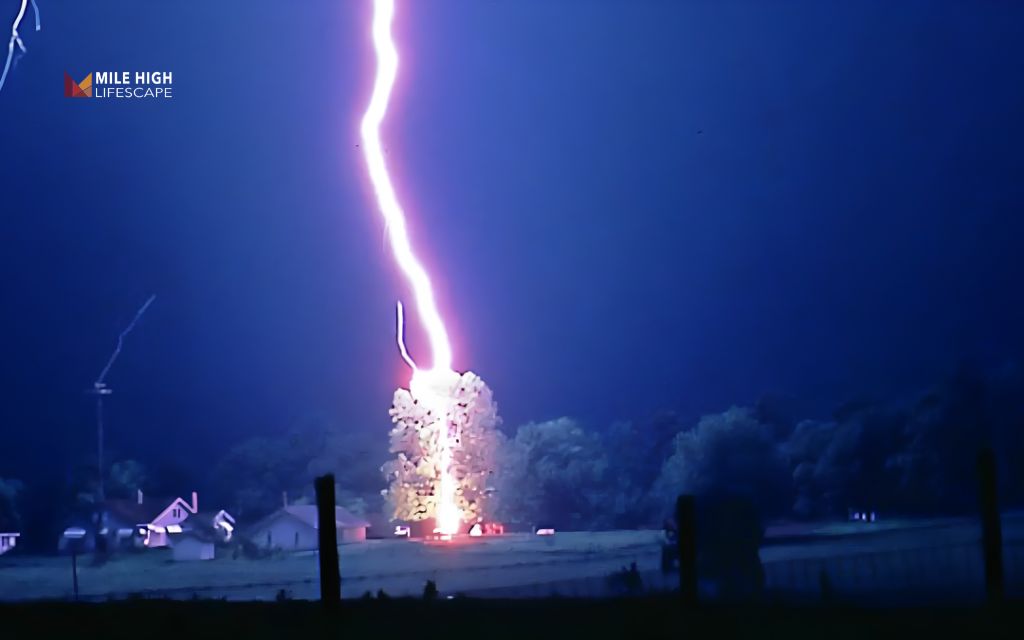
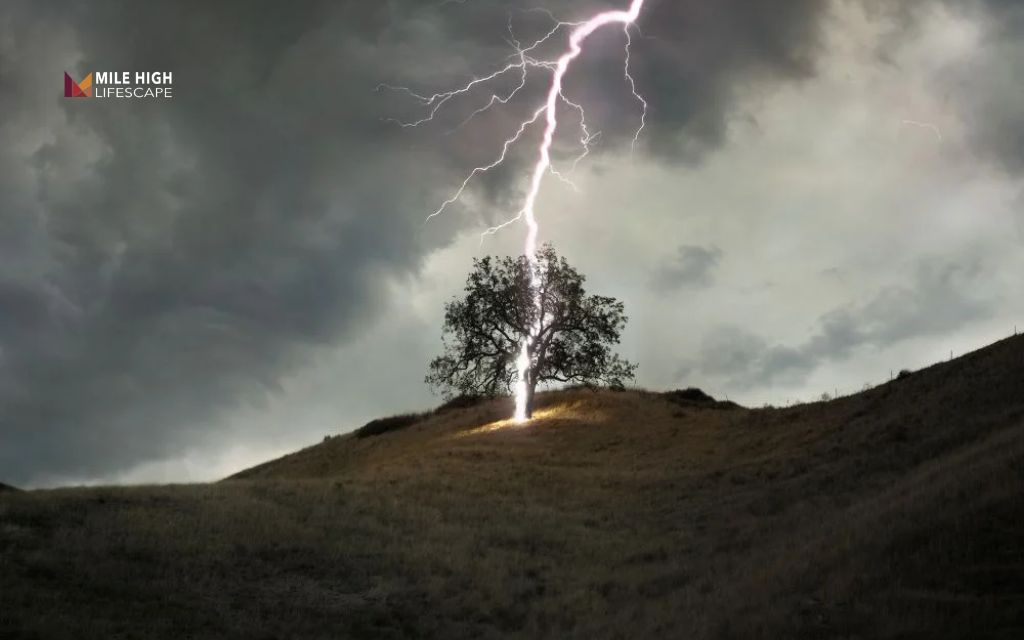
Why does lightning strike trees more often than other objects in a storm? The answer comes down to height, moisture, and exposure. Lightning follows the path of least resistance, and a tall tree standing alone or above the surrounding canopy often provides exactly that path. Water and sap inside a tree conduct electricity far better than dry wood, and rain on the bark adds another conductive layer. In many cases, lightning hits tree canopies first, then travels down through the trunk toward the roots. The mechanics behind lightning striking a tree come down to conductivity and height, most often through the cambium, the thin layer of living tissue just beneath the bark.
That current carries enormous heat and voltage. The moisture inside the tree flashes into steam almost instantly, and the sudden expansion can blow bark off the trunk, crack wood fibers, or in severe cases split the trunk open. The extent of the damage depends on how much energy passed through the tree, how deep it traveled, and how much of the trunk and root system carried the charge.
Signs a tree was hit by lightning
Bark loss
Bark loss ranges from a narrow strip blown off the trunk to large bare sections exposing the wood underneath. A small area of loss often points to surface level to moderate damage, while loss across a large portion of the trunk raises more serious concerns about the tree’s ability to move water and resist pests.
Vertical cracks
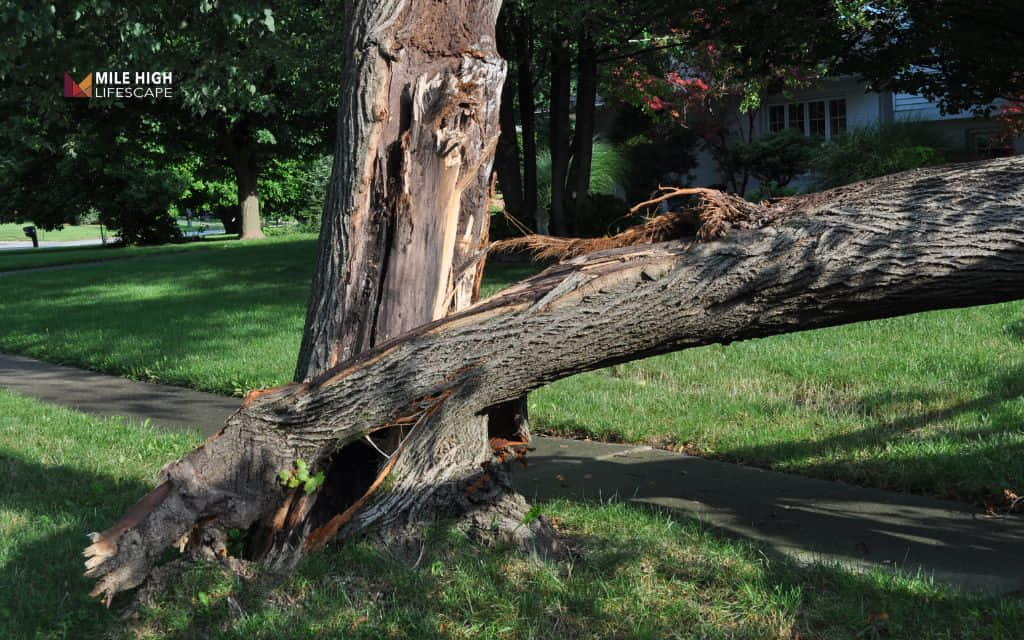
Vertical cracks appear as long splits running down the trunk or major limbs. These cracks signal structural weakening, and how much of a concern they represent depends largely on how deep the crack runs into the wood.
Split trunk
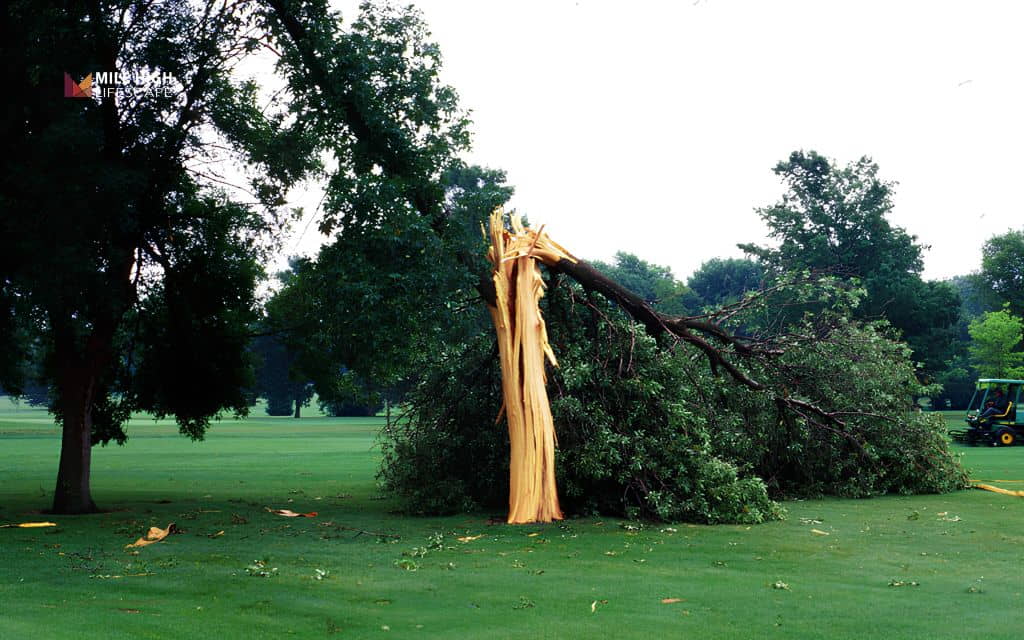
A split trunk is broken apart or separated into distinct sections. This is one of the clearest signs of lost structural integrity, and a tree in this condition often cannot be saved.
Canopy dieback
Canopy dieback shows up as branches losing leaves early or failing to leaf out the following season. This points to vascular damage that limits how well the tree can move water and nutrients from the roots to the crown.
No visible damage
Some trees show no outward sign of a strike at all. This does not rule out internal or root damage, since the current may have traveled below ground without leaving a visible trace on the trunk or canopy.
Why some trees die immediately and others survive
Two trees standing side by side can react to the same storm in completely different ways. A tree hit by lightning may explode into splinters within seconds, while a nearby tree of the same species takes the hit and shows almost nothing the next morning. The difference usually comes down to how the current traveled through the tree and how much living tissue it damaged along the way.
Species also plays a role, since trees with higher starch or resin content tend to conduct electricity more readily and sustain heavier damage. A tree’s health before the strike matters just as much. A vigorous, well established tree has more reserves to draw on during recovery, while a tree already weakened by drought, disease, or old age has far less capacity to survive a lightning strike of any size.
Delayed decline after a lightning strike
The most misleading part of a lightning strike to a tree is the delay. The moment of lightning hitting a tree lasts only a fraction of a second, but the damage can take months to fully appear. A tree can leaf out normally the following spring, hold its canopy through summer, and still be dying underneath. Damage to the cambium disrupts the movement of water and nutrients, and the tree slowly loses the ability to support its own growth even while sitting in well watered soil.
Weakened wood also invites secondary problems. Fungal pathogens move into damaged tissue and accelerate decay from the inside, while insects target the chemical signals a stressed tree releases. Most trees that fail after being struck by lightning show clear signs of decline within the following year, which makes ongoing monitoring just as important as the initial assessment.
Assessing damage safely
Before evaluating how a tree might recover, confirm that it is safe to approach. A tree with a split trunk, a heavy lean, or limbs hanging loosely in the canopy can fail without warning, and no assessment is worth standing underneath one of these hazards. Keep a safe distance from any tree with visible structural compromise, and treat branches tangled in power lines as an emergency rather than a landscaping issue.
Once it is safe to approach, view the tree from a distance rather than walking underneath the canopy. Confirming the full extent of lightning striking a tree usually calls for the training and equipment of a certified arborist rather than a visual check from the ground, especially for large or valuable trees, or any tree positioned near a home, driveway, or walkway.
Should the tree be removed or can it be saved
The decision depends on several factors together, not one sign alone. Minor bark loss without cracking is often recoverable with monitoring. Moderate bark loss with shallow cracks still leaves room for recovery, depending on species and health before the storm. Deep trunk cracks or a fully split trunk usually mean the structure is already compromised, and removal is typically the safer call.
Major canopy loss lowers the odds of recovery and needs a case by case look. Location is the tiebreaker. A tree in an open area has room to fail safely and can be given time. A tree near a home, garage, or walkway has little room for error, and a compromised tree in that spot is rarely worth the wait.
What to do after a lightning strike
The first hours and days after lightning striking a tree matter, since the choices made early on affect how well the tree recovers. Follow these steps in order.
- Confirm safety first: Stay away from any tree with a split trunk, a new lean, or limbs caught in power lines until it has been professionally evaluated.
- Arrange a professional inspection: An arborist can check for internal fractures and root damage that are not visible from the ground.
- Remove hazardous limbs: Broken or hanging branches should be pruned by a trained crew rather than handled as a do it yourself project.
- Water consistently: A damaged tree needs steady moisture to support recovery, especially during dry stretches following the storm.
- Monitor over the following months: Watch for delayed leaf drop, canopy thinning, or signs of pests, since decline often shows up well after the initial strike.
Preventing lightning damage to trees
No tree is fully protected from a direct strike, but a few steps reduce the odds and the consequences. Spacing large trees away from structures limits the risk of current traveling into a building, and keeping trees pruned on a regular schedule supports overall health, which improves a tree’s odds of surviving a strike if one occurs. For exceptionally valuable or historic trees, a certified arborist can install a copper lightning protection system that gives a strike a direct path to the ground instead of through living tissue.
Conclusion
Lightning striking a tree does not automatically mean the tree is lost, but it does mean the situation calls for a careful look rather than a guess. Reading the signs correctly, understanding why some damage takes months to appear, and knowing when a tree has crossed from recoverable to hazardous all make the difference between saving a valuable tree and dealing with a bigger problem later.
If lightning hit a tree on your property and it is showing bark damage, cracking, or a canopy that is not bouncing back, the Tree and Shrub Care team at Mile High Lifescape can inspect the damage and recommend the right next step for homeowners in the Denver Metro area. Call (303) 877-9091 to schedule an assessment.
Frequently asked questions (FAQs)
Can a tree survive being struck by lightning?
Yes. Many trees survive a lightning strike, especially when damage is limited to bark loss or shallow cracking. Survival depends on the extent of the damage, the tree’s health before the strike, and how it is cared for afterward.
How long does it take for a lightning struck tree to die?
Trees that decline after a lightning strike typically show signs of failure within a few months to about a year. A tree that remains healthy through a full growing season has a better chance of long term survival.
Is a tree dangerous after being hit by lightning?
It can be, particularly if the trunk is split, the tree is leaning, or branches are damaged and likely to fall. Any of these conditions calls for keeping a safe distance until a professional has assessed the tree.
Do all trees react the same way to a lightning strike?
No. Species, size, health, and the path the current takes through the tree all affect how much damage occurs and whether the tree survives.
Why do lightning strike trees more than other objects on a property?
Height and moisture are the main reasons. Tall trees standing above nearby structures, along with their natural water content, make them a common target during a storm.
Why does lightning hit trees during summer storms specifically?
Summer produces more frequent thunderstorms in most regions, and trees are often the tallest living structures in a yard during that season, which increases their exposure.