Cool season vs warm season grasses differ in one main way: when they grow. Cool-season turf peaks in spring and fall, while warm-season turf thrives in summer heat. This guide helps homeowners compare both groups, identify their own lawn, and pick a grass that fits Colorado conditions.
Cool-season vs warm-season grasses: what is the difference?
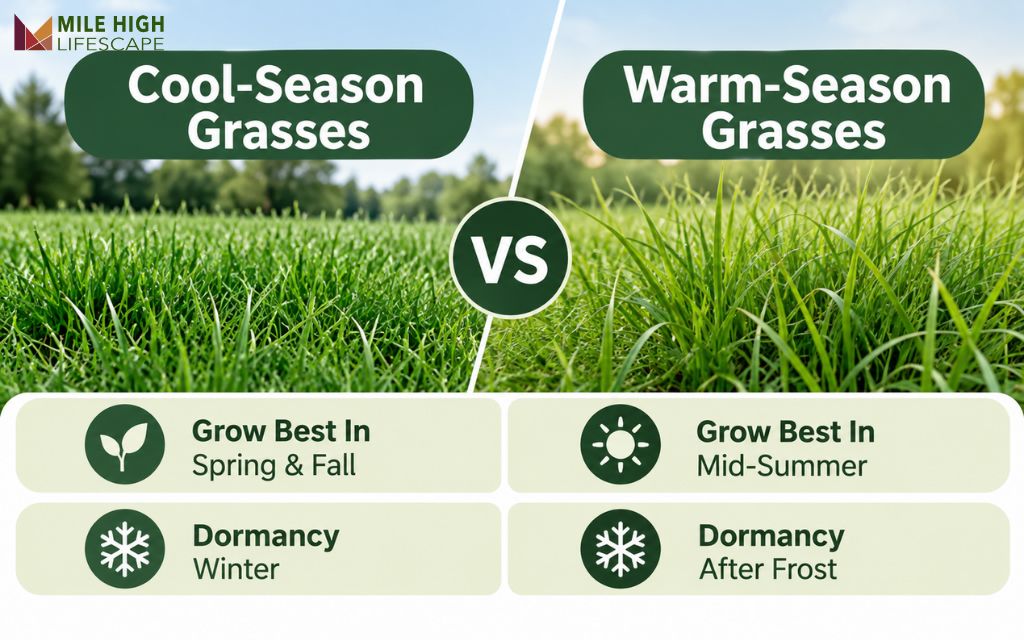
The difference between cool-season and warm-season grasses is timing. Cool-season grasses do most of their growing in spring and fall. Warm-season grasses grow hardest in mid-summer and go dormant once frost arrives.
That timing comes from climate preference and plant chemistry. It decides when you should seed, feed, aerate, and water your lawn.
Growth timing and dormancy
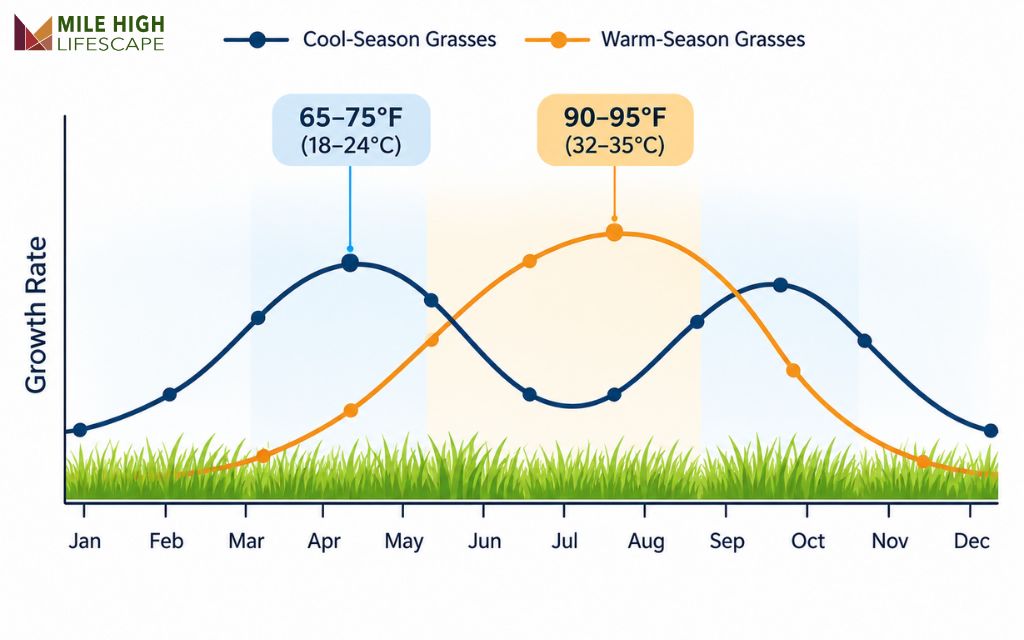
Cool-season grass starts growing in late winter or early spring. It slows in summer heat and picks up again in fall. In a dry summer, Kentucky bluegrass can go dormant and turn tan until cooler weather returns.
Warm-season grass stays brown until late spring. It grows through the hottest months and goes dormant after the first frost. In Colorado, buffalograss usually greens up in mid-to-late May and browns again at the first hard freeze.
Temperature ranges for growth
Cool-season grasses grow best at about 65–75°F (18–24°C). They start growing once soil reaches roughly 40–45°F (4–7°C). Warm-season grasses prefer about 90–95°F (32–35°C) and need soil near 60–65°F (16–18°C) to wake up.
Seed companies and lawn brands publish slightly different ranges. Treat any range as a guide, not a switch. Soil moisture, sun exposure, and elevation all shift real-world growth.
C3 vs C4 photosynthesis, explained simply
Cool-season grasses use the C3 pathway, and warm-season grasses use the C4 pathway. The names refer to whether the first molecule built during photosynthesis holds three or four carbon atoms.
C3 plants lose 15–40% of captured light energy to photorespiration, and that loss climbs as temperatures rise. C4 plants avoid most of that loss and use water and nitrogen more efficiently. That is why bluegrass struggles in July while buffalograss hits its stride.
What are cool-season grasses?
Cool-season grasses, sometimes called northern grasses or cold-weather grasses, are turfgrasses that grow best in mild temperatures and survive hard winters. They cover most lawns across the northern United States and most of Colorado.
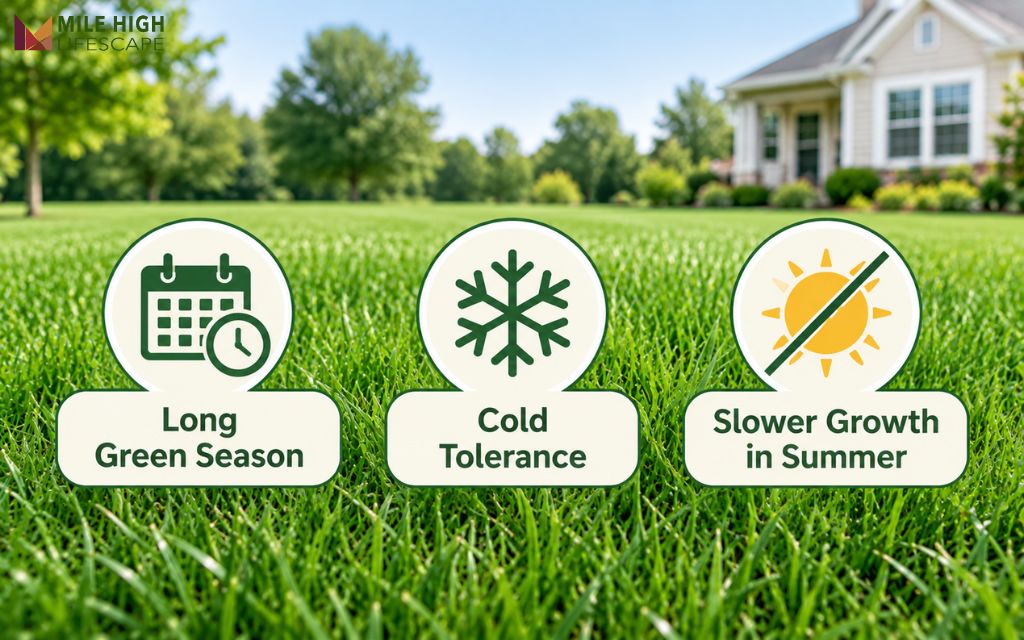
Their strengths are a long green season and strong cold tolerance. Their weak point is summer heat, which slows growth and raises water demand.
Common cool-season grass types
Four cool-season species make up most home lawns:
- Kentucky bluegrass: Soft, dense, and sod-forming. It recovers well from wear but needs steady water and nitrogen. Seeding rate: 3–5 lb per 1,000 sq ft (1.5–2.4 kg per 100 m²).
- Turf-type tall fescue: Coarser blades, deep roots, and better shade tolerance than bluegrass. CSU Extension discourages the old “Kentucky 31” variety because it makes poor-quality turf.
- Fine fescues (hard, creeping red, chewings, sheep): Fine-textured, very shade tolerant, and well suited to high elevations. They don’t handle heavy foot traffic.
- Perennial ryegrass: Germinates fast and matches bluegrass in color and texture. It often fills gaps in overseeding mixes.
For a closer look at the two most common choices, read our comparison of Kentucky bluegrass vs tall fescue.
What are warm-season grasses?
Warm-season grasses, also called summer grasses or warm-weather grasses, are turfgrasses that grow most in heat and go dormant in cold weather. They dominate lawns in the southern United States.
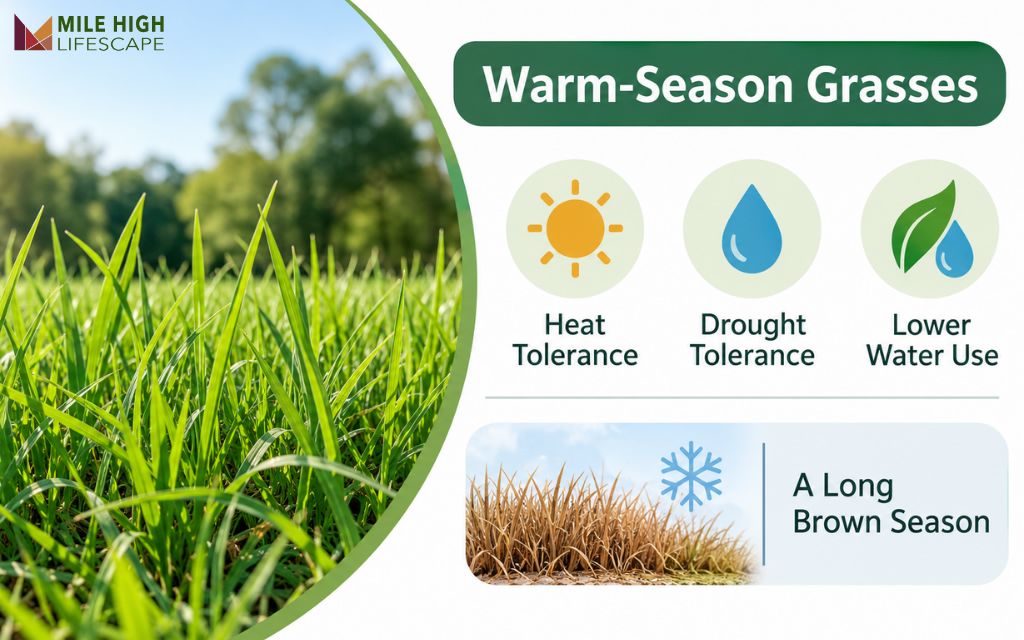
Their strengths are heat tolerance, drought tolerance, and lower water use once established. Their trade-off is a long brown season wherever winters run cold.
Common southern warm-season lawn grasses
Five species cover most warm-season lawns from Texas to the Carolinas:
- Bermudagrass: Aggressive, wear tolerant, and sun-hungry. Learn more in our guide to types of Bermuda grass.
- Zoysiagrass: Dense and slow-growing, with better shade tolerance than Bermuda. See our overview of types of zoysia grass.
- St. Augustinegrass: Wide blades and good shade tolerance in humid climates.
- Centipedegrass: A low-input grass for acidic southern soils.
- Bahiagrass: Tough, drought-tolerant turf common in the Southeast.
Most of these grasses are poorly suited to Denver’s cold winters and short warm season. Our fescue vs Bermuda comparison explains the trade-off.
Native warm-season grasses for dry western lawns
Buffalograss and blue grama are native warm-season grasses of the Great Plains, including Colorado’s Front Range. Both tolerate heat, cold, and drought, need little fertilizer, and need infrequent mowing.
Buffalograss spreads by aboveground stems called stolons and forms a sod. Blue grama is a bunchgrass that doesn’t form sod. Neither handles shade or heavy traffic well, and both turn straw-colored after the first frost.
Cool-season vs warm-season grass: side-by-side comparison
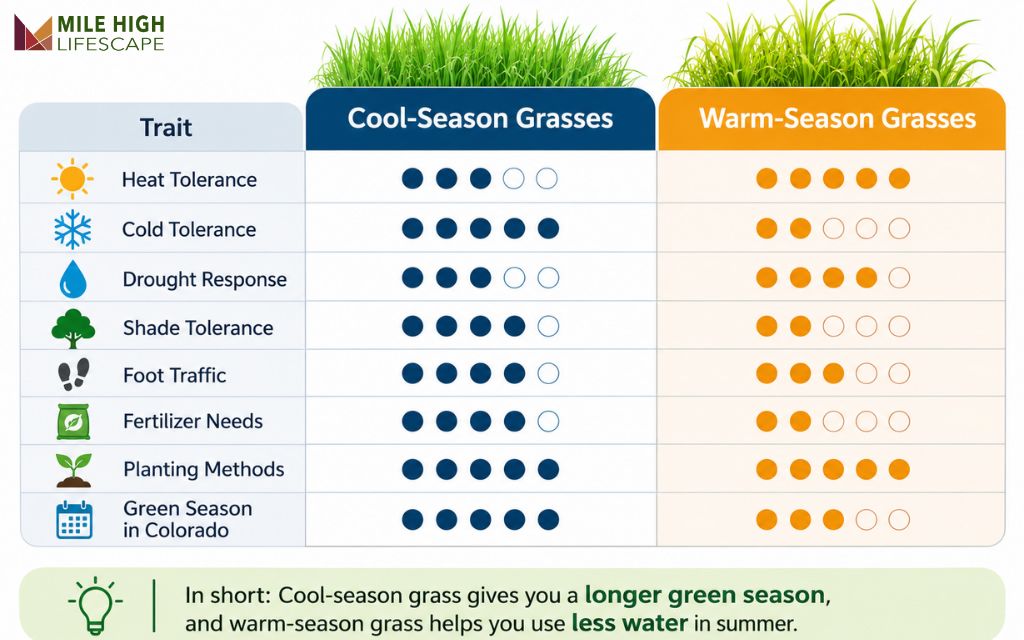
The table below compares the two grass groups on the traits homeowners ask about most.
| Trait | Cool-season grasses | Warm-season grasses |
| Heat tolerance | Moderate; growth slows above 85°F (29°C) | High |
| Cold tolerance | High | Low for southern species; high for buffalograss and blue grama |
| Drought response | Goes dormant (bluegrass) or needs irrigation (tall fescue) | Stays green longer on less water |
| Shade tolerance | Fair to very good (fine fescues best) | Poor to fair for most species |
| Foot traffic | Good for bluegrass, ryegrass, tall fescue | Good for Bermuda and zoysia; poor for buffalograss and blue grama |
| Fertilizer needs | Moderate to high | Low for native grasses; higher for Bermuda |
| Planting methods | Seed or sod | Seed, sod, or plugs |
| Green season in Colorado | Early spring to late fall | About late May to the first hard frost |
In short, cool-season grass gives you a longer green season, and warm-season grass gives you lower summer inputs.
Where each type grows best: north, south, and the transition zone
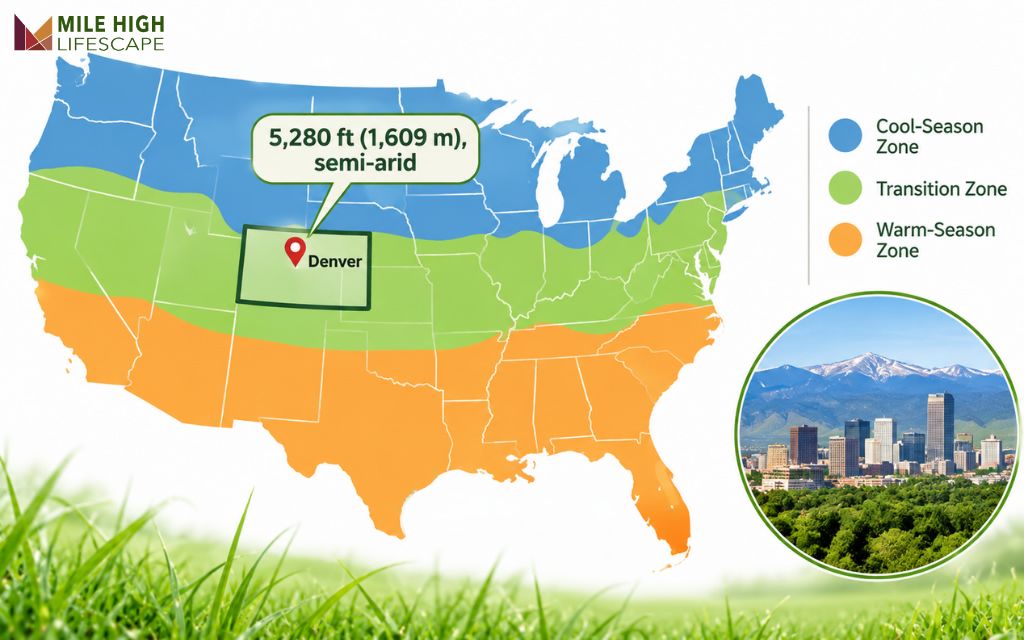
Turf maps split the United States into three broad regions. Cool-season grasses lead in the northern states, warm-season grasses lead in the South, and a middle band called the transition zone can grow either type, though neither grows perfectly there.
Why latitude alone doesn’t explain Colorado
Denver sits near 39.7°N, close to the northern edge of many transition-zone maps. Latitude misses three factors that matter more here:
- Elevation: Denver sits at 5,280 feet (1,609 meters). Higher ground brings cooler nights, a shorter warm season, and earlier frost.
- Semi-arid climate: Low rainfall and dry air make water use a bigger factor than heat tolerance.
- Variable winters: Freeze-thaw swings and spring snow favor cold-hardy turf.
That mix explains why Colorado lawns behave like northern lawns, with a native warm-season option for low-water sites.
Which grass type works best for Denver-area lawns?
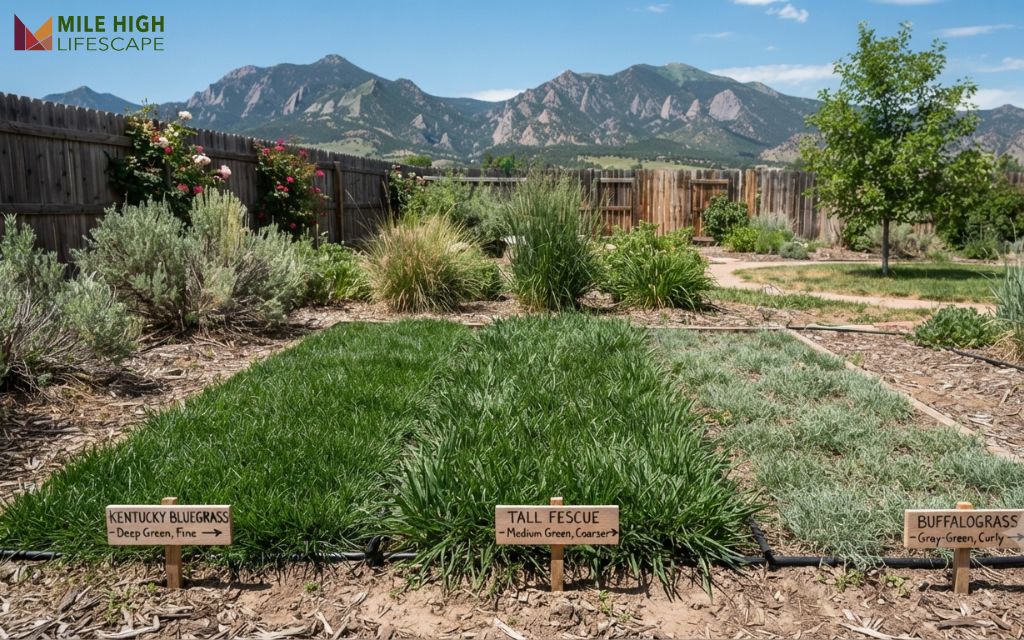
For most Denver Metro homes, a cool-season grass is the practical default. Kentucky bluegrass, turf-type tall fescue, and buffalograss make up 99% of Colorado home lawns, according to CSU Extension.
With over 20 years of experience caring for lawns across the Denver Metro area, we start with how the yard gets used. Then we look at how much water it can get.
Why Kentucky bluegrass is Colorado’s default
Kentucky bluegrass handles traffic, repairs itself, and stays green from early spring into late fall. Local growers produce high-quality bluegrass sod, so a new lawn can go in quickly.
Its weak point is water. PlantTalk Colorado notes that typical bluegrass grows best on about 1.5 inches (38 mm) of supplemental water per week when temperatures pass 85°F (29°C).
Turf-type tall fescue: lower input, not automatically lower water
Many homeowners switch to tall fescue to save water. CSU Extension found that switching alone won’t do it. Tall fescue can’t go dormant, so it needs irrigation through summer dry spells.
Its deep roots help only in loose, well-drained soil. On the Front Range’s heavy clay or shallow, gravelly ground, tall fescue may need as much water as bluegrass, or more.
Buffalograss and blue grama: the low-water warm-season option
Buffalograss suits sunny, low-traffic areas below about 6,500 feet (1,981 meters). Once established, it stays green on roughly 1–2 inches (25–51 mm) of water every 2–4 weeks in summer.
Expect trade-offs. It needs at least half a day of full sun, greens up around mid-to-late May, and browns at the first hard frost. Many Front Range homeowners find that long brown season harder to accept than the water savings suggest.
Water use by grass type in Colorado
CSU’s seasonal water estimates (rain plus irrigation) show the gap clearly:
| Lawn type and care level | Seasonal water need |
| Kentucky bluegrass, high quality (100% ET) | 34 in (864 mm) |
| Turf-type tall fescue, high quality (90% ET) | 31 in (787 mm) |
| Kentucky bluegrass, reduced irrigation (60% ET) | 20 in (508 mm) |
| Buffalograss, turf quality | 17 in (432 mm) |
| Kentucky bluegrass, summer dormant (June–August) | 14 in (356 mm) |
ET means evapotranspiration, the water a lawn loses to evaporation and plant use. CSU’s conclusion is direct: species selection is secondary to irrigation management when it comes to saving water. A tuned system matters, so pair grass choice with efficient sprinkler installation.
Local rules matter too. As of November 2026, Denver Water is in a Stage 1 drought with two assigned watering days per week, and lawn watering has been prohibited since Oct. 1 until further notice. Check your provider’s current rules before you plant.
Why some lawn patches stay brown in spring
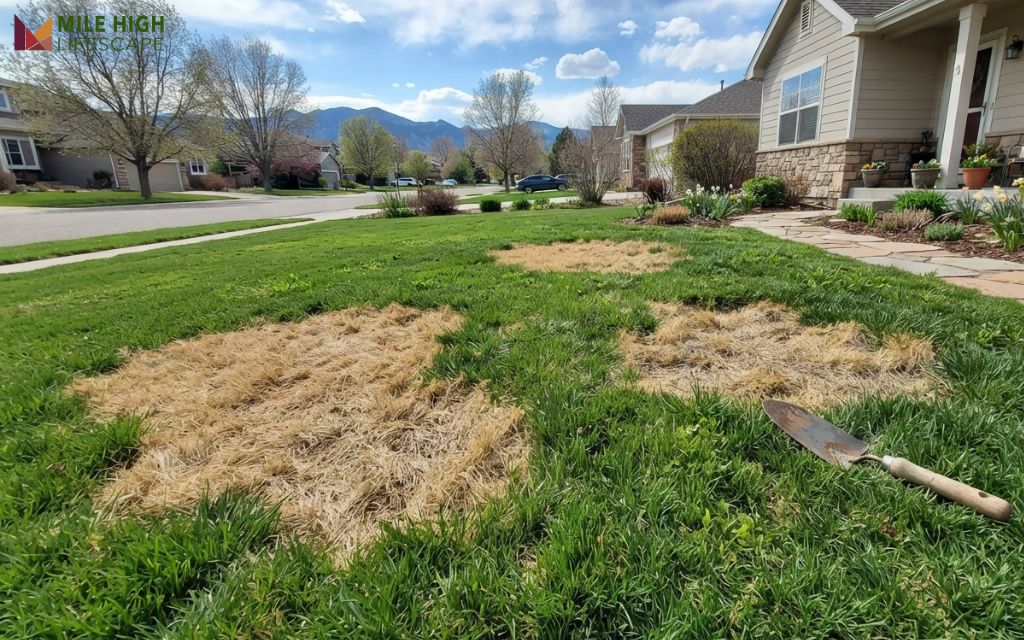
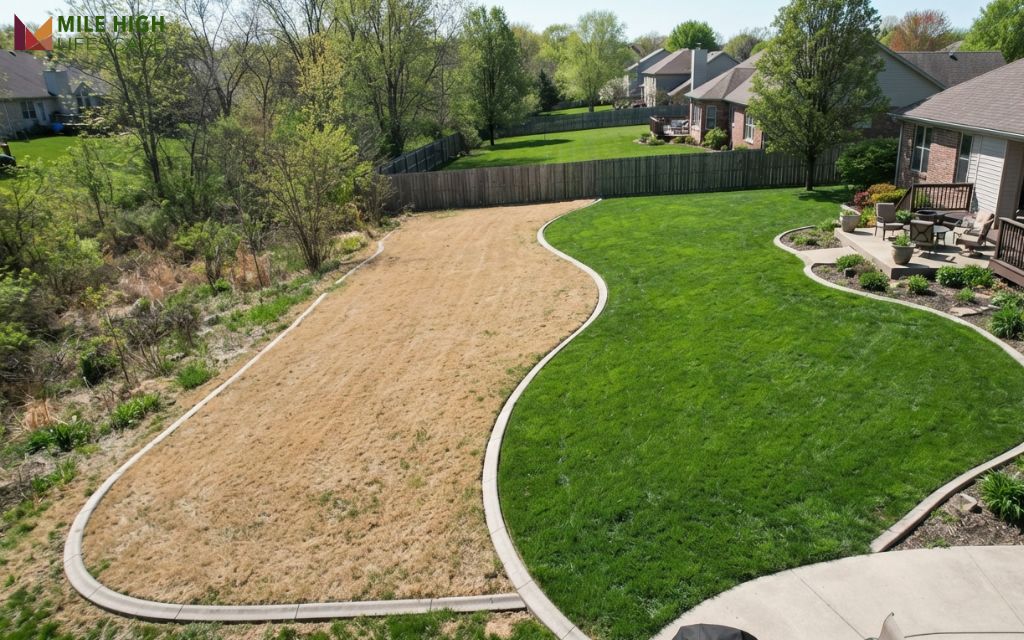
Brown patches in an otherwise green spring lawn often mean warm-season grass is growing inside a cool-season lawn. The bluegrass greens up early, while the warm season patches wait for warmer soil.
CSU Extension lists three ways to handle it:
- Leave it. The patches green up later and blend in by summer.
- Dig it out and overseed the spot with a cool-season grass.
- Spot-treat it with a non-selective herbicide once the patches are green and actively growing, then overseed.
If patches stay brown into June, look for another cause, such as drought stress, grubs, or disease. A lawn care pro can check the roots and soil.
Can you mix cool-season and warm-season grasses?
You can, but most lawns look better without mixing. The two groups green up and go dormant at different times, so a mixed lawn looks patchy for weeks each spring and fall.
Mowing and feeding schedules also clash. For a lower-water lawn, convert a whole area to buffalograss or blue grama instead of blending warm-season seed into bluegrass.
How your grass type changes your lawn care calendar
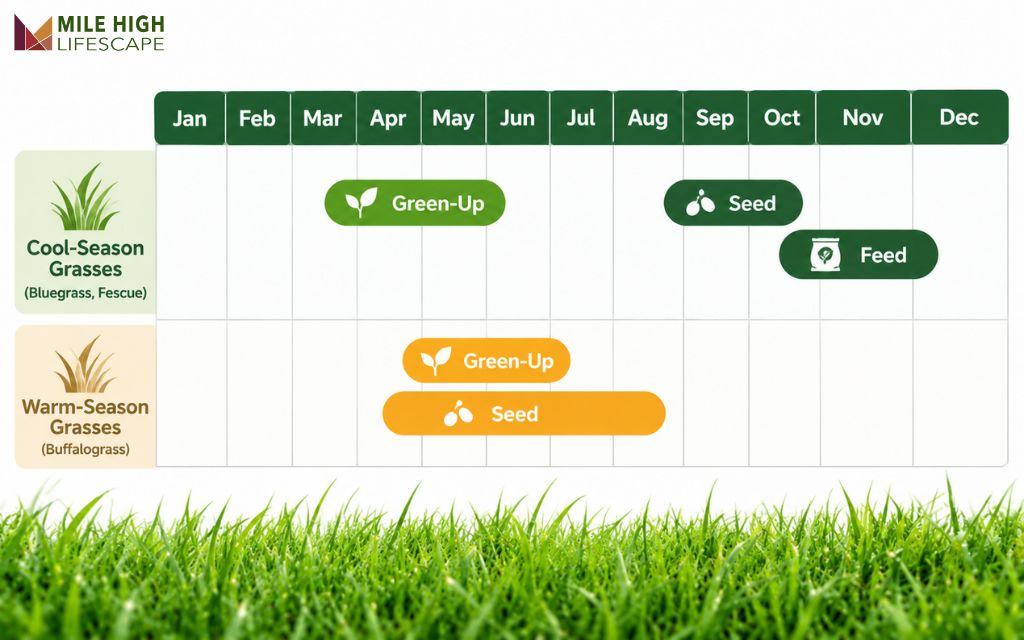
Grass type sets the timing for nearly every lawn task. Schedule work during active growth so the turf recovers fast.
Seeding and overseeding windows
Seed Kentucky bluegrass in late August to early September, using a blend of two to five cultivars. Seed buffalograss from spring to late July, since seed sown from Aug. 1 to Oct. 1 risks winter kill.
Plant buffalograss plugs on 12–18 inch (30–46 cm) centers at least six weeks before the first fall frost. For thin bluegrass, our aeration and overseeding service opens the soil so new seed reaches it.
Fertilizing and aeration timing
Feed cool-season lawns mainly in fall, with a spring feeding for high-quality turf. Buffalograss needs little fertilizer, and extra nitrogen or water invites weeds. Aerate cool-season turf in spring or fall, when it can recover quickly.
| Task | Cool-season (bluegrass, fescue) | Warm-season (buffalograss) |
| Seeding | Late August–early September | Spring–late July |
| Green-up | Early spring | Mid-to-late May |
| Peak growth | Spring and fall | Late May–early September |
| Dormancy | Summer drought (if unwatered) and winter | First hard frost to late spring |
| Fertilizer | Fall focus, plus spring for high-quality turf | Low; overfeeding invites weeds |
Mowing and watering differences
Mow cool-season grass a little higher in summer, since taller blades shade the soil and support deeper roots. Never remove more than one-third of the blade at once.
Water both types deeply and less often. Let buffalograss stay dry until mid-to-late May, because early watering won’t speed green-up and encourages weeds.
How to tell which type of grass you have
Three quick checks identify most lawns:
- Green-up timing: Grass that greens in early spring is cool-season. Grass that stays brown until late May is likely warm-season.
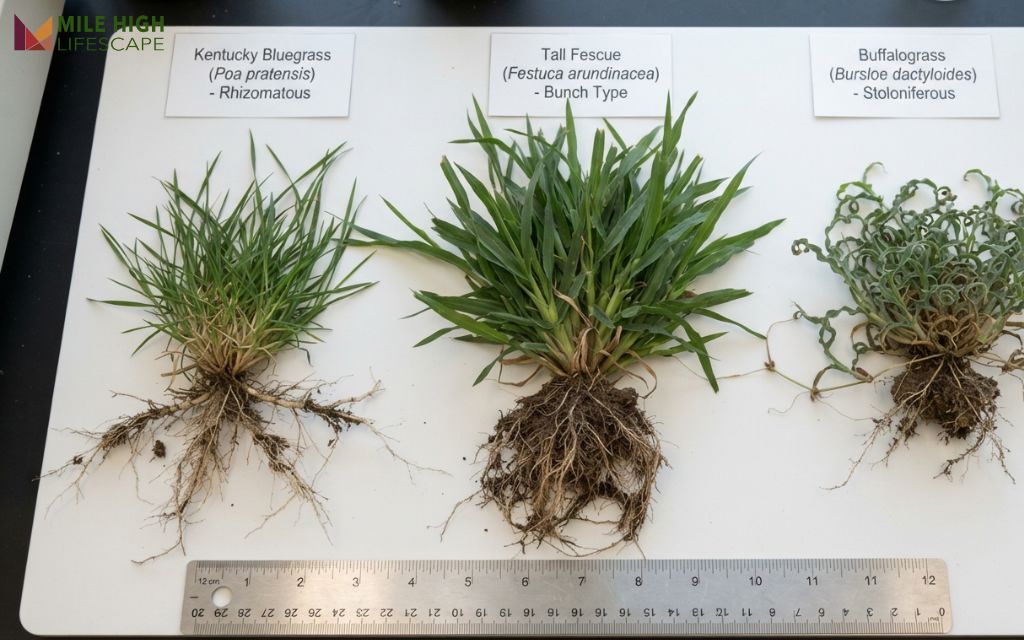
- Growth habit: Buffalograss and Bermuda spread by aboveground runners. Bluegrass spreads by underground rhizomes, and tall fescue grows in clumps.
- Blade shape: Bluegrass has a boat-shaped tip. Tall fescue has wide, ribbed blades. Buffalograss blades are fine, curly, and gray-green.
For a firm ID, take a sample to your county CSU Extension office or ask a lawn professional.
Sod installation for a fast, even cool-season lawn
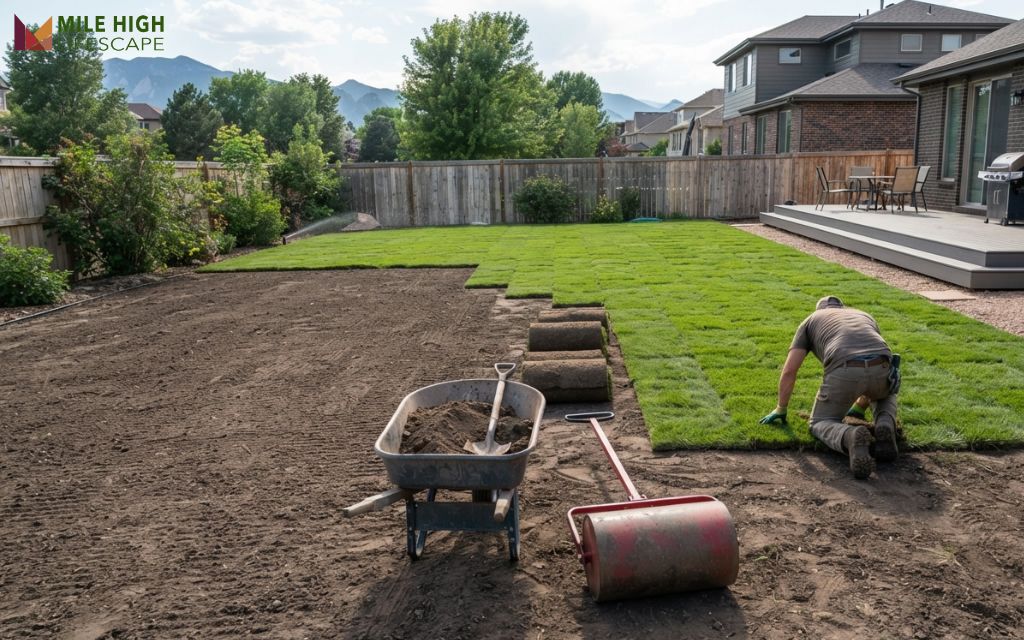
If you want a full lawn this season, professional Sod Installation is the fastest route to even, established turf. Sod skips the weeks of seedling care and weed pressure that come with seeding.
Our team starts with a consultation and site assessment of your soil, sunlight, and yard layout. Then we clear rocks and weeds, level the ground, and work in organic matter or fertilizer before laying sod.
We lay rolls in a staggered pattern with no gaps and water them in well. After the job, we guide you on watering, mowing, and care, so the new turf roots in.
Tip: Match the sod to the site. Bluegrass suits sunny, active yards with reliable irrigation. Shady or low-water areas may call for a different grass or a xeriscape design.
Which option fits your yard? When to call a lawn care professional
Once you understand cool season vs warm season grasses, match your lawn’s problem to the right next step:
- Thin or patchy bluegrass: Core aeration and overseeding in late summer or fall.
- Bare yard or failed lawn, need results fast: Sod installation, or turf renovation for a lawn worth saving.
- Want less turf and less water: A xeriscape landscaping plan with native grasses and plants.
- Dry spots and uneven color: A sprinkler audit or upgrade.
- Routine upkeep: Lawn care with weekly, biweekly, monthly, or one-time mowing, plus fertilization and weed control.
Mile High Lifescape serves homeowners in Denver, Lakewood, Littleton, Centennial, Broomfield, Thornton, Westminster, and Highlands Ranch. Call (303) 877-9091 or email hello@milehighlifescape.com, Monday to Saturday, 8am to 5pm.

FAQs about cool season vs warm season grasses
Is Kentucky bluegrass a cool-season or warm-season grass?
Kentucky bluegrass is a cool-season grass. It greens up early in spring, slows in summer heat, and handles cold winters well. It is the most widely used lawn grass in Colorado.
Is fescue a cool-season or warm-season grass?
Fescue is a cool-season grass. Tall fescue and the fine fescues all grow best in spring and fall. No common lawn fescue is a warm-season species.
What are northern grasses?
Northern grasses is another name for cool-season grasses, such as Kentucky bluegrass, fescues, and perennial ryegrass, that thrive in the northern United States.
Can warm-season grass grow in Colorado?
Yes. Native buffalograss and blue grama grow well in sunny Front Range yards below about 6,500 feet (1,981 meters). Most southern species, such as St. Augustine and centipede, are poor fits.
Which is more drought tolerant, cool-season or warm-season grass?
Warm-season grass is more drought tolerant. In CSU estimates, buffalograss needs about half the seasonal water of high-quality Kentucky bluegrass.
When is the best time to plant cool-season grass in Denver?
Seed cool-season grass in late August to early September. Sod can go in through most of the growing season if you can water it.
Cool season vs warm season grasses: should I switch to save water?
It depends on how you use the yard. Buffalograss saves water in sunny, low-traffic areas, but irrigation management often saves more than changing species.